A common expectation in Second Temple Judaism distinguished "this age" (ha-olam ha-zeh) from "the age to come" (ha-olam ha-ba). The present age was marked by sin, oppression, and death; the coming age would bring resurrection, righteousness, and peace.
Later Jewish sources illustrate this distinction. Fourth Ezra says that the Most High made not one world or age but two (4 Ezra 7:50), and the Mishnah compares this world to a vestibule before the world to come (m. Avot 4:16).
Although Second Temple Jewish expectations varied, the basic sequential model placed the ages end to end: the arrival of the coming age would coincide with the termination of the present age. The kingdom's arrival and the decisive removal of evil belonged to the same expected transition. This sequential understanding formed a common expectation among Jews in Jesus' day.
New Testament Reality: The Ages Overlap
The New Testament preserves the distinction between the ages (Matthew 12:32; Ephesians 1:21), but reveals an unexpected relationship between them. The coming age enters history before the present age disappears, challenging the common expectation of a strictly sequential transition.
Through the Messiah's ministry, death, resurrection, exaltation, and outpouring of the Spirit, the life and powers of the coming age become present within this age. Jesus declares that his expulsion of demons by God's Spirit demonstrates the kingdom's arrival (Matthew 12:28). His resurrection introduces the future harvest into history: Christ is already risen as the firstfruits, while his people await resurrection at his coming (1 Corinthians 15:20–23).
Between Christ's resurrection and return, the two ages run together. United to Christ, believers already participate in the coming age. Living in mortal bodies, they still inhabit the present evil age (Galatians 1:4). This is the overlap Geerhardus Vos explored in The Pauline Eschatology (1930) and which lies at the heart of inaugurated eschatology.
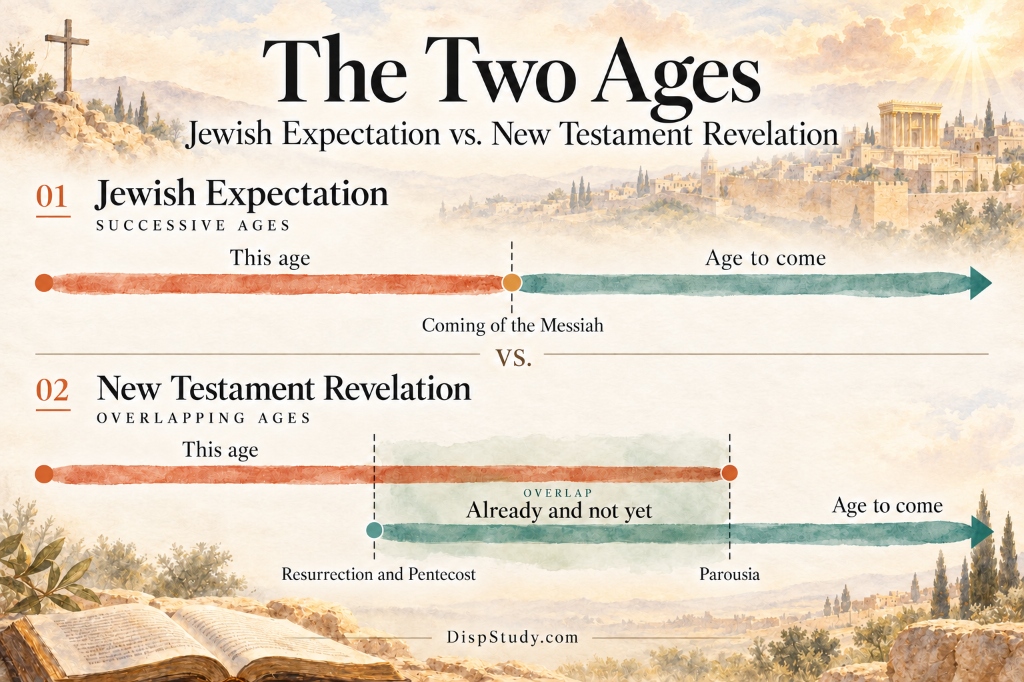
From Sequential Expectation to Overlapping Fulfillment
| Dimension | Sequential Expectation (Second Temple) | Overlapping Fulfillment (New Testament) |
|---|---|---|
| The Ages | End of this age coincides with the beginning of the coming age | The coming age enters history while this age continues |
| The Kingdom | Kingdom's arrival joined to the decisive removal of evil | The kingdom begins its work before evil is finally removed |
| Resurrection | Resurrection placed at the future transition of the ages | Christ rises as firstfruits before the future resurrection of his people |
| Fulfillment | Anticipated one single, decisive transition | God's promises unfold through two stages: inauguration and consummation |
The Mystery of Matthew 13: The Kingdom Before the Harvest
The kingdom itself was already promised in the Old Testament (Daniel 2:44; 7:13–14). Matthew 13 reveals something surprising about how it arrives: the kingdom begins its work while evil continues until the end of the age.
This is a central dimension of the "mysteries of the kingdom" disclosed by Jesus (Matthew 13:11). The overlap of the ages is a theological description of this teaching, rather than Matthew's own terminology.
This overlap can be seen clearly in the parables, which develop the pattern from several angles (as analyzed in dispensational studies on the futurist interpretation of Matthew 13):
- The sower (13:3–23): The word of the kingdom is proclaimed and produces fruit amid rejection, opposition, and distraction.
- The wheat and the weeds (13:24–30, 36–43): The children of the kingdom and the children of the evil one coexist until the harvest at the end of the age.
- The mustard seed and the leaven (13:31–33): The kingdom's small beginnings and hidden activity anticipate an outcome far greater than its initial appearance.
- The treasure and the pearl (13:44–46): The kingdom already possesses incomparable value, even when that value is not widely recognized.
- The dragnet (13:47–50): The gathering precedes the final separation of the righteous and the wicked.
The wheat and the weeds offer the clearest picture. Jesus identifies the field as the world, the good seed as the children of the kingdom, and the harvest as the end of the age. The coexistence therefore concerns the world and should not simply be reduced to a mixed institutional church.
The Son of Man is already establishing his people, but the final separation awaits the harvest. The kingdom's presence does not immediately terminate the conditions of the present age.
The mystery includes this unexpected unfolding of the promised kingdom: inauguration precedes consummation. The old hope is being fulfilled through a newly revealed pattern.
Progressive Dispensationalism
This understanding fits the progressive dispensational view: the mystery concerns the kingdom promised in the Old Testament being established in phases. Rather than identifying a distinct "mystery form of the kingdom," as many classical dispensationalists have done, progressive dispensationalism understands the present fulfillment as the inauguration of that same promised messianic kingdom.
The coming age has begun its work within the present age. Classical dispensationalism commonly described the church period as a parenthesis in the prophetic program for Israel, placing the promised messianic kingdom in the future. Progressive dispensationalism understands the church's present blessings as part of the unfolding fulfillment of that prophetic program.
The promised new covenant, belonging to the blessings of the coming age, has already been inaugurated through Christ's blood (Luke 22:20; 2 Corinthians 3:6). The promised Spirit has already been poured out as the eschatological guarantee or pledge (arrabon) of our inheritance (Acts 2:16–21; Ephesians 1:13–14). The risen Messiah already exercises royal authority from God's right hand (Acts 2:30–36). These realities belong to the promised age to come, yet they are active while the present age continues.
Matthew 13 fits this understanding. The word of the kingdom is already proclaimed, the children of the kingdom already exist, and the Son of Man already works within the world. Judgment remains future.
The church therefore participates in blessings promised through the prophets: forgiveness, the Spirit, and reconciliation with God. Gentiles, formerly strangers to the covenants of promise, are brought near through Christ's blood and united with believing Jews in one body (Ephesians 2:11–22).
Present participation does not exhaust future fulfillment. Progressive dispensationalism maintains God's continuing promises to Israel, Christ's future earthly reign, and the ultimate renewal of creation. His return brings the millennial manifestation of his reign, followed by the final judgment and new creation described in Revelation 20–22.
The church's present life is part of God's promised purpose already underway. The overlap explains how fulfillment can be real now while further dimensions remain future.
The Overlap of the Ages Throughout the New Testament
The consequences of this overlap appear throughout New Testament theology. Theologians use the expression "already and not yet" to describe this relationship between present fulfillment and future consummation (see how you already believe this framework).
| Theme | Present Fulfillment («Already») | Future Consummation («Not Yet») |
|---|---|---|
| 1. Kingdom | The kingdom is present in Jesus' ministry, and believers have been transferred into it (Matthew 12:28; Colossians 1:13). | Its full manifestation and inheritance remain future (Matthew 6:10; 13:39–43). |
| 2. Christ's Lordship | Christ is enthroned at the Father's right hand (Acts 2:32–36). | All things are not yet visibly subjected to him (Hebrews 2:8). |
| 3. Resurrection | Christ is the firstfruits, and believers share his risen life (1 Corinthians 15:20; Ephesians 2:5–6). | Bodily resurrection awaits his coming (1 Corinthians 15:23). |
| 4. Eternal Life | Believers have passed from death to life (John 5:24). | They await resurrection on the last day (John 6:40). |
| 5. Salvation | Believers are justified and at peace with God (Romans 5:1). | They await deliverance from wrath and future glory (Romans 5:9; 8:17–23). |
| 6. Sonship | Believers are God's children now (Romans 8:15–16). | They await the redemption of their bodies (Romans 8:23). |
| 7. Spirit | Believers have received the Spirit as firstfruits and the guarantee of their inheritance (Romans 8:23; Ephesians 1:13–14). | The inheritance awaits full possession (Ephesians 1:14). |
| 8. Time | The ends of the ages have arrived, and the coming age's powers are experienced (1 Corinthians 10:11; Hebrews 6:5). | The present evil age continues (Galatians 1:4). |
| 9. New Creation | Those in Christ participate in new creation (2 Corinthians 5:17). | Creation awaits liberation and renewal (Romans 8:19–23; Revelation 21:1–5). |
| 10. Victory over Evil | Hostile powers have been defeated through the cross (Colossians 2:15). | Death's destruction and Satan's final judgment remain future (1 Corinthians 15:26; Revelation 20:10). |
| 11. Church | The church is God's dwelling in the Spirit (Ephesians 2:19–22). | It awaits presentation in glory (Ephesians 5:27). |
The King Has Come; the Harvest Is Still Future
The already and not yet is a biblical framework shared by Christians with different eschatological systems. Progressive dispensationalism integrates it with covenant fulfillment, Christ's Davidic kingship, Israel's future, and the everlasting kingdom.
What a sequential expectation placed end to end, the New Testament reveals as overlapping for a period. The King has come, his kingdom is active, and its people already share in the coming age. The harvest still awaits the appointed end.
FreeRequest: Matthew 24:4–31 — Chronology in Dispensationalism
The chronological view of more than 60 dispensational authors on Matthew 24 — request it by email below.
Enter your email and we will send the PDF as an attachment. See our privacy policy.
Frequently Asked Questions
What was the common Jewish expectation of the two ages in the Second Temple period?
How does the New Testament change this sequential model?
How do Jesus' parables in Matthew 13 illustrate the overlap of the ages?
How does Progressive Dispensationalism understand the overlap of the ages?
Does present participation in the age to come replace God's promises to Israel?
Author
Leonardo A. Costa
A researcher and writer exploring dispensationalism from a progressive perspective, with a deep appreciation for the tradition's heritage.
Related Articles
Inaugurated Eschatology, the "Already and Not Yet," and Progressive Dispensationalism
How the 'already and not yet' framework unites diverse eschatologies, and why Progressive Dispensationalism's application is uniquely non-supersessionist.
Arrabōn and Progressive Dispensationalism
Paul's arrabōn of the Spirit frames Progressive Dispensationalism: present Kingdom blessings guarantee the future earthly inheritance, not replace it.
Christ Reigns Now: The Present Kingship of Christ in Progressive Dispensationalism
Psalm 110 and 1 Cor 15:25 show Christ reigns now from God's right hand — a cornerstone of Progressive Dispensationalism's inaugurated eschatology.
Historic Premillennialism and Progressive Dispensationalism: A Comprehensive Comparative Analysis
A comprehensive comparison of Historic Premillennialism and Progressive Dispensationalism, refuting the claim that Kingdom Theology is merely Laddianism.