Many traditional dispensationalists (TD) say that "already / not yet" is a strange device, incompatible with dispensationalism — imported by Progressive Dispensationalists as a failed attempt to shoehorn something into the system that does not fit at all.
But here is what is funny: I could cite plenty of examples of "already / not yet" in the Bible, and even in traditional dispensationalism itself. That is exactly what I am doing in a chapter of my next book.
Now, be honest — do you know any TD who would deny the "already / not yet" reading of Jesus in Luke 4:18–21? Or any TD who would deny that Zechariah 9:9 has already been fulfilled while 9:10 has not yet? Or any TD who would deny that the first 69 weeks have already been fulfilled while the 70th has not yet?
Nine Examples of Already / Not Yet
The chart below summarizes nine cases where even traditional dispensationalists recognize a divided fulfillment — something already accomplished and something still awaited:
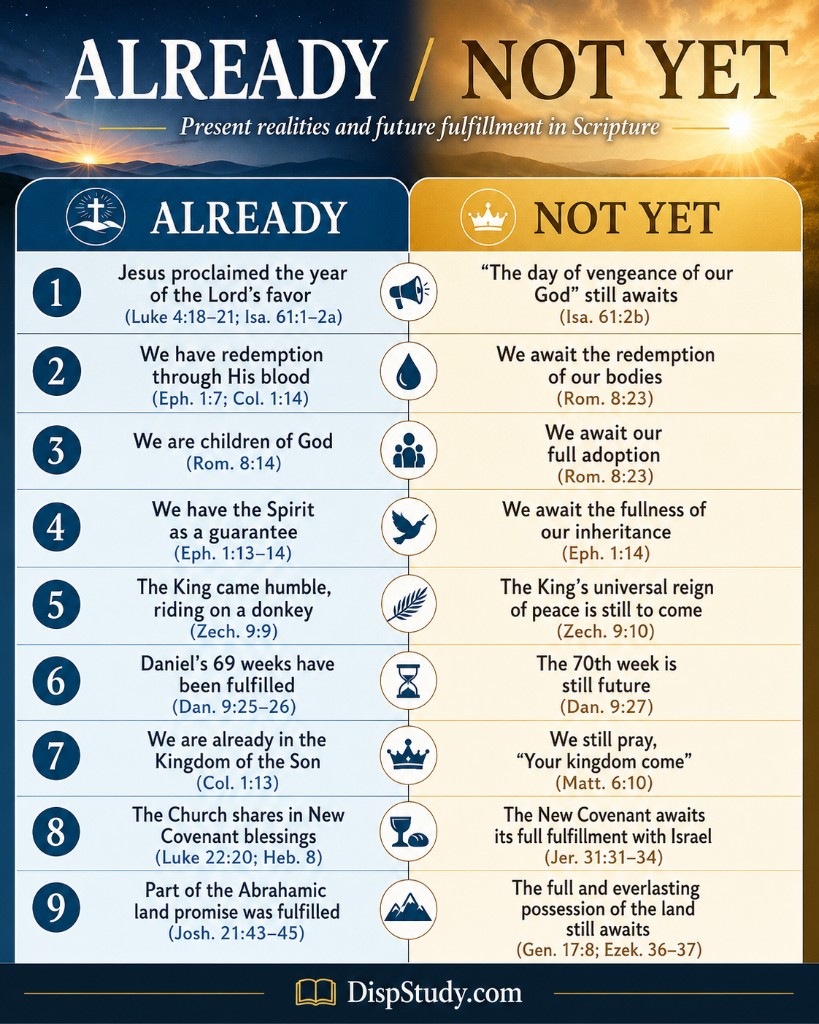
Let us walk through each pair.
1. Isaiah 61 and Luke 4
ALREADY: Jesus proclaims "the year of the Lord's favor" (Luke 4:18–21; Isa. 61:1–2a)
NOT YET: "The day of vengeance of our God" still awaits (Isa. 61:2b)
Jesus deliberately stopped mid-verse in the synagogue at Nazareth. He unrolled the scroll to Isaiah 61, read through "to proclaim the year of the Lord's favor," and sat down without reading the next line. This was not an oversight — it was hermeneutical precision. The year of favor belongs to the first advent; the day of vengeance belongs to the second. A single verse, two horizons, one "already" and one "not yet."
2. Redemption of blood and redemption of bodies
ALREADY: We have redemption through His blood (Eph. 1:7; Col. 1:14)
NOT YET: We await the redemption of our bodies (Rom. 8:23)
The cross accomplished a real and present redemption. But Paul tells us in Romans 8 that creation groans alongside believers who await the redemption of their bodies. Spiritual redemption is already; bodily resurrection is not yet.
3. Adoption as children of God
ALREADY: We are children of God (Rom. 8:14)
NOT YET: We await our full adoption as sons (Rom. 8:23)
Remarkably, the same passage (Romans 8:23) that teaches the not-yet redemption of the body also teaches a not-yet aspect of adoption. We are already children — the Spirit bears witness to that (Rom. 8:15–16) — yet the full manifestation of that sonship awaits the resurrection age.
4. The Spirit as guarantee
ALREADY: We have the down payment — the Spirit (Eph. 1:13–14)
NOT YET: We await the full inheritance (Eph. 1:14)
Paul calls the Holy Spirit an arrabon — a down payment, a pledge, a first installment (Eph. 1:14; 2 Cor. 1:22; 5:5). The Spirit is genuinely given now (already), but precisely because he is a down payment he guarantees something larger still to come (not yet). A down payment only makes sense within an already/not yet structure.
5. Zechariah 9:9–10
ALREADY: The King came humble, on a donkey (Zech. 9:9)
NOT YET: The King's universal reign of peace (Zech. 9:10)
This is arguably the most uncontroversial example on the list. Every traditional dispensationalist affirms that the triumphal entry (Matt. 21:5; John 12:15) fulfilled Zechariah 9:9, while the universal reign of peace described in verse 10 — from sea to sea, from the River to the ends of the earth — awaits the millennial kingdom. Verse 9 is already; verse 10 is not yet. One prophecy, two advents, classic phased fulfillment.
6. Daniel's Seventy Weeks
ALREADY: Daniel's 69 weeks are fulfilled (Dan. 9:25–26)
NOT YET: The 70th week is still future (Dan. 9:27)
The standard dispensational interpretation of Daniel 9 is built entirely on an already/not yet framework. The first 69 weeks run from Artaxerxes' decree to the cutting off of Messiah — already accomplished at the cross. Then a gap (the Church Age) intervenes before the 70th week runs its course in the future tribulation. This is not a Progressive Dispensational innovation; it is the cornerstone of traditional dispensational prophetic theology.
7. The Kingdom of the Son
ALREADY: We are already in the Kingdom of the Son (Col. 1:13)
NOT YET: We still pray, "Your kingdom come" (Matt. 6:10)
Paul tells the Colossians that the Father "has delivered us from the domain of darkness and transferred us to the kingdom of his beloved Son" (Col. 1:13) — past tense, present reality. Yet the Lord's Prayer, which Jesus taught his disciples to pray as an ongoing petition, asks for the kingdom to come. Both statements are true. The already/not yet tension is built into the canonical text itself. This example is closely related to the argument in The Already-Not Yet in Dispensationalism Was Never Foreign to the Tradition.
8. The New Covenant
ALREADY: The Church shares in New Covenant blessings (Luke 22:20; Heb. 8)
NOT YET: The New Covenant is not yet fulfilled with Israel (Jer. 31:31–34)
Most traditional dispensationalists today acknowledge that the Church participates in certain spiritual benefits of the New Covenant — regeneration, forgiveness, the indwelling Spirit — even while insisting that the covenant's full national fulfillment awaits Israel in the millennium. That is an already/not yet reading of the New Covenant. For a full treatment of how dispensationalism has wrestled with this tension, see The Already-Not Yet in Dispensationalism Was Never Foreign to the Tradition and The Present Blessings of the New Covenant in Hebrews and Dispensationalism.
9. The Abrahamic Land Promise
ALREADY: Part of the Abrahamic land promise fulfilled (Josh. 21:43–45)
NOT YET: Full, eternal possession of the land awaits (Gen. 17:8; Ezek. 36–37)
Joshua 21:43–45 explicitly states that "the LORD gave Israel all the land he had sworn to give their ancestors" and that "not one of all the LORD's good promises to Israel failed." Traditional dispensationalists do not interpret this as the exhaustion of the land promise; they read it as a partial, conditional fulfillment pointing forward to a fuller, unconditional possession yet to come. That move is already/not yet logic applied to the Abrahamic covenant.
So What Is the Real Debate?
The nine examples above demonstrate that traditional dispensationalists have always employed "already / not yet" reasoning — in their Christology, their pneumatology, their eschatology, their covenantal theology, and their reading of Old Testament prophecy.
The real debate, therefore, is not about whether phased fulfillment is a legitimate hermeneutical category. It plainly is — Jesus himself used it in Luke 4. The debate is about which texts fall into which category, and how much has already been inaugurated. Traditional dispensationalists worry — rightly — about over-realizing eschatology, about claiming more present fulfillment than the text warrants.
But that concern about application cannot become a rejection of the framework itself. As I argue in my next book, the dispensational tradition has always operated with this logic; it just has not always been transparent about it. Recognizing that shared ground is the first step toward a more honest and productive discussion between traditional and progressive dispensationalists. For more on how this relates to the canonical reading question, see Canonical Reading and the Double Standard in Traditional Dispensationalism and Peter's Use of Joel 2 in Acts 2 in Dispensationalism.
FreeRequest: Matthew 24:4–31 — Chronology in Dispensationalism
The chronological view of more than 60 dispensational authors on Matthew 24 — request it by email below.
Enter your email and we will send the PDF as an attachment. See our privacy policy.
Frequently Asked Questions
Do traditional dispensationalists accept any 'already / not yet' fulfillments?
Is 'already / not yet' only a Progressive Dispensationalist concept?
What is the significance of Jesus stopping mid-verse in Luke 4?
Author
Leonardo A. Costa
A researcher and writer exploring dispensationalism from a progressive perspective, with a deep appreciation for the tradition's heritage.
Related Articles
Two Prophets, Two Crises, One Method: Acts 2, Acts 15, and Partial Fulfillment in Progressive Dispensationalism
Peter and James both answer crises by citing fulfilled prophecy—not mere analogy. Why Acts 2 and Acts 15 demand partial fulfillment, the key insight.
Peter's Use of Joel 2 in Acts 2 in Dispensationalism: Analogy or Partial Fulfillment?
A survey showing that many traditional dispensationalists affirm the same partial/inaugurated fulfillment of Joel 2 in Acts 2 that progressive.
The Canonical Reading Layer: A Hermeneutical Double Standard in Traditional Dispensationalism
The thousand-year millennium is not in the Old Testament — it comes from Revelation 20. Traditional Dispensationalism reads it back into Isaiah, Ezekiel.
The Tabernacle of David, the Gentiles, and Progressive Dispensationalism: How James Read Amos in Acts 15
James cites Amos in Acts 15 to prove Gentiles enter as Gentiles—not analogy but staged fulfillment. A Progressive Dispensationalism reading.