Inaugurated eschatology—commonly known by the theological shorthand "already and not yet"—has become the standard conceptual vocabulary across contemporary biblical studies and systematic theology. Under this broad umbrella, one finds an astonishing variety of theological traditions: Amillennialists, Postmillennialists, Historic Premillennialists, Progressive Dispensationalists, Progressive Covenantalists, Pentecostals, and mainstream academic biblical scholars. Writers from all of these traditions appeal to the same basic structural framework: the realities of the age to come have already broken into human history through Jesus Christ, yet their final consummation remains future.
How is it possible that theological traditions that disagree so sharply on nearly every major prophetic question can appeal to the exact same formula?
The answer lies in a fundamental distinction: "already and not yet" is a theological framework (a temporal structure), not a standalone theological system. It identifies the historical reality that two ages overlap, but it does not, by itself, determine:
- The material content and scope of what has already been fulfilled;
- What remains reserved for future consummation;
- The hermeneutical relationship governing how present fulfillment connects to future promise.
Recognizing that end-time realities began with Jesus Christ does not settle several decisive questions:
- The Millennium: Is it spiritual and present, an intra-historical golden age, or a literal post-Parousia reign on earth?
- The Future of National Israel: Have national and territorial promises been absorbed and typologically fulfilled in Christ and the Church, or do they remain unfulfilled and awaiting literal historical realization?
- Covenant Relations: Do subsequent covenants replace (supersessionism), typologically absorb, or complement original covenant terms?
- Spiritual Gifts: Did the miraculous gifts of the Spirit cease with the apostolic foundation, or do they continue throughout the inter-advent age?
- Historical Expectations: Does the inter-advent age move toward spiritual decline and apostasy, the coexistence of wheat and tares until the harvest, or the gradual Christianization of human society?
Because the framework does not answer these questions on its own, it is embraced by traditions that disagree on almost everything else.
For the Progressive Dispensationalist (PD), this dynamic has created significant confusion. Traditional dispensationalists have frequently accused PD of "abandoning dispensationalism" or "building a bridge to amillennialism" simply because PD employs the language of inaugurated eschatology. Conversely, covenant theologians and historic premillennialists have often assumed that because PD adopted the "already and not yet," it has essentially conceded the debate and collapsed into their own frameworks.
Both assumptions are mistaken. The purpose of this article is to examine the architectural core of inaugurated eschatology, survey its diverse manifestations across major traditions, and demonstrate why the "already and not yet" of Progressive Dispensationalism is hermeneutically and theologically unique.
1. Definition and the Common Core: The Age to Come Has Invaded History
At its most fundamental level, inaugurated eschatology is the conviction that the realities of the end times began with the first advent, death, resurrection, and ascension of Jesus Christ, but still await final consummation at His Parousia.
What unites all proponents of the framework is the recognition that biblical hope is not merely a distant future expectation. The work of the Messiah has introduced realities that belong intrinsically to the prophetic era of fulfillment:
- Eschatological forgiveness of sins and present justification;
- The outpouring of the Holy Spirit as an eschatological gift;
- The inauguration of the New Covenant;
- The power of resurrection life working within believers;
- The exaltation and present cosmic lordship of Jesus Christ.
At the same time, death, sin, demonic opposition, and human suffering remain tragic realities in the world. This prevents any naive identification of the present age with the final consummation. Creation still "groans" under the bondage of corruption (Rom 8:22); believers still die physically and battle against the flesh (Gal 5:17); and the author of Hebrews reminds us that "at present, we do not yet see everything in subjection to him" (Heb 2:8).
The Christian lives "between the times": genuinely participating in the life and powers of the age to come, yet still residing in mortal bodies within the present evil age (Gal 1:4).
| Term | Meaning | Historical Origin / Primary Advocates |
|---|---|---|
| Realized Eschatology (Only "Already") | The kingdom of God arrived entirely within the historical ministry of Jesus; future apocalyptic expectation is reinterpreted. | C. H. Dodd, The Parables of the Kingdom (1935) |
| Consistent Eschatology (Only "Not Yet") | The kingdom is entirely future, apocalyptic, and imminent; Jesus anticipated the immediate end of the world. | Johannes Weiss (1892); Albert Schweitzer (1906) |
| Inaugurated Eschatology ("Already and Not Yet") | The kingdom was genuinely inaugurated in Christ's first coming, but awaits visible, physical consummation at His return. | Geerhardus Vos (1930); Oscar Cullmann (1946); popularised by George Eldon Ladd |
2. The Two Overlapping Ages
2.1 The Jewish Background of the Second Temple
The conceptual foundation of the New Testament writers was the temporal framework of Second Temple Judaism, which structured redemptive history into two successive epochs:
- This Age (ha-olam ha-zeh): The present world order under the curse of sin, characterized by pain, foreign oppression, moral corruption, and physical death.
- The Age to Come (ha-olam ha-ba): The future messianic era inaugurated by the "Day of the Lord," characterized by the bodily resurrection of the dead, divine judgment, international peace, and the restoration of Israel under God's righteous rule.
In Jewish literature, such as 4 Ezra 7:50 ("The Most High has made not one age, but two") and the Mishnah (Avot 4:16, comparing this world to a "vestibule" leading to the world to come), these two eras were strictly successive. The end of the first marked the immediate beginning of the second:
The New Testament preserves this vocabulary. Jesus speaks of blasphemy against the Holy Spirit which will not be forgiven "either in this age or in the age to come" (Mt 12:32). Paul exalts Christ far above every name "not only in this age but also in the one to come" (Ef 1:21).
2.2 The Christian Modification: Overlapping Ages and the "Mystery"
The great revelation of the New Testament is that in Jesus Christ, the two ages do not run in simple succession; they overlap.
What the Old Testament and Jewish expectation saw as a single catastrophic turning point was revealed by Jesus to be a two-stage process—a dynamic portrayed as a "mystery" in the kingdom parables of Matthew 13. The age to come broke into the middle of this present age through the incarnation, ministry, cross, resurrection, and ascension of Jesus, and the subsequent outpouring of the Holy Spirit. Yet, this present evil age continues alongside it until the Parousia.
Geerhardus Vos captured this transformation in The Pauline Eschatology (1930) with his classic diagram:
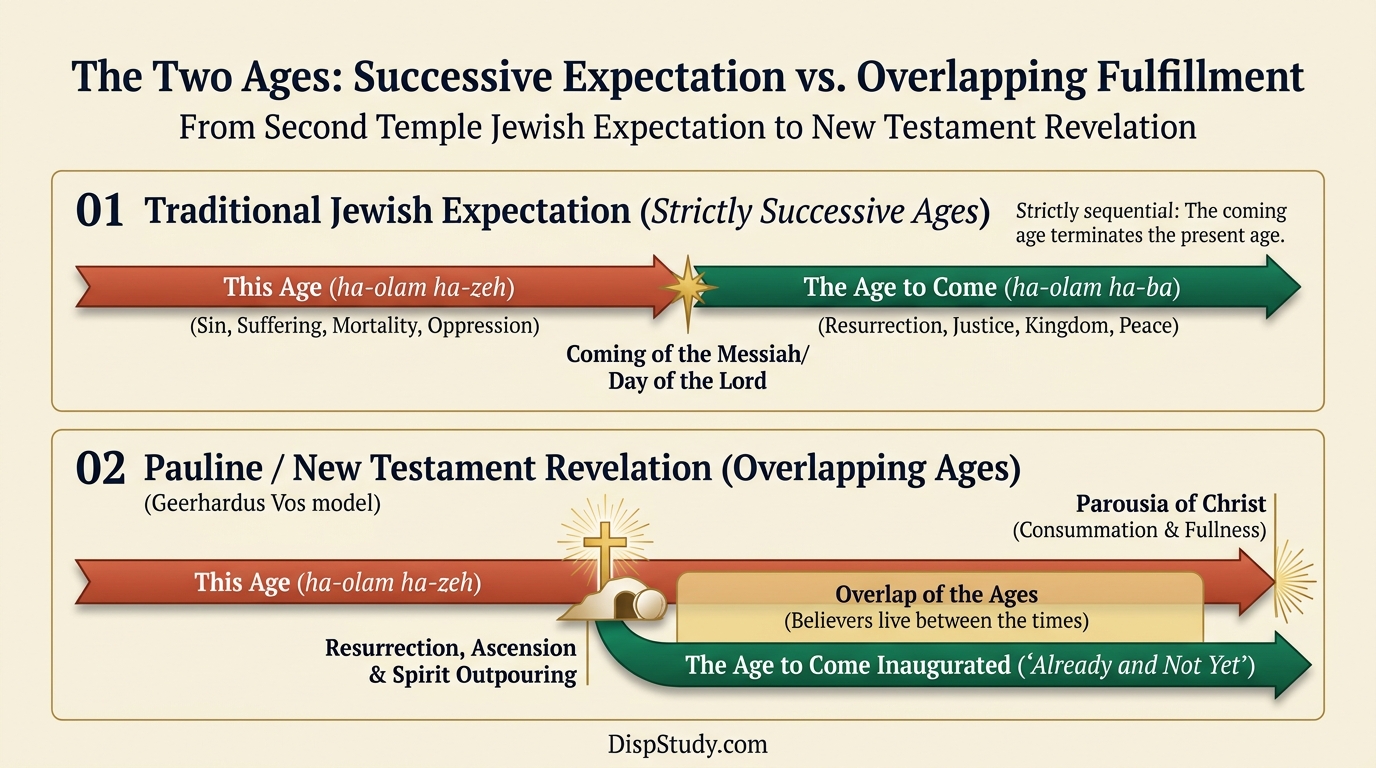
Between the ascension of Christ and His return, believers belong simultaneously to two realities: through union with Christ, they already participate in the life and powers of the age to come (Heb 6:5); by living in mortal bodies in a fallen world, they remain subject to the trials of this present age (Rom 8:18-25).
3. The Historical Development of the Framework
The concept of inaugurated eschatology did not emerge in a vacuum; it was forged through decades of intense scholarly dialogue throughout the twentieth century:
- Albert Schweitzer vs. C. H. Dodd: In the early twentieth century, New Testament scholarship was polarized. Albert Schweitzer (1906) argued for consistent eschatology, claiming Jesus was an apocalyptic visionary who expected the end of the world in His own lifetime and was mistaken. C. H. Dodd (1935) reacted with realized eschatology, insisting the kingdom had arrived in its entirety in Jesus' earthly ministry. Inaugurated eschatology emerged as the exegetical necessity to do justice to both sets of biblical texts: those declaring the presence of the kingdom and those asserting its future coming.
- Geerhardus Vos (1862–1949): Teaching biblical theology at Princeton, Vos systematically articulated the overlapping ages before the Schweitzer-Dodd debate reached the English-speaking world. In The Pauline Eschatology (1930), Vos formulated his famous dictum that eschatology precedes soteriology: salvation in Paul is experiential participation in the inaugurated age to come.
- Werner G. Kümmel (1945) & Joachim Jeremias (1947): In post-war European scholarship, Kümmel (Promise and Fulfilment) and Jeremias (The Parables of Jesus) established that Jesus taught both the present operational reality of the kingdom and an interval before its final apocalyptic consummation.
- Oscar Cullmann (1902–1999): In Christ and Time (1946), Cullmann offered the classic historical-salvific analogy: the cross and resurrection are D-Day (the decisive turning point that guarantees the war's outcome), while the Parousia is V-Day (the public victory celebration). The church lives in the tension between D-Day and V-Day.
- Erich Sauer (1898–1959) — Dispensational Anticipation of Inauguration: Long before Ladd popularized inaugurated eschatology in the broader evangelical world, the German dispensationalist theologian Erich Sauer (director of the Wiedenest Bible School) was already articulating the concept of inaugurated fulfillment and the "already and not yet" from within a dispensational framework. In his seminal works, such as The Dawn of World Redemption (1951; German orig. 1937) and The Triumph of the Crucified (1951), Sauer described Christ's heavenly session, the outpouring of the Holy Spirit, and the Church's participation in New Covenant blessings as the inaugural, spiritual stage of God's redemptive plan, while tenaciously defending the literal, future earthly millennium and the national restoration of Israel. Progressive dispensational scholars such as Darrell L. Bock have explicitly pointed to Sauer as a vital forerunner who proved that inaugurated eschatology was not a foreign amillennial import, but an organic development within rigorous dispensational exegesis.
- George Eldon Ladd (1911–1982): Professor at Fuller Theological Seminary, Ladd popularized inaugurated eschatology within American evangelicalism through Crucial Questions About the Kingdom of God (1952) and The Presence of the Future (1974). Ladd defined the kingdom primarily as God's dynamic reign rather than a static realm. Crucially, as a Historic Premillennialist, Ladd proved that the "already and not yet" did not require an amillennial framework.
- Anthony Hoekema (1913–1988): In The Bible and the Future (1979), Hoekema integrated the framework into systematic dogmatics from an amillennial perspective, viewing the millennium of Revelation 20 as the present church age during which Satan is bound from deceiving the nations.
- Progressive Dispensationalism (Late 1980s–1990s) — Canonical Formalization: In the late 1980s and early 1990s, scholars such as Craig A. Blaising, Darrell L. Bock, and Robert L. Saucy, working through the Dallas Seminary Dispensational Study Group, formalized and systematized inaugurated eschatology within Dispensationalism. Crucially, the "already and not yet" of Progressive Dispensationalism is fundamentally distinct from George Eldon Ladd's model: while Ladd (Historic Premillennialism) subsumed Israel's prophetic identity into the Church, Progressive Dispensationalism follows the trajectory pioneered by Erich Sauer, maintaining God's unconditional covenants, promises, and distinct redemptive plan for national Israel completely intact. Through complementary hermeneutics, PD demonstrates that present inaugurated fulfillment serves as an arrabōn (pledge or down payment) that guarantees—rather than replaces or cancels—the literal, geopolitical, and territorial restoration of national Israel in the earthly millennium.
4. The Diverse Traditions Under the Same Framework
While all four traditions detailed below affirm the common core—that the kingdom was inaugurated at Christ's first coming and will be consummated at His return—they disagree sharply on:
- How much has already been fulfilled;
- What remains to be fulfilled;
- Whether the "already" reinterprets and replaces, or inaugurates and guarantees, the prophetic promises.
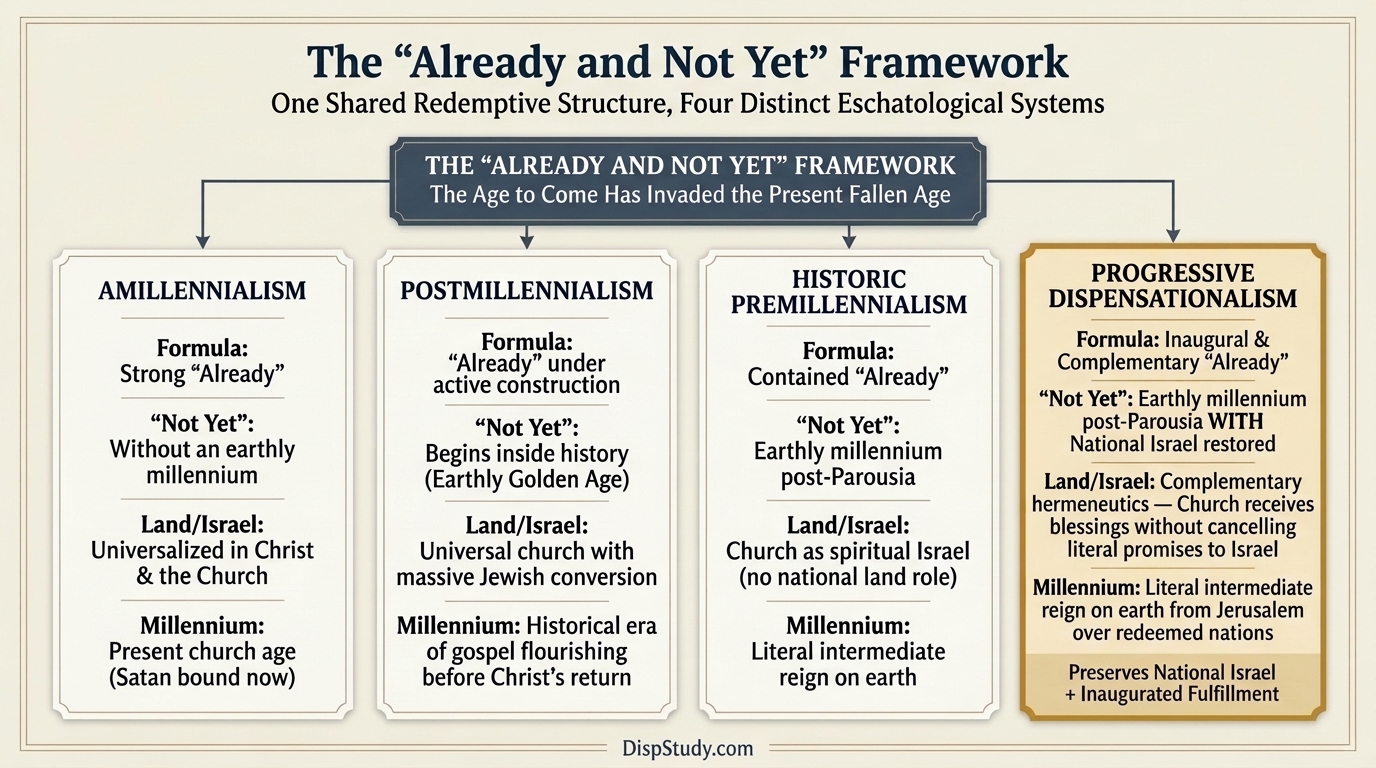
4.1 Amillennialism: Strong "Already" and "Not Yet" Without an Earthly Millennium
- Key Representatives: G. Vos, H. Ridderbos, A. Hoekema, R. Gaffin, G. K. Beale, K. Riddlebarger, C. Venema, S. Storms; historic Lutheran and Reformed traditions.
- The "Already" is Comprehensive: Christ is already seated upon the Davidic throne in heaven (Acts 2:30-36); Old Testament promises to Israel are typologically fulfilled and universalized in Christ and the Church (the "Israel of God", Gal 6:16); the thousand years of Revelation 20 is the present inter-advent age; Satan is currently bound (Mt 12:29; Rev 20:1-3) so that the gospel can reach the nations.
- The "Not Yet" Has No Earthly Millennium: The consummation consists of a single cluster of events: the Parousia, the general resurrection of all people (just and unjust simultaneously), the final judgment, and the new heavens and new earth. There is no intermediate earthly reign. The land promises of the Old Testament are absorbed and expanded into the new creation (Rom 4:13; Heb 11:16).
- Hermeneutical Engine: Typological reinterpretation. The "already" fulfills and spiritualizes the national promises made to Israel, leaving no distinct national program for ethnic Israel in the future.
4.2 Historic Premillennialism: Contained "Already" and "Not Yet" With an Earthly Millennium (Without Distinct Israel)
- Key Representatives: C. H. Spurgeon, G. E. Ladd, D. Moo, M. Erickson, W. Grudem, C. Blomberg.
- The "Already" is Contained: God's kingdom is dynamically active as "the presence of the future" through the preaching of the gospel and the Spirit. However, the present age is not the millennium, Satan is not bound in the sense of Revelation 20, and the world remains hostile to God.
- The "Not Yet" Features an Earthly Millennium: Christ returns visibly before a literal intermediate kingdom (Revelation 20). Only after this millennial reign does the final judgment and the eternal state arrive.
- No Distinct Role for National Israel: While Historic Premillennialists expect a future conversion of ethnic Jews (Rom 11:26), they do not see an ongoing national, geopolitical, or covenantal program for Israel separate from the Church. The Church is the "spiritual Israel," and the millennium is universally Christocentric without an elevated or distinct covenantal role for Israel.
4.3 Postmillennialism: "Already" Under Construction and a "Not Yet" That Begins Inside History
- Key Representatives: The Puritans (J. Owen, J. Edwards); B. B. Warfield; L. Boettner; K. Gentry; K. Mathison; D. Wilson.
- The "Already" is Expansive and Increasing: The kingdom of God was established at the first advent and grows organically within human history through the proclamation of the gospel, the Great Commission, and the sovereign power of the Spirit. The parables of the mustard seed and the leaven (Mt 13:31-33) and the vision of Daniel 2 are understood as prophecies of historical conquest and transformation.
- The "Not Yet" Begins Within History: Prior to the Parousia, the expanding kingdom produces a prolonged period of cultural flourishing, broad international repentance, social justice, and worldwide gospel success. This period is the millennium. Only after this intra-historical era does Christ return to close history with the general resurrection and final judgment.
5. Progressive Dispensationalism: A Unique Architectural Model
In the late 1980s and early 1990s, scholars such as Craig A. Blaising, Darrell L. Bock, and Robert L. Saucy initiated the movement known as Progressive Dispensationalism (PD). Emerging through discussions at the Dallas Seminary Dispensational Study Group, PD sought to address the exegesis of the biblical covenants and New Testament texts that Traditional Dispensationalism struggled to integrate.
Traditional Dispensationalism had insisted that the Church was a completely unrevealed "parenthesis" in God's plan, with zero connection to the Davidic Kingdom or the Old Testament covenants. In contrast, Progressive Dispensationalism recognized that the New Testament clearly presents Christ's resurrection and ascension as the inauguration of His messianic session and the inauguration of New Covenant blessings for the Church.
However, adopting the "already and not yet" framework did not mean PD became Amillennialism or Historic Premillennialism. Rather, PD articulates a distinct model characterized by three structural features:
5.1 The "Already": Inaugural, Not Exhaustive
For Progressive Dispensationalism, the "already" includes:
- The Inauguration of Christ's Davidic Session: In Acts 2:30-36, Peter connects Jesus' resurrection and ascension to God's oath to place one of David's descendants upon his throne. Christ has already begun to reign from the Father's right hand in heaven as the exalted Son of David, pouring out the Holy Spirit upon the Church.
- Participation in the New Covenant: The Church partakes of the spiritual, redemptive blessings of the New Covenant (Jer 31:31-34; Heb 8:8-12; 1Co 11:25) without replacing national Israel.
- The Unity of God's Redemptive Purpose: There are not two separate, disconnected programs (one heavenly for the Church and one earthly for Israel). God's purpose is a single, progressive unfolding of the kingdom across distinct dispensational phases.
Crucially, the "already" does not include the binding of Satan or the millennium of Revelation 20. Satan is not bound in a bottomless pit; the world lies in the power of the evil one (1Jn 5:19).
5.2 The Hermeneutical Engine: Complementary Hermeneutics
The primary methodology that distinguishes Progressive Dispensationalism from all other traditions is complementary hermeneutics:
Complementary hermeneutics maintains that the New Testament introduces additional, previously unrevealed dimensions of fulfillment—such as the inclusion of Gentile believers as equal co-heirs with Jewish believers in the body of Christ—without canceling, reinterpreting away, or superseding the original terms and recipients of the Old Testament covenants.
- When an Amillennialist reads the New Testament, he assumes that the fulfillment in the Church reinterprets and exhausts the Old Testament promise. The land becomes heaven or the new earth; ethnic Israel becomes the multi-ethnic Church; the throne of David becomes a permanently celestial reality.
- When a Progressive Dispensationalist reads the New Testament, he recognizes that the inclusion of the Church is an addition to the covenantal blessing, not an erasure of its original promises. The spiritual blessings given to Gentile believers now do not eliminate the literal, geopolitical, and territorial promises made to the physical seed of Abraham and the nation of Israel (Rom 11:28-29).
5.3 The "Not Yet": Earthly Millennium and National Israel Restored
The "not yet" in Progressive Dispensationalism is the most expansive of any tradition:
- Christ will return physically at the Parousia.
- He will establish a literal intermediate millennial reign on the earth (Rev 20:1-6).
- During this millennium, Israel as an ethnic and geopolitical nation will be spiritually converted and physically restored in her ancestral land (Ezek 36–37; Zech 12–14; Rom 11:25-27).
- Christ will exercise His Davidic authority not only from heaven, but visibly from Jerusalem over all redeemed nations (Isa 2:1-4; Lk 1:32-33; Mt 19:28).
- Only after this millennial kingdom does the final rebellion occur, followed by the Great White Throne Judgment and the eternal state in the new heavens and new earth.
5.4 Internal Diversity Within Progressive Dispensationalism
Even within Progressive Dispensationalism, scholars navigate the tension of the "already and not yet" with varying nuances:
- Craig Blaising and Darrell Bock: Present the most explicit view of the inauguration of the Davidic throne. They argue that in Acts 2:30-36, Peter intentionally links Jesus' heavenly session to the Davidic covenant, demonstrating that Christ is already seated upon the Davidic throne in an inaugural, celestial phase of His reign.
- Robert L. Saucy (The Case for Progressive Dispensationalism, 1993): While affirming that the messianic age and New Covenant blessings broke into history through the Spirit, Saucy adopted a more cautious stance regarding the throne itself. Saucy preferred to view Christ as currently seated upon the "Father's throne" (Rev 3:21), mediating messianic authority and kingdom blessings to the Church, while reserving the formal exercise of the Davidic throne proper for the future millennial reign upon the earth.
- Contemporary Discussions (e.g., Michael Vlach): Contemporary dispensationalists continue to explore these nuances, emphasizing that acknowledging the real presence of the Spirit and the inaugurated New Covenant must never diminish the literal, geopolitical, and land-centered realities of the future kingdom.
This internal dialogue demonstrates that the "already and not yet" within PD is not a simplistic slogan imported from outside, but an ongoing, rigorous exegetical endeavor.
6. Cross-Cutting Issues Not Resolved by the Framework
The versatility of the "already and not yet" framework is further evidenced by how it intersects with questions that do not depend on millennial views:
6.1 The Continuity of Spiritual Gifts
Does the inaugurated presence of the Spirit in "the last days" (Acts 2:16-21) imply that miraculous gifts continue until the Parousia, or were they confined to the apostolic foundation?
- Cessationists: Richard Gaffin (Amillennialist), John MacArthur (Dispensationalist), and traditional Presbyterians argue that the sign gifts belonged strictly to the inaugural apostolic foundation.
- Continuationists: Sam Storms (Amillennialist), Wayne Grudem (Historic Premillennialist), Craig Keener, and classical Pentecostals argue that because the "already" has arrived, the supernatural gifts of the Spirit operate throughout the inter-advent age.
6.2 The Relationship Between the Covenants
How does the New Covenant relate to the prior biblical covenants?
- Covenant Theology: A single covenant of grace administered in different economies; the Church is the spiritual continuation of Israel.
- Progressive Dispensationalism: Progressive development of biblical covenants (Abrahamic, Davidic, New); inaugurated in Christ for the Church, but retaining literal, irrevocable terms for national Israel.
- Progressive Covenantalism (P. Gentry, S. Wellum, Kingdom through Covenant, 2012): Rejects both Covenant Theology's infant baptism and dispensationalism's future for national Israel, viewing biblical covenants as typological steps culminating and finding termination in Christ.
6.3 Historical Trajectory and Culture
How should the Christian expect history to unfold before the end?
- Pessimism / Decline: Traditional dispensationalism and some premillennialists expect moral decay, apostasy, and spiritual collapse.
- Realistic Coexistence: Amillennialism and historic premillennialism expect the simultaneous coexistence of the wheat and the tares until the final harvest.
- Optimistic Conquest: Postmillennialism expects the gradual transformation of cultures and political institutions through the power of the gospel.
7. Comparative Matrix: The Four Traditions
7.1 Doctrinal Summary
| Theological System | The "Already" (Inauguration) | The "Not Yet" (Consummation) | Future for National Israel |
|---|---|---|---|
| Amillennialism | Strong & Comprehensive: Christ reigns permanently on the celestial Davidic throne; the millennium is the present church age; Satan is currently bound (Rev 20:1-3). Present spiritual fulfillment exhausts and universalizes Old Testament promises. | Minimal & Non-Millennial: Strictly future Parousia, general simultaneous resurrection of just and unjust, final judgment, and new creation. No intermediate earthly reign or historical millennium. | Absorbed & Spiritualized: No distinct geopolitical, territorial, or national future. The Church is the spiritual Israel of God (Gal 6:16); land promises are universalized into the new creation (Rom 4:13). |
| Postmillennialism | Expansive & Victorious: The kingdom grows organically within history through the Great Commission and the Spirit; Satan is bound; Christ reigns from heaven progressively subduing cultural and political spheres. | Begins Inside History: Prolonged golden age of worldwide peace and gospel flourishing on earth (the millennium) before Christ's return, followed by Parousia, general resurrection, and final judgment. | Spiritual Incorporation: Massive future conversion of ethnic Jews into the Christian Church during the golden age, but without a distinct national, geopolitical, or territorial land program. |
| Historic Premillennialism | Contained & Spiritual: The dynamic reign of God operates through the gospel and the Spirit in believers; Satan is not bound in the Revelation 20 sense; the present age remains hostile and marked by tribulation. | Literal Earthly Millennium: Visible return of Christ before a literal intermediate 1,000-year reign on earth (Rev 20:1-6); Satan bound; ends with final rebellion, judgment, and eternal state. | Absorbed into the Church: Future conversion of ethnic Jews (Rom 11:26) is understood as inclusion in the one spiritual body; no distinct ongoing national or geopolitical role for Israel in the millennium. |
| Progressive Dispensationalism | Inaugural & Complementary: Christ is enthroned at the Father's right hand in the celestial phase of His Davidic reign (Acts 2:30-36); Church partakes in New Covenant spiritual blessings (Heb 8:8-12); the Spirit is the arrabōn (pledge). Satan is not bound; the "already" is a divine down payment that guarantees, rather than replaces, future prophetic promises. | Expansive & Terrestrial: Bodily Parousia; literal intermediate millennial reign on earth (Rev 20); Christ reigning visibly from Jerusalem over all redeemed nations; literal fulfillment of Davidic and Abrahamic covenants; followed by final rebellion, judgment, and new creation. | Literal, National & Irrevocable: National conversion and physical restoration of ethnic Israel in her ancestral promised land (Ezek 36–37; Rom 11:25-29). Complementary hermeneutics: blessings extended to Gentiles do NOT cancel or spiritualize Israel's geopolitical inheritance. |
*With the noted nuance of Robert Saucy, who prefers to describe Christ's current session as mediated from the Father's throne.
8. The "Already and Not Yet" Across Major New Testament Themes
The "already and not yet" is not an isolated theme restricted to end-time prophecy; it forms the internal architecture of the entire New Testament witness:
| Biblical Theme | Present Fulfillment («Already») | Future Consummation («Not Yet») |
|---|---|---|
| Kingdom of God | God's dynamic royal rule has invaded history: "the kingdom of God has come upon you" (Mt 12:28; Lk 17:21). Believers are already transferred into the kingdom of the Son (Col 1:13). | The church prays "Your kingdom come" (Mt 6:10). The physical inheritance of the kingdom remains future (1Co 15:50; 2Ti 4:18), unveiled at the close of the age (Mt 13:39-43). |
| Lordship of Christ | Resurrected and enthroned at the Father's right hand above all rule and authority (Acts 2:32-36; Eph 1:20-22). | "At present, we do not yet see everything in subjection to him" (Heb 2:8); He must reign until every enemy is visibly placed under His feet (1Co 15:25). |
| Resurrection | Christ is raised as the firstfruits (aparchē) (1Co 15:20); believers are spiritually regenerated and raised with Him (Eph 2:5-6; Col 3:1). | The bodily resurrection of believers occurs at His coming (1Co 15:23, 51-54; 1Th 4:16). |
| Eternal Life | Present spiritual possession: "Whoever hears my word and believes... has eternal life. He has passed from death to life" (Jn 5:24). | Eschatological consummation: "I will raise him up on the last day" (Jn 6:40; Jn 5:28-29). |
| Justification & Salvation | Decisive present status: "Since we have been justified by faith, we have peace with God" (Rom 5:1); no condemnation (Rom 8:1). | Deliverance from the coming wrath (Rom 5:9); the public unveiling of our glorification (Rom 8:30). |
| Adoption / Sonship | Present reality: "You have received the Spirit of adoption as sons" (Rom 8:15); "we are God's children now" (1Jn 3:2a). | Consummation of sonship: "waiting eagerly for our adoption as sons, the redemption of our bodies" (Rom 8:23; 1Jn 3:2b). |
| The Holy Spirit | Poured out in fulfillment of "the last days" (Acts 2:16-21; Joel 2:28-32); the Spirit is the arrabōn (down payment/pledge) and firstfruits (Rom 8:23; 2Co 1:22; Eph 1:13-14). | The down payment guarantees the complete possession of our imperishable inheritance (Eph 1:14; 1Pe 1:4). |
| Time & Ages | "The end of the ages has come" (1Co 10:11); "in these last days" (Heb 1:2); tasting the powers of the age to come (Heb 6:5). | "This present evil age" continues (Gal 1:4); "the night is far gone; the day is at hand" (Rom 13:12). |
| New Creation | Individual spiritual renewal: "If anyone is in Christ, he is a new creation" (2Co 5:17; Gal 6:15). | Cosmic renewal: creation set free from decay (Rom 8:19-23); new heavens and new earth (2Pe 3:13; Rev 21:1-5). |
| Victory Over Evil | Disarming of demonic rulers at the cross (Col 2:15); the ruler of this world cast out (Jn 12:31). | The final enemy, death, destroyed at the end (1Co 15:26); Satan cast into the lake of fire (Rev 20:10). |
| The Church | The people of the New Covenant, the spiritual temple of God (1Co 3:16; Eph 2:19-22). | The glorified Church presented without spot or wrinkle (Eph 5:27); the marriage supper of the Lamb (Rev 19:7-9). |
9. Conclusion: Why the Progressive Dispensational "Already and Not Yet" Is Unique
We arrive at the central theological takeaway. Over decades of debate, Progressive Dispensationalism has frequently suffered from a fundamental category mistake: the assumption that sharing a common framework implies adopting a common theology.
When traditional dispensationalists warn that adopting the "already and not yet" is a concession to amillennialism, or when covenant theologians claim that PD has conceded the core debate, they mistake the formal temporal architecture for the material hermeneutical content.
The "already and not yet" of Progressive Dispensationalism is fundamentally distinct from that of every other tradition. It is built upon three non-negotiable convictions:
1. The "Already" Guarantees Rather than Replaces the Future (Arrabōn, Not Exhaustion)
In amillennial and postmillennial thought, the present spiritual fulfillment operates as an interpretive exhaustion: the spiritual blessings experienced by the Church fulfill, spiritualize, and eliminate the need for literal, national fulfillments of the promises made to Israel.
In Progressive Dispensationalism, the theological logic is completely reversed: the present spiritual blessing guarantees the future literal fulfillment. As Paul emphasizes in Ephesians 1:13-14 and Romans 8:23, the Holy Spirit is given to us as the arrabōn (the down payment, deposit, or pledge) and the firstfruits of the coming inheritance. In any legal or commercial transaction, a down payment does not replace the acquisition of the promised estate; it legally commits the buyer to deliver the whole.
For the Progressive Dispensationalist, the spiritual blessings that the Church experiences today through the exalted Messiah are not a theological excuse for God to renege on His physical, geopolitical, and territorial promises to Israel. On the contrary, the "already" is the divine pledge that God will literally, historically, and visibly fulfill every promise He ever made to Abraham, David, and the prophets regarding the nation of Israel.
2. Complementary Hermeneutics Versus Subtractive Typology
Historic Premillennialism recognized the futurism of the millennium, but accepted an interpretive approach in which the New Testament swallows the national identity of Israel into a generic, multi-ethnic body.
Progressive Dispensationalism refuses this hermeneutical surrender. Through complementary hermeneutics, PD insists that progressive revelation is additive, not subtractive. When God reveals that Gentile believers are grafted into the spiritual blessings of the Abrahamic covenant (Gal 3:14), He does not simultaneously revoke His unconditional promise that the physical land of Canaan belongs to the physical seed of Jacob forever (Gen 17:7-8; Jer 31:35-37; Rom 11:28-29). The "already" of Gentile inclusion operates in absolute harmony with the "not yet" of national Israel's future restoration.
3. The Future of National Israel as the Decisive Distinction
What truly differentiates the Progressive Dispensational "already and not yet" from every other inaugurated model—whether Amillennialism, Postmillennialism, or Ladd's Historic Premillennialism—is the future of national Israel.
While other systems utilize the present "already" of the Church to re-interpret, universalize, or eliminate Israel's distinct prophetic destiny, Progressive Dispensationalism insists that God's covenant promises to ethnic, national Israel remain entirely intact:
- Against Amillennialism & Postmillennialism: The Church does not replace or exhaust the promises made to Abraham and David; the present spiritual blessings enjoyed by the Church do not negate the literal, physical, and territorial inheritance promised to Israel's descendants (Gen 17:7-8; Jer 31:35-37).
- Against Historic Premillennialism: While Ladd affirmed a future earthly millennium, he viewed the Church as "spiritual Israel" and denied an ongoing, distinct covenantal role for national Israel. Progressive Dispensationalism, following the heritage of Erich Sauer, maintains that the millennium will witness the literal, geopolitical restoration of national Israel in her land, ruling under Christ from Jerusalem over the redeemed nations (Isa 2:2-4; Zec 14:16-21; Rom 11:25-29).
The future of Israel is therefore the decisive watershed: for Progressive Dispensationalism, the "already" of the Church does not erase the "not yet" of national Israel, but serves as the divine guarantee that every covenant promise to Israel will reach its visible, earthly consummation.
Final Reflection
Saying that a theologian believes in the "already and not yet" answers only one chronological question: Have the realities of the age to come begun to manifest in history? To that question, virtually all evangelical scholars now answer: yes.
However, that shared answer tells us nothing about the substantive theology that follows:
- To the Amillennialist, the "already" has spiritually realized the Davidic throne and the promises to Israel, leaving only the eternal state for the future.
- To the Postmillennialist, the "already" is an unstoppable historical process that will transform human society before the Lord returns.
- To the Historic Premillennialist, the "already" inaugurated the kingdom and points to a future earthly millennium, but without a distinct covenantal future for national Israel.
- To the Progressive Dispensationalist, the "already" inaugurated the messianic reign of Christ in heaven and New Covenant spiritual blessings in the Church, serving as an irrevocable down payment that guarantees God will consummately fulfill His promises in history through the Parousia, a literal earthly millennium, and the geopolitical and spiritual restoration of Israel in her land.
Progressive Dispensationalism did not embrace the "already and not yet" to dilute its theology or accommodate covenantal systems. It embraced the framework because it represents the most consistent, exegesis-driven method to honor the whole counsel of God: one that boldly proclaims everything the risen Christ has already accomplished in His session and through His Spirit, while refusing to compromise a single syllable of God's unwavering covenantal faithfulness to Israel.
FreeRequest: Matthew 24:4–31 — Chronology in Dispensationalism
The chronological view of more than 60 dispensational authors on Matthew 24 — request it by email below.
Enter your email and we will send the PDF as an attachment. See our privacy policy.
Author
Leonardo A. Costa
A researcher and writer exploring dispensationalism from a progressive perspective, with a deep appreciation for the tradition's heritage.
Related Articles
Historic Premillennialism and Progressive Dispensationalism: A Comprehensive Comparative Analysis
A comprehensive comparison of Historic Premillennialism and Progressive Dispensationalism, refuting the claim that Kingdom Theology is merely Laddianism.
Is the Kingdom in Colossians 1:13 Present or Future?
An exegetical defense of Colossians 1:13 showing how the Kingdom of the Son is genuinely inaugurated without canceling God's literal future for national Israel.
Principle and Application: Why Progressive Dispensationalism Remains Dispensational
Progressive Dispensationalism remains dispensational because it affirms the Israel-Church distinction and literal interpretation, differing on application.
The Tabernacle of David, the Gentiles, and Progressive Dispensationalism: How James Read Amos in Acts 15
James cites Amos in Acts 15 to prove Gentiles enter as Gentiles—not analogy but staged fulfillment. A Progressive Dispensationalism reading.