Paul uses the Greek term arrabōn—a pledge, deposit, or down payment—to describe the Holy Spirit in relation to the believer's future inheritance (2 Cor. 1:22; 5:5; Eph. 1:13–14). Strictly speaking, Paul does not call the present form of the Kingdom itself the arrabōn; the Spirit is the down payment. Yet the concept provides an important theological framework for understanding the relationship between present and future fulfillment in Progressive Dispensationalism.
Paul's imagery is reinforced by another eschatological metaphor: believers possess the "firstfruits of the Spirit" while still awaiting the redemption that is to come (Rom. 8:23). Both images express the same fundamental pattern: something of the eschatological future has genuinely been given in the present, but what has been given points beyond itself to a greater fullness still to come. That is the same "already / not yet" structure that runs through Scripture as a whole.
1. The Down Payment Belongs to the Same Reality as the Final Inheritance
A down payment is not something unrelated to what will eventually be received. It is an initial portion of the larger reality that is still to come. Paul's use of arrabōn therefore suggests both continuity and escalation: what believers possess now genuinely belongs to the eschatological inheritance, although they do not yet possess that inheritance in its fullness (Eph. 1:13–14; cf. Rom. 8:23).
This continuity is especially significant in contrast to the position of many Traditional Dispensationalists, who are willing to speak of a present "mystery form of the Kingdom" while sharply disconnecting it from the future millennial Messianic Kingdom. In such a construction, the present Kingdom and the future Kingdom belong to essentially separate phases, with little or no organic continuity between them. The logic of arrabōn, however, points in the opposite direction. A down payment is not a different reality from that which it anticipates and guarantees; it is an initial participation in the same inheritance that will later be possessed in fullness.
Applied to the Kingdom program, this suggests that the Kingdom presently experienced through the exalted Messiah and the Spirit is not an unrelated "mystery kingdom" alongside the future Messianic Kingdom, but the inaugural manifestation of that same eschatological reign (Acts 2:30–36; Eph. 1:20–23; Col. 1:13). The Millennium does not introduce a fundamentally different Kingdom. Rather, it brings the already inaugurated Kingdom into a fuller historical, earthly, political, and national manifestation, with its final consummation in the eternal state.
2. Present Spiritual Blessings Guarantee Rather Than Replace the Future Kingdom
This point marks an important distinction between Progressive Dispensationalism and amillennialism. In many amillennial formulations, the present spiritual blessings of Christ's reign are understood as the fulfillment of Old Testament Kingdom promises in such a way that their national, political, territorial, and physical dimensions are spiritualized or are no longer expected to be fulfilled in the form originally promised to Israel. Present spiritual fulfillment thus functions, in practice, as the fulfillment of promises that dispensationalists continue to expect in a future earthly and national form.
Progressive Dispensationalism moves in the opposite direction. The spiritual blessings presently enjoyed by the Church do not replace, reinterpret away, or exhaust the concrete dimensions of the Old Testament promises. They anticipate and guarantee them. If the Spirit is the arrabōn of the coming inheritance, then what God gives now is not a substitute for what He promised to give later; it is the pledge that He will indeed give it (Eph. 1:13–14).
Stated simply, the spiritual blessings of the present Kingdom are evidence and guarantee of the future political, national, territorial, and physical blessings of the Kingdom. The "already" does not cancel the "not yet"; it secures it. Present participation in messianic blessing therefore strengthens, rather than weakens, the expectation of a future millennial fulfillment in which the promises made to Israel will be realized in their full historical and earthly dimensions (Jer. 31:31–37; Ezek. 36:22–38; 37:21–28).
For this reason, criticisms from Traditional Dispensationalists that Progressive Dispensationalism is moving toward amillennialism fail to engage what Progressive Dispensationalism is actually claiming. The present Kingdom does not replace the future national and political Kingdom; it guarantees it, validates it, anticipates it, and gives an initial participation in the very messianic reality that will later be manifested in fullness. In Progressive Dispensationalism, present spiritual fulfillment is not an alternative to future literal fulfillment but its pledge and assurance. Far from weakening the expectation of a future earthly Kingdom, the present manifestation of the Kingdom provides theological grounds for expecting its future consummation.
3. The Church Already Participates in the Realities of the Age to Come
Because the Holy Spirit is the arrabōn of the future inheritance, believers are not merely waiting for the messianic age from a position completely outside it. They already participate, in an anticipatory manner, in realities that belong to the age to come (Heb. 6:4–5).
The Spirit poured out upon the Church is the Spirit promised by the Old Testament prophets in connection with the messianic age, restoration, and eschatological blessing (Isa. 32:15–18; 44:3–5; Ezek. 36:25–28; 37:14; Joel 2:28–32). Peter's interpretation of Pentecost makes this connection especially explicit: the outpouring of the Spirit is identified with what Joel had promised concerning the latter days (Acts 2:16–21).
The presence of the Spirit therefore indicates that the eschatological program has genuinely begun. The messianic age has dawned, though it has not yet reached its full manifestation. The Church already experiences something of the promised messianic and eschatological reality because the future has broken into the present.
This does not mean that the Church has received the totality of Israel's promises or that the messianic program has reached its consummation. It means that realities belonging to the future Kingdom are already present in an initial and anticipatory form. The Church therefore lives within a genuine already/not yet tension: the future has entered the present without the present exhausting the future.
4. Arrabōn Holds "Already" and "Not Yet" Together
Paul's language helps avoid two opposite errors. On the one hand, it does not allow us to say that nothing of the promised future has arrived, because a genuine down payment has already been given. On the other hand, it does not allow us to say that the entire inheritance has already been received, because the very concept of a down payment points beyond itself to a greater possession still to come (Eph. 1:13–14; Rom. 8:23).
Here the analogy becomes especially illuminating.
Against amillennialism, Progressive Dispensationalism insists that what we possess now is not the whole payment. The present spiritual blessings of the Kingdom do not exhaust the Old Testament promises or remove the expectation of their future national, political, territorial, and physical fulfillment. The down payment is real, but the full inheritance is still future.
Against forms of Traditional Dispensationalism that so sharply separate the present from the future that virtually no continuity remains between them, Progressive Dispensationalism insists on the other side of the same analogy: we have already received part of the payment. The messianic future is not entirely absent. Something genuinely belonging to the promised Kingdom has already entered history through the exaltation of the Messiah and the gift of the Spirit (Acts 2:30–36; Eph. 1:20–23).
The logic of arrabōn—reinforced by Paul's language of the "firstfruits of the Spirit" (Rom. 8:23)—therefore holds both truths together. We have not received the whole payment, but we have truly received a down payment. What we possess now is neither the totality of the future Kingdom nor a reality unrelated to it. It is a genuine initial participation in the same messianic and eschatological reality that will later be manifested in its full earthly, national, political, and ultimately eschatological dimensions.
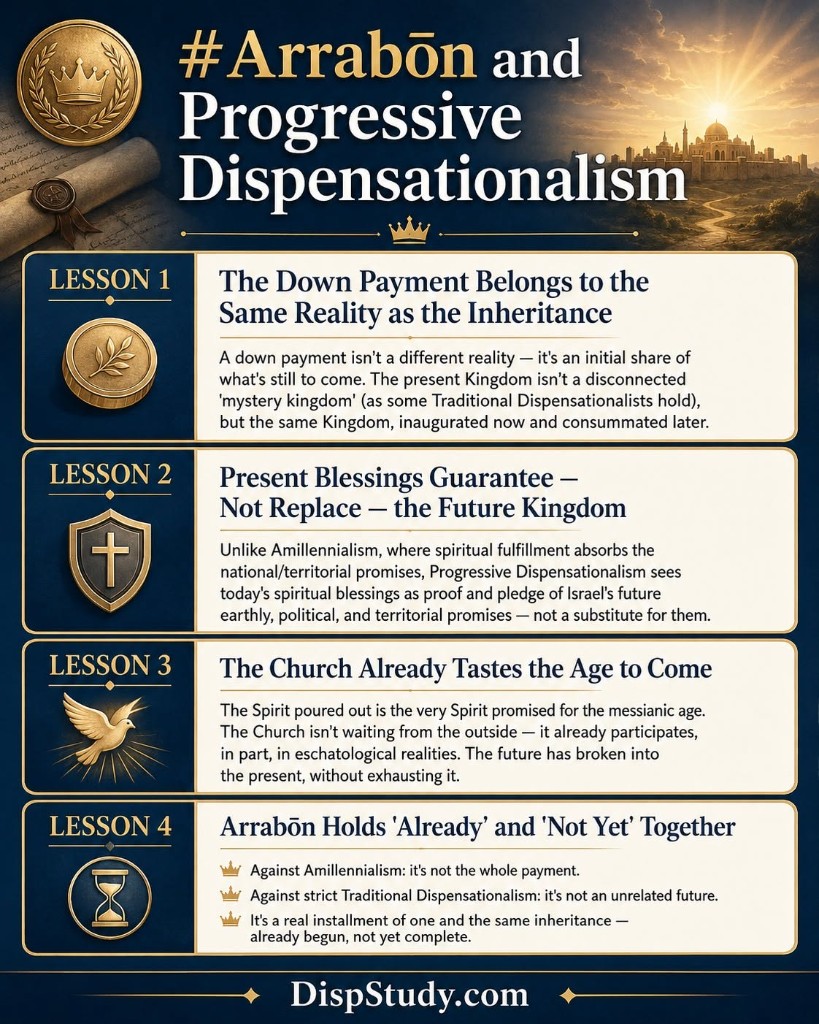
This is precisely the strength of the Progressive Dispensational formulation: inauguration does not equal consummation, but neither does future consummation require present absence. The down payment is already here, and precisely because it is a real down payment, it points beyond itself and guarantees that the fullness is still to come.
FreeRequest: Matthew 24:4–31 — Chronology in Dispensationalism
The chronological view of more than 60 dispensational authors on Matthew 24 — request it by email below.
Enter your email and we will send the PDF as an attachment. See our privacy policy.
Frequently Asked Questions
Does Paul call the present form of the Kingdom the arrabōn?
How does arrabōn distinguish Progressive Dispensationalism from amillennialism?
How does arrabōn distinguish Progressive Dispensationalism from Traditional Dispensationalism?
How does 'firstfruits of the Spirit' in Romans 8:23 relate to arrabōn?
Author
Leonardo A. Costa
A researcher and writer exploring dispensationalism from a progressive perspective, with a deep appreciation for the tradition's heritage.
Related Articles
Christ Reigns Now: The Present Kingship of Christ in Progressive Dispensationalism
Psalm 110 and 1 Cor 15:25 show Christ reigns now from God's right hand — a cornerstone of Progressive Dispensationalism's inaugurated eschatology.
A Progressive Dispensationalist Critique of the Classical "Mystery Christendom" Form of the Kingdom in Matthew 13
A Progressive Dispensationalist critique of the classical view that Matthew 13 describes a mixed Christendom, showing the field is the world, not the church.
The Tabernacle of David, the Gentiles, and Progressive Dispensationalism: How James Read Amos in Acts 15
James cites Amos in Acts 15 to prove Gentiles enter as Gentiles—not analogy but staged fulfillment. A Progressive Dispensationalism reading.
Traditional Dispensationalism and Replacement Theology: An Unexpected Convergence
Traditional dispensationalism and replacement theology travel by different routes but arrive at the same practical destination — dispossessing Israel of her.