Contents
- Preface
- Introduction
- What the Bible Says about the Mark of the Beast
- 1 – The Mark Will Be Put 'On' the Right Hand or 'On' the Forehead of People
- 2 – The Mark of the Beast Will Be an Imitation of the Seal of God
- 3 – The Mark Will Be the Name of the Beast or the Number of His Name
- 4 – What is the Number 666?
- 5 – Everyone on Earth Will Be Forced to Receive the Mark of the Beast
- 6 – Those Who Accept the Mark of the Beast Shall Be Damned Forever in Hell
- 7 – The False Prophet Will Promote the Mark of the Beast through Signs and Wonders
- 8 – Those Who Accept the Mark of the Beast Will Also Worship the Antichrist
- What is the Mark of the Beast?
- Different Views about the Mark of the Beast According to Futurist Interpreters
- Why No Current Technology Qualifies as the Mark of the Beast
- The Mark of the Beast Will Be Required Only After the Church's Time on Earth
- If the Implantable Chips of Today Are Not the Mark of the Beast, Is There a Problem in Using Them?
- Can the Mark of the Beast Be an Electronic Mark?
- The Four Aspects of the Mark: What the Bible Defines and What It Leaves Open
- Conclusion: A Summary of What the Mark of the Beast Is
Preface
Many powerful men have left their mark on the pages of history: politicians, emperors, dictators, generals, and many others who, through wars, schemes, and violence, gained fame, immense power, and wealth. Among them we may mention Nebuchadnezzar, Alexander the Great, Napoleon Bonaparte, Nero Caesar, Hitler, and Stalin.
Yet despite the power and fame those men attained in their day, the Bible teaches that a ruler of even greater authority and cruelty is still to arise on the earth, one whose dominion will extend to its very ends.
The Bible calls this coming figure the Antichrist. When he becomes a world ruler, he will proclaim himself to be God (2 Thess. 2:4), demanding worship from all humanity (Rev. 13:12, 14-15). Those living on the earth at that time who refuse to worship the Antichrist will be regarded as traitors and rebels, and for that reason they will be severely persecuted by his government.
It is at this point in history that the mark that is the subject of this book will appear: the mark of the Beast. This mark will be the visible sign of worship and allegiance to the Antichrist and his government — not merely a symbol of loyalty, but the public act by which every person on earth will be required to declare the Antichrist as their god. Everyone who submits to the worship of this future self-proclaimed god will receive his mark on the right hand or on the forehead (Rev. 13:16-17).
During this period, known in Scripture as the Tribulation, those who refuse the mark of the Antichrist will face severe persecution. The Bible teaches that those who do not have this mark will be unable to engage in any financial transaction, whether buying or selling goods and services (Rev. 13:17). The economic consequences of refusing the mark flow directly from its primary religious purpose: because the mark is the declaration of worship, those who refuse to worship the Antichrist will be denied participation in the economy he controls.
For this reason, the subject has attracted enormous interest. Every day, new claims about the mark of the Beast appear online through emails, blogs, and social media posts. Sadly, many of these messages spread more misinformation than truth and only deepen people's confusion.
For example, when it comes to identifying the mark of the Beast, many objects and technologies have been labeled as that mark over the last fifty years. Some years ago, when supermarket products began to be sold with barcodes, many claimed that the barcode, with its three larger bars at the beginning, middle, and end, symbolized the number 666 and was therefore the mark of the Beast. Based on this misinformation, many zealous Christians stopped buying any product with a barcode because they were told that doing so would amount to accepting the mark of the Beast.
The same thing happened when radios and televisions became popular, as some researchers identified them as the mark of the Antichrist. As a result, many Christians were advised not to keep such devices in their homes, because doing so was said to mean accepting the mark of the Beast. With the advent of the internet, the same happened again. Numerous claims circulated online stating that the internet itself was the mark of the Beast and that www symbolized the number 666 (Rev. 13:18).
As time passed, those supposed marks of the Beast were gradually forgotten. Today no one refrains from buying products with barcodes, owning radios or televisions, or using the internet for that reason. The list of candidates has continued to grow and accelerate. When this book was first written in 2015, the most prominent candidate was the implantable chip — fueled in part by a widely circulated claim in 2012 that the United States was about to require all citizens to be microchipped under healthcare legislation. That claim was false, but it spread virally. The COVID-19 pandemic of 2020 generated an entirely new wave of mark-of-the-Beast announcements: vaccines, vaccine passports, digital health certificates, and QR codes were all proclaimed at various points as the fulfillment of Revelation 13. Brain-computer interfaces such as Neuralink, Central Bank Digital Currencies (CBDCs) being developed by dozens of governments, and national digital identity systems have since joined the rotation. The pattern is consistent and predictable: every major technology that touches the body, identity, or financial transactions becomes, in some corner of the internet, the mark of the Beast.
These examples show that, in little more than fifty years, several objects and technologies have been identified as the mark of the Beast. A quick Google search is enough to show how many conflicting opinions exist on this matter. Amid all this information and misinformation, the aim of this book is to examine the subject carefully in the light of Scripture, setting aside sensationalism and groundless speculation, and allowing the biblical text itself to guide us toward a sound understanding of the mark of the Beast.
Introduction
A mark is a sign or symbol used to represent something else. The mark examined in this book is therefore a symbol or sign that represents what the Bible calls the Beast. The first step in understanding the famous mark of the Beast is to identify the reality it symbolizes: the Beast. This is the starting point for anyone who wishes to study the subject, because one's view of the identity of the Beast will necessarily influence one's view of what the mark of the Beast is.
Identifying the Beast Symbolized by the Mark
In Revelation 13, two beasts appear: the first rises from the sea (Rev. 13:1), and the second rises from the earth (Rev. 13:11). According to verses 16-18, the beast associated with the mark is the first one, the beast that rises from the sea (Rev. 13:1). In order to understand what the mark of the Beast is, we must first understand what the Beast itself is.
The majority of Christian authors agree that this first Beast, in apocalyptic symbolism, represents the Antichrist. They disagree, however, on the identity of the Beast, the Antichrist. Throughout history, the Beast that has a mark has been identified in different ways: as a kingdom, a political system, a ruler from the past, a ruler from the present, or a ruler from the future.
The Reformers, such as Martin Luther and John Calvin,1 held that the Roman papacy represented the Beast. This view is generally found among historicist amillennial interpreters such as John Wycliffe, John Knox, John Wesley, the Westminster Confession of Faith,2 Charles Spurgeon, Martin Lloyd-Jones, and others.3 For this reason, Protestant authors of the Reformation, as well as more recent historicist writers, tend to explain the mark of the Beast allegorically, claiming that it is not a literal mark placed on the skin. Spurgeon, for example, did not believe that this mark would be a physical sign literally placed on people's right hands or foreheads. According to his symbolic interpretation, receiving the mark on the forehead was an allegorical way of accepting the ideas associated with the anti-Christian system represented by the Beast, while receiving it on the right hand meant carrying out the sinful deeds of that system.4
Seventh-day Adventists, who also hold a historicist view, identify the Beast of Revelation 13 with the Roman papal system. For that reason, they claim that the mark of the Beast will not be a literal mark on the skin, or a chip implanted in people, but rather a mark representing an individual's loyalty to the system symbolized by the Beast: the papacy.5 According to this view, the Beast, that is, the papal system, will institute Sunday as the day of worship in the last days; thus Sunday would be the mark of the Beast, whereas Saturday would be the mark of God.6
A well-known modern historicist theologian, William Hendriksen, believes that the Beast in Revelation symbolizes Satan's persecuting power against the Church, operating in nations and through governments in every period of history. In his commentary on Revelation, he observes that in the ancient world slaves were marked, and in this way the mark became a symbol of ownership. To receive someone's mark, therefore, means to belong to that person. In the case of the Beast, to receive his mark means to align oneself with this anti-Christian system that persecutes the Church, not to receive a literal mark on the right hand or forehead. According to Hendriksen, whenever a persecuting power rises against the Church in history, both the Beast and his mark are present.7
Preterist scholars, on the other hand, argue that the Beast of Revelation 13 is neither the Roman papacy nor a future ruler, but a first-century ruler. Stanley Gundry, a preterist author, writes: "I understand that the beast portrays the Roman Empire (the kingdom) in general and the emperor Nero Caesar (king) specifically."8 From this perspective, the mark of the Beast cannot be a chip or any other mark belonging to the present or the future. It must necessarily be a mark connected with the first century and the Roman Empire.
Unlike preterists, futurist scholars believe that the Beast of Revelation 13 is a future figure, someone who will become a world ruler. During his reign, unlike anything history has ever seen, he will gain full control of the global economy. In order to buy or sell, a person will literally need a physical mark on the right hand or on the forehead (Rev. 13:16-17).
We should note, then, that the futurist view, which holds that the mark will be a literal mark placed on the right hand or on the forehead, can only be correct if the Beast, the Antichrist, is 1) a man and 2) a future world ruler. This book adopts the futurist view. Therefore, before asking what the mark of the Beast is, we must first show from Scripture that the Beast is both a human figure and a future one.
The Beast Will Be a Man
The Beast of Revelation 13, which rises from the sea (Rev. 13:1), is the Antichrist. The term antichrist appears only in the New Testament, and only in John's letters (1 John 2:18, 22; 4:3; 2 John 7).9 The apostle uses the term in two different senses: a general sense and a specific or eschatological sense. In a general sense, the term refers to anything that opposes the true teaching of Scripture. For John, anyone who denied a fundamental biblical truth was an antichrist: "Who is a liar but he that denieth that Jesus is the Christ? He is antichrist, that denieth the Father and the Son" (1 John 2:22). In that sense, according to the apostle, there were already many antichrists in the world (1 John 2:18b; see also 2 John 7). Likewise, "every spirit that confesseth not that Jesus Christ is come in the flesh is not of God: and this is that spirit of antichrist" (1 John 4:3). Of the five times this term is used, four carry this general meaning.10
In a specific or eschatological sense, the Antichrist is a future world ruler, as John says: "and as ye have heard that antichrist shall come..." (1 John 2:18a). The apostle writes on the assumption that his readers had already been taught about the coming of the Antichrist ("as ye have heard"). Unlike the passages in which he uses the term in a general way and says that many antichrists are already in the world ("now are there many antichrists", 1 John 2:18b), in this specific sense the Antichrist had not yet appeared in the world ("antichrist shall come", 1 John 2:18a).
Commenting on the verses in Revelation that speak about the Beast, Dr. Henry Morris rightly states that "...the beast is not a kingdom, but a man, and that man has a name, and his name has a number."11 This interpretation is correct because the Bible says clearly that the number of the Antichrist, 666, is the number of a man (Rev. 13:18).12 In other words, it is not just any number, such as a credit card number, a chip, a spirit, a political system, or a movement, but specifically the number of an individual human being. In agreement with this view, Paul calls the Antichrist the "man of sin" and the "son of perdition" (2 Thess. 2:3), indicating that he will indeed be a man. The prophet Daniel, in the prophecy of the seventy weeks, calls the Antichrist "the prince that shall come" (Dan. 9:26), showing that he is a person, a human being who will become a ruler.
A secondary question debated among dispensationalist scholars is whether the Antichrist will be Jewish or Gentile. Some argue that he must be of Jewish origin in order to be accepted by Israel as their messiah, pointing to Daniel 11:37, which states that "he shall not regard the God of his fathers" — a phrase that some interpret as implying a Jewish background. Others, however, point to the imagery of the Beast rising from the sea (Rev. 13:1), where the sea in apocalyptic literature represents the Gentile nations (Dan. 7:3; Rev. 17:15), suggesting a Gentile origin. The weight of the biblical evidence favors the view that the Antichrist will be a Gentile — specifically associated with the Gentile world empire system that traces back through Rome to the earlier empires of Daniel's vision — since the "prince that shall come" of Daniel 9:26 is connected with the people who destroyed Jerusalem in A.D. 70, namely the Romans.13 Whatever his precise ethnic background, Scripture is unanimous that he will be a man of exceptional ability, empowered by Satan, who will rise to global dominance through diplomacy and then force.
The Beast Will Be a Future Figure
Preterist scholars of Revelation believe that Nero was the Beast, the Antichrist, and that the number 666 results from the numerical value of the letters in his name when transliterated into Hebrew (Nrwn Qsr, נרון קסר).14 It is worth noting that this calculation does not work in Greek — the language in which Revelation was actually written — which is one of the reasons many futurist scholars find it unconvincing. Historicist scholars likewise look for a historical figure to identify as the Antichrist. For that reason, throughout history many men have been considered the Antichrist: Kaiser Wilhelm II, Adolf Hitler, Benito Mussolini, Henry Kissinger, Jimmy Carter, Ronald Reagan, George H. W. Bush, Bill Clinton, George W. Bush, Mikhail Gorbachev, Mao Zedong, King Juan Carlos of Spain, the Habsburgs, Saddam Hussein, and David Rockefeller.15
Futurist theologians, however, categorically claim that no historical figure can be considered the Antichrist, since the biblical prophecies concerning him have not yet been fulfilled by any human being.
According to the Bible, the Antichrist will be worshiped throughout the whole world (Rev. 13:3-4, 12), literally on a global scale. That is why Paul says that he will proclaim himself to be God (2 Thess. 2:4). No figure in human history who claimed to be God has been worshiped by the entire world. Nero, an ancient Roman emperor, cannot be the Antichrist because he does not fulfill this prophecy, since he was worshiped only in the regions under Roman rule.16 Dr. Mark Hitchcock also explains that Nero did not require the subjects of his empire to receive a mark on the right hand or on the forehead in order to buy and sell, as the Antichrist will do (Rev. 13:16). There is no historical figure who, while claiming to be God, has been worshiped worldwide and has marked his followers on their foreheads or right hands.17
The Bible says that the man of sin, Paul's term for the Antichrist, will be personally destroyed at the coming of Jesus (2 Thess. 2:8). Paul is clearly speaking of Christ's second coming to the earth, which will occur after the Tribulation. Therefore, no historical figure who has already died, or who will not be alive at Christ's second coming, can possibly be the Antichrist. In Revelation 19:20 we read that, at Christ's return to the earth during the battle of Armageddon, the Antichrist will be personally defeated by Christ and ultimately thrown alive into the lake of fire together with the False Prophet. It is therefore impossible for Nero to be the Antichrist, since he has not been destroyed at the second coming of Christ, an event that has not yet taken place.
In Revelation 13:16-18, the Bible states that the Antichrist will control the global economy. Without his mark, no one will be able to buy or sell. This is something that has never been seen in history, since no leader has yet gained control of the entire world economy.18
A further historical consideration undermines the preterist identification of Nero with 666: the book of Revelation was almost certainly written during the reign of Emperor Domitian, around A.D. 95 — approximately three decades after Nero's death in A.D. 68.19 A prophetic warning directed at Nero would have arrived far too late to serve any practical purpose. Moreover, as Mark Hitchcock notes, the Nero interpretation became especially prominent in modern scholarship beginning in the nineteenth century.20 The major early church fathers did not identify Nero as the standard solution to 666. Irenaeus, for example, proposed Greek names such as Lateinos and Teitan and explicitly warned against dogmatic speculation. Some later Christian sources did associate Nero with an end-time persecutor, but the Nero-gematria reading was not the dominant patristic explanation. That long absence from mainstream early Christian interpretation is one reason many futurist writers remain unpersuaded by it.
It follows that the only correct interpretation of the Antichrist, the Beast, is that he will be a future ruler.
The Prophetic Foundation: Daniel 7, 9, and 11
The Beast of Revelation 13 does not appear without prophetic precedent. The imagery and the reality it represents are rooted in three key passages from the prophet Daniel that together form the biblical foundation for the Antichrist's portrait. In Daniel 7, the prophet sees four great beasts rising from the sea, representing four successive world empires — Babylon, Medo-Persia, Greece, and Rome — followed by a terrifying fourth beast with ten horns from which a "little horn" arises, speaking great things and making war against the saints (Dan. 7:7-8, 21, 25). In Daniel 9:26-27, the angel Gabriel reveals that after the sixty-ninth week of years, "the prince that shall come" will confirm a covenant for one week and break it at the midpoint, bringing about the "abomination of desolation." In Daniel 11:36-45, the "willful king" who "shall exalt himself, and magnify himself above every god, and shall speak marvellous things against the God of gods" provides further detail of this final ruler's blasphemous character and military campaigns.
John's vision in Revelation 13 draws these three Danielic portraits together into a single prophetic figure. As Dr. John Walvoord observes, the first beast of Revelation 13 is best identified as "the 'little horn' of Daniel 7:8, 'the prince who is to come' of Daniel 9:26, the willful king of Daniel 11:36-45, and the man of sin, or the lawless one, of 2 Thessalonians 2:3."21 The composite beast that John sees — combining the leopard, bear, and lion of Daniel's four kingdoms — reveals that the Antichrist's empire will gather into itself all the power and brutality of every preceding Gentile world empire, while the personal characteristics described by Daniel will reach their ultimate expression in a single individual who will dominate the world during the final three and a half years before Christ's return.
The Beast as the Culmination of Gentile World Power
The description of the Beast in Revelation 13:1-2 reveals that he will not arise in a political vacuum but will represent the culmination of all previous Gentile world empires. In his vision, John describes the Beast as having ten horns and seven heads, with the appearance of a leopard, the feet of a bear, and the mouth of a lion (Rev. 13:1-2). This description draws directly from the prophet Daniel's vision in Daniel 7, where four great beasts represent four successive world empires: the lion represents Babylon (Dan. 7:4), the bear represents Medo-Persia (Dan. 7:5), the leopard represents Greece (Dan. 7:6), and a fourth, terrifying beast represents Rome (Dan. 7:7).
What is remarkable is that the Beast of Revelation 13 combines the characteristics of all four empires into a single figure. As Dr. John MacArthur observes, "Like the indescribable fourth beast of Daniel 7:7, which represents the Roman Empire, Antichrist's final empire will be a composite of the empires that preceded it. It will incorporate all the ferocity, viciousness, swiftness, and strength of the other world empires."22 The Antichrist's kingdom will possess the majesty and autocratic power of Babylon (the lion's mouth), the massive military strength of Medo-Persia (the bear's feet), and the swiftness of conquest of Greece (the leopard's body), all combined in a single political entity.
The ten horns of the Beast correspond to the ten horns of Daniel's fourth beast (Dan. 7:7, 24), which represent ten kings or kingdoms that will form a confederation under the Antichrist's rule. This confederation, which many dispensational scholars identify as a revived form of the Roman Empire,23 will serve as the political base from which the Antichrist will extend his dominion over the entire earth. Daniel 7:23 states that this fourth kingdom "shall devour the whole earth, and shall tread it down, and break it in pieces."
The fact that the Beast incorporates the features of all prior empires indicates that his kingdom will surpass them all in power and scope. The dragon, Satan himself, will give the Beast "his power, and his seat, and great authority" (Rev. 13:2). This satanic empowerment, combined with the political and military apparatus of the revived Roman confederation, will enable the Antichrist to establish the most powerful and far-reaching government the world has ever seen — a government that will ultimately require every person on earth to bear his mark.
An important interpretive point emerges from the way Revelation 13 describes the Beast: the text oscillates between language that describes an empire and language that describes an individual person. The seven heads, ten horns, and composite animal imagery point to a political entity — a kingdom or confederation of kingdoms — while the masculine personal pronouns used throughout the passage, the personal acts of blasphemy (Rev. 13:5-6), and the identification of "the number of a man" (Rev. 13:18) point unmistakably to a specific individual. Dr. John Walvoord captures this dual reality when he writes that "the beast is both personal and, in a sense, the empire itself."24 Dr. Robert L. Thomas further observes that the consistent use of masculine pronouns to refer to the Beast — a grammatically neuter noun (thērion) in Greek — is a deliberate indicator that this entity is ultimately a living king, not merely an abstract political system.25 The Beast of Revelation 13 is therefore simultaneously the final Gentile world empire and the individual ruler who embodies and governs it.
The Antichrist Will Be a World Leader
The Antichrist will be a world ruler. Verse 7 of Revelation 13 states that the Antichrist will be given authority over every tribe, nation, and people on the earth. Verse 5 of the same chapter says that his world government will last forty-two months, that is, three and a half years. Since the Tribulation will last seven years (Dan. 9:27), it follows that the Antichrist's government will correspond to the final three and a half years of that period. We know this because, according to Revelation 19, the kingdom of the Antichrist will be destroyed at the second coming of Jesus to the earth (2 Thess. 2:8), an event that will also mark the end of the Tribulation.
A striking feature of Revelation 13:5-7 is the fourfold repetition of the Greek verb edothē ("was given" or "it was given to him"): the Beast "was given" a mouth speaking blasphemies (v. 5a), "was given" authority to continue for forty-two months (v. 5b), "was given" the ability to make war with the saints and to overcome them (v. 7a), and "was given" authority over every tribe, people, tongue, and nation (v. 7b). As Dr. Robert L. Thomas explains, the passive voice here carries the connotation "granted by God," just as it does throughout the rest of the book (cf. Rev. 6:4, 8; 7:2; 9:5).26 This means that the Beast's authority, however terrifying, operates entirely within the bounds set by divine permission — much as Satan could only afflict Job within the limits God established (Job 1:12; 2:6). God allows the Beast to blaspheme and persecute for a limited time, but will still hold him fully accountable. The pastoral implication is profound: the saints who suffer under the Beast's reign are not outside the providence of God. Their persecution has been measured, its duration fixed at forty-two months, and their faithfulness in the face of it is precisely the "endurance and faith of the saints" to which Revelation 13:10 calls them.27
Although the Antichrist's worldwide economic control will be unprecedented in its scope, history offers several precedents that illustrate how rulers can use economic coercion to enforce religious and political loyalty. In Asia Minor, emperor worship could function as a public test of allegiance; as Sir William Ramsay observed, "in one way or another every Asian must stamp himself overtly and visibly as loyal, or be forthwith disqualified from participation in ordinary social life and trading."28 Later, during the Decian persecution in the third century, inhabitants of the empire were required to offer sacrifice and obtain a certificate called a libellus as proof of compliance. Those without such proof faced serious social and legal consequences. In more recent history, totalitarian regimes such as Nazi Germany used identification systems to exclude Jews from economic life, and Communist states employed ration cards that could be withheld from dissidents. These historical parallels, though limited in scale compared to what the Bible describes, demonstrate the plausibility of the kind of economic control the Antichrist will exercise on a global scale.
What the Bible Says about the Mark of the Beast
There are five biblical passages that refer to the mark of the Beast, and all of them are found in the book of Revelation (Rev. 13:16-18; 14:9-11; 16:2; 19:20; 20:4). The first, Revelation 13:16-18, gives us the most detail about this mark. Let us examine what these passages tell us about the mark of the Beast.
1 – The Mark Will Be Put 'On' the Right Hand or 'On' the Forehead of People
Some futurist theologians say that the mark will be implanted in people, arguing that these are the only two areas of the human body least likely to reject an implanted chip.
However, writing in the early twentieth century, when the mark was not yet imagined as a chip, Isbon Beckwith suggested that the sign of the Antichrist would be placed on the right hand or on the forehead precisely because these are highly visible parts of the body, making it easier to identify the Antichrist's followers.29 Some modern writers, following the same line of reasoning, believe that these two body parts were chosen both because of their visibility and because they would be suitable locations for a chip.30
In support of a second view, which I find more persuasive on the balance of the evidence, futurist authors point out that the best translation of the passage referring to these parts of the body is on the hand or on the forehead, not, as some translations render it, in the right hand or in the forehead.
The Greek Preposition 'epi' and Its Translation
Dr. Thomas explains that the mark should be placed on the right hand or on the forehead, a point supported by the Greek preposition epi, which appears before the nouns hand and forehead.31 He goes on to say that the mark will be visible and that the choice of the right hand and forehead points in that direction.32 It is true that epi can carry other meanings, but its primary and most natural meaning is on. Therefore, unless the context clearly requires otherwise, the most natural interpretation is that the mark of the Beast will be placed on the skin. This strongly suggests that it will be a visible mark.33
For this reason, some futurist authors reject the idea that the mark of the Beast will be a chip implanted in people. For example, Dr. Mark Hitchcock, commenting on Revelation 13:16, states that the Greek preposition epi used in this text, "on" the hand or "on" the forehead, refers to something placed on the hand or on the forehead, not something implanted into these parts of the body, as a chip would be.34 Dr. Ron Rhodes shares this view and, noting the force of the preposition, makes the following observation:
“Notice that this mark will be on people, not in them (like some kind of microchip). It will be on the right hand or forehead and will be visible to the eye (perhaps like a tattoo), not hidden beneath the skin. It will be universally rejected by believers in God but universally accepted by those who choose against God.”35
A further grammatical detail strengthens this conclusion. In the Greek text of Revelation 13:16, the preposition epi is used with two different grammatical cases: with the genitive case for the hand (epi tēs cheiros) and with the accusative case for the forehead (epi to metōpon). Dr. Robert L. Thomas observes that the genitive construction emphasizes the visibility of the mark on the hand (describing its location as a result), while the accusative construction emphasizes the act of impression upon the forehead (describing the action of placing it).36 Both cases consistently point to surface application, not internal implantation.
The Old Testament provides additional support for understanding the mark as a visible, external sign. In Ezekiel 9:4, the Lord commands that a visible mark be placed on the foreheads of the righteous in Jerusalem: ”Go through the midst of the city, even through the midst of Jerusalem, and set a mark upon the foreheads of the men that sigh and that cry for all the abominations that be done in the midst thereof.” Similarly, Isaiah 44:5 speaks of men writing upon their hands, ”I am the LORD's,” as a visible sign of religious loyalty. The Mosaic Law also uses the imagery of signs placed ”upon thine hand” and ”between thine eyes” (Exod. 13:9, 16; Deut. 6:8; 11:18), consistently pointing to visible, external marks. This Old Testament background provides a strong interpretive precedent for understanding the mark of the Beast as a visible mark placed on the surface of the skin.
Taken together, these converging lines of evidence — the most natural force of epi, the genitive and accusative case analysis, the charagma historical background, the functional visibility argument, and the Old Testament precedents — strongly support the view that the mark will be an external, visible sign placed on the surface of the skin rather than beneath it. This is the interpretation I find most persuasive, and it is shared by many careful dispensational scholars.
It must be acknowledged, however, that epi is a flexible preposition capable of a range of meanings, and a minority of responsible futurist interpreters do not consider the grammatical evidence alone to be conclusive. This honest uncertainty deserves to be stated rather than concealed. What must be emphasized, however, is that this uncertainty changes nothing about the central conclusion of this book. Even if one were to grant that epi in this context permits a subcutaneous application, the conclusion regarding any existing technology would remain entirely unchanged: no pre-Rapture chip or implant is the mark of the Beast. The decisive reason is not grammatical but chronological and theological. The mark is the mark of the Antichrist — it cannot exist before he is revealed to the world, and he cannot be revealed before the Rapture of the Church (2 Thess. 2:6-8). The epi argument, at its strongest, establishes what the mark will most likely look like. The chronological argument establishes that it cannot yet exist, in any form, at any point during the present age. This is precisely the error of popular sensationalism on this subject: it asks whether a given technology could match the physical description of the mark, while bypassing entirely the theological and historical conditions — the person of the Antichrist, his world government, the specific moment of the second half of the Tribulation — without which no mark of any kind is possible.
Examining the Greek Term for “Mark” (charagma)
Based on the historical context of the period, Dr. Robert L. Thomas offers an interesting interpretation of the mark of the Beast, which in my view is correct:
“The mark must be some sort of branding similar to that given soldiers, slaves, and temple devotees in John’s day. In Asia Minor, devotees of pagan religions delighted in the display of such a tattoo as an emblem of ownership by a certain god (Kiddle, Sweet). In Egypt, Ptolemy Philopator I branded Jews, who submitted to registration, with an ivy leaf in recognition of their Dionysian worship (cf. 3 Macc. 2:29).37 This meaning resembles the long-time practice of carrying signs to advertise religious loyalties (cf. Isa. 44:5) (Kiddle) and follows the habit of branding slaves with the name or special mark of their owners (cf. Gal. 6:17).38 Charagma ("mark") was a term for the images or names of emperors on Roman coins, so it fittingly could apply to the beast's emblem placed on people.”39
Mark Bailey and Tom Constable, agreeing with Dr. Thomas, comment: "The mark of the beast is evidently a brandlike mark, similar to a tattoo, that will identify beast-worshipers and will enable them to buy and sell. Those bearing the mark of the beast show by their mark that they are his followers."40
Further evidence for this understanding comes from the papyrus documents of the Roman period, where the term charagma appears frequently in connection with the emperor. As Tony Garland notes, "In the Papyri, charagma is always connected with the Emperor, and sometimes contains his name and effigy, with the year of his reign. It was necessary for buying and selling."41 This historical usage is remarkably significant: the very Greek word that John chose to describe the mark of the Beast was already, in his own day, a technical term for imperial seals attached to commercial documents. The connection between the mark and the ability to buy and sell (Rev. 13:17) is therefore not an arbitrary imposition but follows naturally from the established meaning of charagma in the first-century Roman world.
2 – The Mark of the Beast Will Be an Imitation of the Seal of God
In chapter 13, the Beast that rises from the sea (Rev. 13:1) symbolizes the Antichrist, who will exercise political power over the inhabitants of the earth. The Beast that rises from the earth (Rev. 13:11) symbolizes the assistant or spokesman of the Antichrist, a religious leader devoted to promoting the universal worship of the Antichrist.42 These two figures act through the power and influence of Satan himself, who is represented in chapters 12 and 13 by the dragon. Thus we have here the three main figures of the Tribulation: Satan, the Antichrist, and the False Prophet.
Throughout history, many theologians have seen a similarity between these three figures and the persons of the divine Trinity.43 For that reason, these scholars believe that the three figures form a satanic trinity, an evil imitation of the divine Trinity.44 In this counterfeit trinity, Satan imitates God the Father, the Antichrist imitates Christ, and the False Prophet imitates the Holy Spirit.45 Observing this, theologian A. W. Pink writes:
“The above scriptures clearly establish the fact that there is a Trinity of Evil. Now it surely needs no argument to prove that these three evil persons are opposed to and are the antithesis of the three Persons in the Godhead. The Devil stands opposed to God the Father—"Ye are of your father, the Devil," John 8:40, etc. The Antichrist stands opposed to God the Son—his very name shows this. The remaining evil person stands opposed to God the Spirit. If this be the case, then our present task is greatly simplified: it is merely a matter of noting what is separately predicted of the two Beasts in Revelation 13 so as to ascertain which of them stands opposed to Christ and which to the Holy Spirit.”46
The quotation above shows that a large number of commentators, even among those who hold different interpretations of Revelation, agree on this point. This counterfeit trinity operates through specific functional parallels that reveal the depth of Satan's imitation. Just as God the Father gave all authority to the Son (John 5:22; Matt. 28:18), so the dragon gives "his power, and his seat, and great authority" to the Beast (Rev. 13:2). Just as the Holy Spirit glorifies Christ and directs worship toward Him (John 16:14), so the False Prophet directs the worship of the world toward the Beast (Rev. 13:12). And just as the Holy Spirit performs signs that testify to Christ (Acts 2:22; Heb. 2:4), so the False Prophet performs great signs and wonders on behalf of the Beast (Rev. 13:13-14). As Dr. Arnold Fruchtenbaum observes, "As the Father gave His authority to the True Son, Satan will give his authority to the counterfeit son. Just as the Father is worshipped through the True Son, Satan is to be worshipped through the counterfeit son."47
The role of the False Prophet as the satanic counterpart of the Holy Spirit deserves particular emphasis. Just as the Holy Spirit does not seek glory for Himself but directs all attention and worship toward Christ — "He shall glorify me," Jesus said of the Spirit, "for he shall receive of mine, and shall shew it unto you" (John 16:14) — so the False Prophet does not seek worship for himself but directs all worship toward the first Beast (Rev. 13:12). He exercises all the authority of the first Beast "in his presence" (Gk. enōpion autou), functioning as a subordinate who operates under the constant oversight of his superior, just as the Spirit proceeds from and acts in union with the Father and the Son. As A. W. Pink observes, "As the Holy Spirit is here to glorify Christ, so the False Prophet will magnify the false christ" — making the False Prophet the anti-Spirit in the fullest sense of that term.48
The pattern of counterfeiting extends to the very person and work of the Antichrist in contrast with Christ:
- Christ came down from heaven (John 6:38); the Antichrist rises from the sea, symbolizing the nations in turmoil (Rev. 13:1).
- Christ humbled Himself and became a servant (Phil. 2:7-8); the Antichrist exalts himself above all that is called God (2 Thess. 2:4).
- Christ performed miracles by the power of the Holy Spirit to bring people to salvation; the Antichrist will perform lying wonders by the power of Satan to bring people to damnation (2 Thess. 2:9-10).
- Christ died and rose again (1 Cor. 15:3-4); the Antichrist will receive a fatal wound that is healed in a counterfeit resurrection (Rev. 13:3).
- God the Father seals His own people for protection (Rev. 7:2-4); the Antichrist marks his followers as a sign of ownership and allegiance (Rev. 13:16-17).
Once we recognize this pervasive pattern of imitation, it follows that the mark of the Beast will also be an imitation. The Bible states that during the Tribulation the Lord Jesus will mark 144,000 Jews by placing a seal on their foreheads (Rev. 7:2-8). In chapter 14, we learn that the seal of God on the foreheads of the 144,000 Jews will contain the names of God the Father and of Jesus (Rev. 14:1).49 That mark will be a sign of God's protection over those 144,000 Jews, keeping them safe during that dark period.
As a counterfeit of Jesus, the Antichrist will also place a mark on his followers during the Tribulation. Therefore, the mark of the Beast will be a counterfeit or imitation of God's mark.50 Dr. John MacArthur argues that, just as God will protect the 144,000 Jews during the Tribulation (Rev. 7:2-3; 9:4), so the Antichrist will offer his own false protection to those who bear his mark.51
3 – The Mark Will Be the Name of the Beast or the Number of His Name
“It also forced all people, great and small, rich and poor, free and slave, to receive a mark on their right hands or on their foreheads,__ __so that they could not buy or sell unless they had the mark, which is the name of the beast or the number of its name.” (Rev. 13.16-17, NIV)
The Bible says that during the Antichrist's rule, people will be marked on their right hand or on their forehead with either the name of the Beast or the number of its name (Rev. 13:17). This means that the visible content of the mark may be either the name of the Antichrist or the number that corresponds to that name.
The Mark as the Name of the Antichrist
The first possible form of the mark is the name of the Antichrist. In Revelation 14 we see a contrast between the seal of God (v. 1), placed on the foreheads of the 144,000 chosen Jews, and the mark of the Beast (v. 11), placed on the forehead or right hand of his followers. As noted above, the mark of the Beast is a counterfeit or imitation of the seal of God. Both the seal of God and the mark of the Beast are connected with names. That is why, in verse 11, when referring to the mark of the Antichrist, the Bible calls it the 'mark of his name' or, in some translations, the 'sign of his name' (Rev. 14:11).
So just as the seal of God bears the names of God and Jesus Christ written on the foreheads of his followers, the mark of the Beast will bear either the name of the Antichrist or the number of his name on the forehead or right hand of his followers.
This becomes even clearer when we read verses 16 and 17 of Revelation 13 carefully. Some translations present the mark, the name of the Beast, and its number as three different options. For example, the King James Version renders the text this way: "And that no man might buy or sell, save he that had the mark, or the name of the beast, or the number of his name" (Rev. 13:17). However, the preferred translation is the one that treats the name of the Beast and its number as the two elements that make up the mark itself. Dr. Robert L. Thomas explains that this is the proper meaning of the original text and that, therefore, the mark should be understood as the name of the Beast or the number of his name, not as something different from those two elements.52
The manuscripts of Revelation 13:17 preserve several variant readings of the relationship between the mark, the name, and the number. Codex Sinaiticus reads "the mark of the beast or his name or the number of his name," presenting three separate options. Papyrus 47 reads "the mark or the name of the beast or the number," offering a slightly different arrangement. However, Codex Alexandrinus — widely regarded as the most reliable witness for this verse — reads "the mark, the name of the beast or the number of his name," treating the name and the number as the two elements that constitute the mark itself. As Dr. Robert L. Thomas explains in his textual notes, "The reading of Alexandrinus best accounts for the origin of the others" — the other variants being copyist attempts to clarify or rearrange a construction they found difficult.53 This manuscript evidence further confirms that the mark should not be understood as something separate from the Beast's name and number, but as consisting precisely of one or the other.
This interpretation also fits better with the information in the following chapter, where the mark of the Beast is called 'the mark of his name' (Rev. 14:11). Another important point is that the expressions 'mark of the Beast' and 'mark of his name' are used interchangeably in similar passages, suggesting that they are equivalent expressions rather than two different things (Rev. 14:11; 16:2; 19:20; 20:4). Therefore, the mark of the Beast is best understood as the name of the Antichrist or the number of his name.54
The Mark as the Corresponding Number to the Name of the Antichrist
The second possible form of the mark will be the number that corresponds to the name of the Antichrist displayed on people. Revelation 13:16-18 states that the name of the Antichrist will have a corresponding number, and that this number will be 666.55 Dr. Arnold Fruchtenbaum shows that this interpretation is the logical conclusion drawn from the following points:
- The name of the Beast;
- The number of his name;
- The number of the Beast;
- The number of a man;
- The number is 666.56
Considering the information above, drawn from the biblical text itself, we come to the logical conclusion that the mark of the Beast cannot be just any chip containing any number whatsoever, but a specific mark containing specific data: namely, the name of the Antichrist or the number of his name.
“Following through this logical progression, the number of the Beast is also the number of a man because the Antichrist will be a man who will be the last ruler of the final form of the Fourth Gentile Empire. Furthermore, this number is the number of his very own name, and the numerical value of his name is 666.”57
According to Dr. Arnold Fruchtenbaum, this mark "has nothing to do with credit, as is often taught today. In a credit system, everyone must have a different number. In this case, everyone has the same number. The purpose of the mark will be to serve as a sign of identification of those who will own the Antichrist as their god. Only those who have this number will be permitted to work, to buy, to sell, or simply to make a living. The verse does not speak of credit cards, banking systems, a cashless society, a one-world money system, or computers, etc."58
Dr. Fruchtenbaum's point is well taken: the primary purpose of the mark is identification of allegiance, not individual financial identification as in modern credit systems. However, it should be noted that some futurist commentators, such as Tony Garland, have suggested that the mark could serve a dual function — a visible mark identifying shared allegiance to the Beast combined with a unique identifier enabling individual economic transactions.59 While the biblical text emphasizes the mark's role as a sign of worship and loyalty, it does not preclude additional practical functions in the Antichrist's economic system.
On this point, we may summarize what has been said so far with the words of the well-known dispensational theologian Charles Ryrie: "Verse 17 indicates that it will be either the name of the Beast or the number of his name (v. 17). Greek letters also stand for numbers. The number is further explained in verse 18 as 666. Evidently, people will be stamped with the number 666 or the name for which those numbers stand."60
What Does It Mean to Calculate the Number of the Name of the Beast?
The Bible says that the number of the Beast's name is 666. It also says, "Let him that hath understanding count the number of the beast" (Rev. 13:18). In the previous verse (Rev. 13:17), the Bible speaks of the mark of the Beast and states that it will be the name of the Beast or "the number of his name." To calculate the number of the Beast, therefore, is to calculate the number that corresponds to his name. This means that the sum of the numerical value corresponding to each letter of the Antichrist's name will total 666. As Mark Bailey and Tom Constable rightly observe, "The interchangeability of the beast's name and the number of his name suggests that the name, written in letters, has a numerical equivalent (13:18)."61
The practice of calculating the numerical value of a name was very common in biblical times and was known among the Jews as gematria.62 It was also common among the Romans.63 For example, an inscription found in the ancient city of Pompeii reads: "I love the one whose name is 545."64
To understand how this practice worked, we need to remember that in both the Hebrew and Greek alphabets, every letter carried a fixed numerical value — a system that made it possible to calculate the number of any word or name by adding the values of its individual letters.6566 (The Roman system was different: only certain letters — I, V, X, L, C, D, M — served as numerals, rather than every letter of the alphabet.67 Roman numerals are therefore not gematria in the strict sense, though they illustrate the broader ancient practice of using letters to represent numbers.)
In the Greek alphabet, which is the language of the New Testament, each letter carries a fixed numerical value. The system works as follows: the first nine letters represent the units (α=1, β=2, γ=3, δ=4, ε=5, ϛ=6, ζ=7, η=8, θ=9); the next nine represent the tens (ι=10, κ=20, λ=30, μ=40, ν=50, ξ=60, ο=70, π=80, ϟ=90); and the final nine represent the hundreds (ρ=100, σ=200, τ=300, υ=400, φ=500, χ=600, ψ=700, ω=800, ϡ=900). To calculate the number of a name, one simply adds the numerical value of each letter. This is what John means when he writes, "Let him that hath understanding count the number of the beast" (Rev. 13:18) — the Greek verb psēphisatō ("count" or "calculate") refers precisely to this practice of adding up the letter-values of a name.
How to Calculate a Name in Greek (Isopsephy)
As a worked example, consider the Greek name Ἰησοῦς (Iēsous, "Jesus"):
| Letter | Name | Value |
|---|---|---|
| Ι | iota | 10 |
| η | eta | 8 |
| σ | sigma | 200 |
| ο | omicron | 70 |
| ῦ | upsilon | 400 |
| ς | final sigma | 200 |
| Total | 888 |
The process is straightforward: write the name in Greek letters, look up each letter's value in the table above, and add them together. Early Christians noticed that the name of Jesus totals 888 — and regarded it as a meaningful counterpart to the Beast's 666.
How to Calculate a Name in Hebrew (Gematria)
The Hebrew alphabet works on the same principle. Its twenty-two letters carry the following values: the first nine represent the units (א=1, ב=2, ג=3, ד=4, ה=5, ו=6, ז=7, ח=8, ט=9); the next nine represent the tens (י=10, כ=20, ל=30, מ=40, נ=50, ס=60, ע=70, פ=80, צ=90); and the final four represent hundreds (ק=100, ר=200, ש=300, ת=400).
As a worked example, consider the Hebrew word משיח (Mashiach, "Messiah"):
| Letter | Name | Value |
|---|---|---|
| מ | mem | 40 |
| ש | shin | 300 |
| י | yod | 10 |
| ח | chet | 8 |
| Total | 358 |
The calculation is the same as in Greek: write the word in Hebrew letters, look up each letter's value, and sum them.
Early Attempts to Identify the Beast by Gematria
The earliest surviving Christian attempt to apply this method to Revelation 13:18 was made by Irenaeus of Lyons in the second century, in his work Against Heresies (5.30).68 It should be noted that many modern scholars have proposed a different solution: when the name "Nero Caesar" is transliterated into Hebrew (Nrwn Qsr, נרון קסר), the letter-values also total 666. This identification, first advanced by German scholars in the nineteenth century, is widely held among preterist and critical commentators, though — as we have argued elsewhere in this book — it faces serious objections on both chronological and theological grounds. Irenaeus himself, writing much closer to the events and to the apostle John's own circle, did not propose Nero but instead offered three Greek names whose letter-values total 666. His most notable example was ΛΑΤΕΙΝΟΣ (Lateinos, "the Latin"), which he calculated as follows: Λ=30 + Α=1 + Τ=300 + Ε=5 + Ι=10 + Ν=50 + Ο=70 + Σ=200 = 666. He considered this a plausible solution because the Latins (Romans) were the ruling power of his day and represented the fourth kingdom of Daniel's vision. He also proposed ΤΕΙΤΑΝ (Teitan, a variant spelling of "Titan"): Τ=300 + Ε=5 + Ι=10 + Τ=300 + Α=1 + Ν=50 = 666. However — and this is significant for our study — Irenaeus explicitly cautioned against making a definitive identification. He wrote that "it is therefore more certain, and less hazardous, to await the fulfilment of the prophecy, than to be making surmises" — a principle that remains as valid today as it was in the second century.
According to the biblical data, then, to calculate the number of the Beast (Rev. 13:18) we must add the numerical value corresponding to each letter of his name; if we do so, the result will be 666.69 As Irenaeus's examples demonstrate, many names can produce this total — which is precisely why the identification of the Antichrist must await his actual appearance on the world stage, rather than being the subject of premature speculation. Some scholars, such as Dr. Arnold Fruchtenbaum, believe that this calculation should be made using the name of the Antichrist transliterated into Hebrew.70 Others, such as Henry Morris71 and B. W. Johnson,72 believe that it should be made using the name of the Antichrist transliterated into Greek, since the New Testament was written in Greek. At this point, we do not have enough information to say which of these two views is correct, since both are possible and Western names can easily be transliterated into those languages.73
The Textual Variant: 666 or 616?
While the number 666 is supported by the overwhelming majority of Greek manuscripts, a small number of early witnesses preserve a variant reading of 616. Most notably, Papyrus 115 (P115, dated to the late third or early fourth century) and Codex Ephraemi (fifth century) read 616 instead of 666. This variant was already known in the second century: Irenaeus himself was aware of manuscripts that read 616, but he explicitly rejected that reading as a scribal error and affirmed 666 as the correct number.74
The existence of this variant may not be accidental. Several scholars have noted that if the name "Nero Caesar" is transliterated into Hebrew with the final nun (נרון קסר, Nrwn Qsr), the letter-values total 666 — but if the Latin form "Nero Caesar" is used without the final nun (נרו קסר, Nrw Qsr), the total becomes 616. This has led some scholars to suggest that the 616 variant arose precisely because a copyist adjusted the number to match the Latin spelling of Nero's name.75 Whether or not this theory is correct, the textual evidence for 666 is far stronger. Dr. Robert L. Thomas concludes that the reading 666 has the support of "the most approved MSS" and should be regarded as original, while the 616 variant is most likely a secondary alteration motivated by interpretive considerations rather than by faithful transmission of the text.76
4 – What is the Number 666?
Before examining the various interpretations of the number 666, it is important to identify the fundamental methodological question that divides scholars: does the command to "calculate" (psēphisatō) the number of the Beast (Rev. 13:18) point to a literal gematria calculation — that is, the arithmetic addition of the numerical values of the letters of a name — or does it call for a broader spiritual discernment of the Beast's character and identity? Some interpreters, following Irenaeus and the ancient tradition, take the command at face value as an invitation to apply gematria to the Antichrist's name when he appears (Thomas, Fruchtenbaum). Others, particularly those who emphasize the symbolic dimension of Revelation's numbers, argue that "calculate" here means to exercise moral wisdom rather than to perform arithmetic — recognizing the Beast's nature as the epitome of human fallenness and rebellion against God. As Dr. Buist Fanning observes in his commentary on Revelation, the referential dimension (identifying a specific person) and the ethical dimension (discerning the Beast's character) "can hold together" — they are not mutually exclusive but complementary aspects of the same divine command.77 The most balanced approach, therefore, recognizes that 666 functions on both levels simultaneously: it will serve as a literal identification tool for believers living during the Tribulation, while also carrying a rich symbolic meaning that points to the Beast's ultimate inadequacy before God.
As we have seen, the number 666 represents the number corresponding to someone's name. Throughout history, however, this number has been interpreted and applied in different ways. Some scholars have argued that this number actually refers to the duration of the Antichrist's government. From this perspective, '666' has been applied to certain empires and political regimes thought to be connected with the Antichrist, such as the Roman Empire, Islam, and Nazism.78
Other authors see no relationship between this number and historical events, viewing it only as a symbol. In this symbolic approach, they see a contrast between the number 6, which they associate with man, and the number 7, which they associate with God. In this contrast, the number 7 symbolizes divine perfection, whereas the number 6 symbolizes human imperfection. Some authors argue that the fact that 666 consists of three consecutive sixes points to humanism and even to a satanic counterfeit trinity.79
The first view, that '666' corresponds to the duration of the Antichrist's government, is obviously wrong. The second view, that it is a symbolic interpretation of the number, is not wrong per se, since the number does in fact symbolize man (Rev. 13:18). The error of that second view is that it sees only the symbolism of the number and overlooks the Bible's clear statement that this is specifically the number corresponding to the name of the Antichrist (Rev. 13:17; 14:11).
Having said that, this number has symbolic meaning, as we will see later, but it also represents something real: the name of the Antichrist. That is the correct interpretation of the number 666. Yet even this is not enough. Many people who understand that this number corresponds to the name of a person have still wrongly applied it to people who are not the Antichrist. A simple survey of articles on the internet shows scholars applying this number to various people such as Nero, Napoleon, Hitler, several popes, Mussolini, Bill Gates, Barack Obama, and many other prominent figures.
The Number 666 Was Given to Identify the Antichrist
Later we will see that those who accept the mark of the Antichrist on their bodies will face eternal condemnation. In view of this, God provides in Revelation a way for people to identify the Antichrist, so that they are not deceived into receiving his mark.
One of the ways people will be able to identify the Antichrist during the Tribulation is through his mark and through calculating the numerical value corresponding to his name: "Let him that hath understanding count the number of the beast: for it is the number of a man; and his number is Six hundred threescore and six." (Rev. 13:18). In his commentary on Revelation, Dr. Robert L. Thomas states that the main purpose of this divine command, namely the calculation of the number of the Beast, is to enable future believers living in the Tribulation to identify the Antichrist.80 This will be necessary because the Tribulation will be a time of widespread deception. The Bible states that the Antichrist and the False Prophet will deceive people through signs and wonders performed by Satan's power:
“And he doeth great wonders, so that he maketh fire come down from heaven on the earth in the sight of men, And deceiveth them that dwell on the earth by the means of those miracles which he had power to do in the sight of the beast; saying to them that dwell on the earth, that they should make an image to the beast, which had the wound by a sword, and did live. And he had power to give life unto the image of the beast, that the image of the beast should both speak, and cause that as many as would not worship the image of the beast should be killed.” (Rev. 13.13-15)
Referring to the Antichrist, the apostle Paul says that his coming will be "after the working of Satan with all power and signs and lying wonders, And with all deceivableness of unrighteousness in them that perish" (2 Thess. 2:9-10). Notice the expression 'lying wonders' or 'deceptive wonders' in some translations: the result of these signs and wonders is that many people will be deceived into accepting the mark of the Beast:
“And the beast was taken, and with him the false prophet that wrought miracles before him, with which he deceived them that had received the mark of the beast, and them that worshipped his image. These both were cast alive into a lake of fire burning with brimstone.” (Rev. 19.20).
According to the biblical text, those who receive the mark of the Beast will be 'deceived'. The mark therefore involves some kind of deception, brought about through the signs performed by the False Prophet and the Antichrist.81
Paul does not stop at describing the nature of this deception. In the very next verses he explains its theological cause: "And for this cause God shall send them strong delusion, that they should believe a lie: That they all might be damned who believed not the truth, but had pleasure in unrighteousness" (2 Thess. 2:11-12). This is a sobering dimension of the mark: those who accept it will not do so simply because Satan's power overwhelms them. God Himself will judicially confirm them in the delusion they have chosen. Those who spent their lives rejecting the truth will, in the Tribulation, lose the capacity to recognize the Antichrist for what he is. The acceptance of the mark will be the culmination of a long history of willful unbelief, and God will sovereignly seal that choice — making the warning of Revelation all the more urgent for those who hear it now.
In view of this, the information about the mark and the number 666 was given so that people living during the Tribulation would have an objective way to identify the Antichrist by calculating the numerical value of his name, and thus be able to refuse his mark.
The Symbolism of the Number 666
The number 666, which appears in the mark of the Beast, will be a literal number placed on people, and it will correspond to the name of the Antichrist. Yet this literal number also has symbolic meaning, as Dr. Paul Benware explains: "The '666' is to be understood as the numerical value of the beast's name, but it clearly has a mystical significance."82
Within biblical symbolism, many authors associate the number 6 with man and the number 7 with God. For example, in creation God rested on the seventh day; in Revelation 1:20, the seven golden lampstands represent the seven churches of God. In Revelation we also read about the seven Spirits of God, the seven seals, the seven thunders that proceed from his throne, the seven angels, the seven trumpets, and the seven bowls of his wrath.83 This shows a direct association between God and the number 7, which represents his perfection and fullness.
The number 6, on the other hand, is associated with man. In creation, man was created on the sixth day. God established six days of the week for man to work and ordained the seventh day to be set apart for God. Most theologians who give a symbolic explanation of this number believe that 6 represents imperfection and incompleteness, whereas 7 represents God's fullness and perfection. During the Tribulation, the Antichrist, though he is a man, will claim to be God and will demand the worship of the world. Yet even while proclaiming himself to be God and being worshiped by the whole world, he will remain merely a man, a figure in the satanic trinity represented by '666'.84
Since the number 6 is connected with man, we may also suggest that it has some relation to the growth of humanism in our society, which will reach its peak under the government of the Antichrist. In recent centuries, man has increasingly made himself the measure of all things, replacing objective moral principles with subjective human will. This trajectory of human self-exaltation — in which man seeks to be his own god and the ultimate standard of truth — will find its fullest expression in the Antichrist, who will literally proclaim himself to be God and demand the worship of the world (2 Thess. 2:4). In this light, some scholars have seen in contemporary cultural and religious movements a cultural preparation for the kind of worldwide deception the Bible predicts will accompany the rise of the Antichrist.
The number 666, therefore, carries a double significance that the Bible itself establishes: it is both a literal number that will correspond to the specific name of a specific future man, and a symbol that captures the essence of that man's identity — the supreme human pretender to divinity, the embodiment of man's rebellion against God, who falls eternally short of the divine perfection represented by the number 7. The three sixes declare simultaneously who the Antichrist is (a man whose name computes to 666) and what he is (a mere man exalting himself as God, the ultimate expression of human pride).
5 – Everyone on Earth Will Be Forced to Receive the Mark of the Beast
The Bible makes it clear that when the Antichrist establishes his world government, every person on earth will be forced to receive his mark as an act of worship and allegiance:
“It also forced all people, great and small, rich and poor, free and slave, to receive a mark on their right hands or on their foreheads” (Rev. 13.16)
The biblical text refers to the small and the great, the rich and the poor, the free and the enslaved, which according to Gwyn Pugh is a rhetorical way of referring to the whole of humanity.85 In other words, the Antichrist will demand acceptance of his mark from everyone. No matter how much influence a person has, how much wealth he possesses, or to what social class he belongs, if he does not accept the mark of the Antichrist, he will be persecuted.
During the reign of the Antichrist, there will be no neutrality: a person will either accept his mark or be harshly persecuted.86 As theologian Mark Hitchcock says, the slogan of the Antichrist's political campaign will be very simple: "Take my mark and worship me, or starve."87 There will be no middle ground or third option. Dr. Arnold Fruchtenbaum explains that anyone who does not accept the mark of the Beast will not be able to buy, sell, work, or even move about freely in public spaces, which will be monitored by surveillance systems designed to identify those who do not possess the mark.88
The Antichrist's empire will maintain strict economic control over the whole world. Food, clothing, medical supplies, and other vital necessities will be scarce in a devastated land. Even so, only those who bear the mark of the Antichrist on their right hand or on their forehead will be able to obtain these goods.89 The Bible is very clear on this point:
“…so that they could not buy or sell unless they had the mark, which is the name of the beast or the number of its name.” (Rev. 13.17)
Whether one wishes to go to a doctor, to a pharmacy, to the supermarket, or anywhere else, the mark of the Antichrist will be required; otherwise that person will face persecution.90
This persecution will be severe and unprecedented in its scope. In Revelation 13:1, the Antichrist is symbolized by a beast rising from the sea. In Daniel 7, the kingdom of the Antichrist comes from the fourth beast, which is likewise a wild animal. In Revelation 17, the Antichrist is symbolized by a beast on which a woman is seated. The Greek term for beast (therion), which is applied to the Antichrist, is the same term used for a wild, predatory animal.91 This term reveals something of the character of the Antichrist, who will be a dictator responsible for the deaths of many.92 As Daymond Duck observes, the scale of his persecution will surpass even the worst dictatorships in recorded history.93 Because of his cruelty, many lives will be lost during his government:
“And I saw thrones, and they sat upon them, and judgment was given unto them: and I saw the souls of them that were beheaded for the witness of Jesus, and for the word of God, and which had not worshipped the beast, neither his image, neither had received his mark upon their foreheads, or in their hands; and they lived and reigned with Christ a thousand years.” (Rev. 20.4).
Yet amid this picture of persecution, the Bible also provides a message of hope for those who will refuse the mark. The verse just quoted reveals the glorious reward awaiting them: they ”lived and reigned with Christ a thousand years” (Rev. 20:4). Though they will lose their earthly lives, they will share in the millennial reign of Christ Himself.
Moreover, the Scriptures show that God has always sustained His faithful people in times of extreme persecution. He miraculously fed the prophet Elijah through ravens by the brook Cherith (1 Kings 17:4-6) and sustained the entire nation of Israel in the wilderness for forty years, so that their clothes did not wear out and their feet did not swell (Deut. 8:3-4; 29:5). In the same way, during the Tribulation, God will providentially care for those who refuse to bow to the Antichrist. Revelation 12:6 and 14 describe how God will provide a place of refuge in the wilderness for the woman (representing the Jewish remnant), where she will be supernaturally nourished during the final three and a half years of the Antichrist's reign — the very period in which the mark will be enforced. Those who refuse the mark will face severe hardship, but they will not be abandoned by God. The Lord Jesus Himself, in the parable of the sheep and the goats (Matt. 25:31-46), appears to point to this very period. Several dispensational commentators, including Ron Rhodes, identify the "least of these my brethren" in that passage as the 144,000 Jewish witnesses of Revelation 7, who will proclaim the gospel throughout the Tribulation.94 The righteous Gentiles who feed, clothe, and shelter them — at great personal risk, since those without the mark cannot lawfully participate in the economy — demonstrate by these acts a genuine saving faith. Thus, God's provision for mark-refusers will often come through the hands of other believers who risk everything to care for them. The body of Christ, even in its most persecuted hour, will be an instrument of divine sustenance.
6 – Those Who Accept the Mark of the Beast Shall Be Damned Forever in Hell
Those who accept the mark of the Beast during the Tribulation will enjoy significant temporary and commercial benefits, including the right to buy, sell, and walk 'freely' in the streets, as noted above. Spiritually, however, those who accept the mark of the Beast will be lost forever.95 It will be an irreversible choice that seals a person's eternal destiny in hell, as the following biblical text makes clear:
“And the third angel followed them, saying with a loud voice, If any man worship the beast and his image, and receive his mark in his forehead, or in his hand, The same shall drink of the wine of the wrath of God, which is poured out without mixture into the cup of his indignation; and he shall be tormented with fire and brimstone in the presence of the holy angels, and in the presence of the Lamb:” (Rev. 14.9-10)
This solemn warning is further illuminated by Revelation 13:8, which reveals a profound truth about those who will worship the Beast and accept his mark: ”And all that dwell upon the earth shall worship him, whose names are not written in the book of life of the Lamb slain from the foundation of the world.” This verse teaches that those who worship the Beast and receive his mark are those whose names have not been written in the Lamb's Book of Life. As Dr. John MacArthur explains, ”The Book of Life is the registry in which God inscribed the names of those chosen for salvation before the foundation of the world... Believers have been in the keeping power of God since before creation.”96 This provides a measure of comfort for believers: those who truly belong to God will not take the mark. The true people of God, whose names are written in the Book of Life, will refuse the mark even at the cost of their lives, for they will recognize the Antichrist for what he is — a blasphemous impostor. In contrast, those who accept the mark will do so because their ultimate allegiance has never been to the true God.
7 – The False Prophet Will Promote the Mark of the Beast through Signs and Wonders
"It exercised all the authority of the first beast on its behalf, and made the earth and its inhabitants worship the first beast, whose fatal wound had been healed. And it performed great signs, even causing fire to come down from heaven to the earth in full view of the people. Because of the signs it was given power to perform on behalf of the first beast, it deceived the inhabitants of the earth. It ordered them to set up an image in honor of the beast who was wounded by the sword and yet lived. The second beast was given power to give breath to the image of the first beast, so that the image could speak and cause all who refused to worship the image to be killed. It also forced all people, great and small, rich and poor, free and slave, to receive a mark on their right hands or on their foreheads." (Rev. 13:12-16)
This text shows the context in which the mark will appear and be required. To understand this context properly, we must consider the sequence of events that leads up to the imposition of the mark. Several crucial events precede it, and understanding them helps explain why the whole world will be so willing to accept the mark.
The Fatal Wound and the Counterfeit Resurrection of the Beast
One of the most significant events leading to the worldwide worship of the Antichrist — and subsequently to the imposition of his mark — is his apparent death and resurrection. Revelation 13:3 states: "And I saw one of his heads as it were wounded to death; and his deadly wound was healed: and all the world wondered after the beast." The Greek phrase used here, hōs esphagmenēn ("as if slain"), is remarkably significant, for the same expression is used in Revelation 5:6 to describe the Lamb, Jesus Christ, who appeared "as it had been slain."97 This verbal parallel is not accidental. It reveals that the Beast's apparent death and recovery is a deliberate satanic counterfeit of the death and resurrection of Christ, the central event of the Christian faith.
Dr. Gregory H. Harris, writing in Bibliotheca Sacra, notes that "if Christ died actually, then it appears that this ruler will also actually die. But his wound would be healed, which can only mean restoration to life."98 Whether this constitutes an actual resurrection brought about by Satan's power or a masterful deception that merely appears to be a resurrection, the effect on the world will be the same: universal amazement and worship. Revelation 13:4 states that upon witnessing this event, the inhabitants of the earth will worship the dragon (Satan) and the Beast, saying, "Who is like unto the beast? who is able to make war with him?"
The exclamation of the Beast's worshipers — "Who is like the beast?" — is far from a random expression of awe. It is a deliberate, blasphemous echo of language that the Old Testament reserves exclusively for Yahweh. In Exodus 15:11, Moses sings, "Who is like unto thee, O LORD, among the gods?" The psalmist asks, "LORD, who is like unto thee?" (Ps. 35:10). Isaiah proclaims God's incomparability: "To whom then will ye liken me, or shall I be equal? saith the Holy One" (Isa. 40:25; cf. 40:18; Mic. 7:18). The very name Michael — the archangel who casts the dragon out of heaven (Rev. 12:7) — means in Hebrew "Who is like God?" (mî kā'ēl). The Beast's worshipers, therefore, take the language of divine praise and redirect it toward a creature, making their acclamation the exact inversion of Michael's name and of the Old Testament's most exalted declarations about God.99 This is not accidental worship; it is the ultimate blasphemy — the formal declaration that the Beast has taken the place of God in the devotion of the world.
This counterfeit resurrection is the event that triggers worldwide worship and creates the conditions for the mark to be imposed. As Dr. Arnold Fruchtenbaum explains, the world will see "the counterfeit resurrection of the Antichrist from the dead"100 — an event so extraordinary that it will convince the masses that the Antichrist is truly divine, making them willing to receive his mark as a sign of their devotion.
Among futurist interpreters, the precise nature of this "fatal wound" and its healing has been understood in three principal ways. The first reading, advanced notably by Dr. John Walvoord, interprets the wounded head as the Roman Empire, which "seemingly died" historically but will be revived in the end times; the Beast himself is not said to die, but the empire he represents will experience a miraculous restoration that astonishes the world.101 The second reading, defended by scholars such as Dr. Gregory Harris and Dr. Arnold Fruchtenbaum, takes the wound as the literal death and apparent resurrection of an individual — the Antichrist himself — arguing that the verbal parallel with the slain Lamb (Rev. 5:6) demands a personal, not merely political, death-and-resurrection sequence.102 The third reading connects the fatal wound to the ancient Nero redivivus myth — the popular legend that Nero would return from the dead — but this interpretation is rejected by virtually all futurist scholars, since Nero has not returned and the ancient church fathers closest to John's time showed no knowledge of this myth in connection with Revelation 13.103 Of these three readings, the individual interpretation (the second) appears to have the strongest textual support, since Revelation 13:12 and 14 equate the head with the Beast himself, making the healing of the head identical to the healing of the Beast. However, the empire interpretation (the first) cannot be entirely ruled out as a complementary dimension, since the Beast functions simultaneously as both a person and the kingdom he embodies.
The Image of the Beast
The passage quoted above also reveals another critical element in the sequence leading to the mark: the image of the Beast. Revelation 13:14-15 states that the False Prophet will order the inhabitants of the earth to construct an image in honor of the Beast. This image will then be given "breath" (Gk. pneuma) by the False Prophet, so that it appears to speak (Rev. 13:15). More sobering still, those who refuse to worship this image will be killed: "and cause that as many as would not worship the image of the beast should be killed" (Rev. 13:15).
This blasphemous image will likely be connected with the "abomination of desolation" spoken of by the prophet Daniel (Dan. 9:27; 11:31; 12:11) and referenced by the Lord Jesus Himself (Matt. 24:15). As Dr. John MacArthur observes, "This blasphemous image will probably be set up on the temple grounds in Jerusalem (2 Thessalonians 2:4) and will be connected with the abomination of desolation (Daniel 9:27; 11:31; 12:11; Matthew 24:15)."104
A further question concerns the nature of the pneuma ("breath" or "spirit") that the False Prophet gives to the image. The Greek word pneuma is broad in meaning, and commentators have proposed several explanations within the futurist framework. Dr. Robert L. Thomas argues that the pneuma given to the image is the equivalent of pneuma zōēs ("the breath of life"), the same expression used in Revelation 11:11 of the two witnesses whom God raised, and that the image therefore genuinely comes to life and speaks by supernatural power.105 Dr. John Walvoord, by contrast, suggests that the image may receive only the appearance of life — breathing and speaking — without possessing actual life, noting that "it may be no more than a robot" whose capabilities could be explained by advanced technology or satanic simulation.106 A third possibility, noted by several scholars, is that a demonic spirit inhabits the image, enabling it to speak and act — a form of possession rather than genuine animation (cf. Acts 16:16). The text does not require us to choose definitively among these views. What it does make clear is that the image will be convincing enough to compel worship and that the penalty for refusal will be death (Rev. 13:15).
The text of Revelation 13 reveals a clear sequence: the Beast's counterfeit resurrection leads to worldwide amazement (v. 3); the False Prophet arises and performs great signs and wonders, including making fire come down from heaven (vv. 12-13); through these signs he deceives the inhabitants of the earth and commands them to make an image of the Beast (v. 14); the image is given breath and power to kill those who refuse to worship it (v. 15); and then, immediately following the image, the mark is imposed on all people (vv. 16-17). The mark, therefore, does not appear in isolation but is the culmination of a carefully orchestrated campaign of deception and coercion. In view of all this, it is clear that when the mark is presented to the world, the chief promoter of the worldwide campaign to accept it will be the False Prophet, operating through signs and wonders.
A crucial distinction must be drawn regarding the signs and wonders performed by the False Prophet. The biblical text does not present these signs as mere illusions or sleight of hand. The "great signs" of Revelation 13:13-14, including fire called down from heaven, are described in language that indicates genuine supernatural events — not tricks, but real displays of power enabled by Satan (cf. 2 Thess. 2:9). Yet they are theologically false, because they attest a false god and lead people away from the true God. This distinction has deep Old Testament roots. In Deuteronomy 13:1-4, Moses warned Israel that a prophet might perform a sign or wonder that actually comes to pass, yet if that prophet leads the people to serve other gods, he must be rejected: "Thou shalt not hearken unto the words of that prophet … for the LORD your God proveth you, to know whether ye love the LORD your God with all your heart and with all your soul" (Deut. 13:3). The signs of the False Prophet will be the ultimate fulfillment of this warning: supernatural, effective, and real — yet serving the purpose of drawing the world into the worship of a false christ.107 The implication for believers in any age is that signs and wonders alone are never a reliable indicator of divine approval; the decisive test is always whether the message behind the signs accords with the revealed truth of Scripture.
8 – Those Who Accept the Mark of the Beast Will Also Worship the Antichrist
The mark of the Beast is not primarily an economic mechanism — it is, first and foremost, a religious act of worship with economic consequences. The biblical order is clear: worship of the Beast comes first, and the ability to buy and sell follows as a secondary benefit granted to those who have pledged their allegiance (Rev. 13:12-15, then vv. 16-17). When the Antichrist becomes a world ruler, he will demand worship from all his subjects and will require all his followers to be identified by this mark. In Revelation 13 we see that people will be deceived by the great signs and wonders performed by the False Prophet (Rev. 13:14) so that they worship the Antichrist and receive his mark. This deception does not mean that people will receive his mark unknowingly, nor that they will be unaware that in doing so they are worshiping the Antichrist.108 The very identification of the Antichrist by the number of his name, 666, removes any doubt about that. Rather, this deception means that people, amazed by the signs and wonders of the False Prophet, will actually believe that the Antichrist is God, the true savior of the world, a world that in that period of history will be in utter chaos, with war, financial crisis, famine, and more.
Seeing the Antichrist as the savior and solution for a chaotic world, people will devote themselves to him with loyalty and devotion. To show that devotion, they will deliberately accept his mark, the visible sign that they worship the Antichrist. Therefore, everyone who accepts the mark of the Beast will knowingly and unequivocally be acknowledging the Antichrist as God.
The main aspect of the mark of the Beast is spiritual, not commercial, as some believe. In biblical times, especially in the days of the apostle John, who wrote Revelation, the mark was a symbol of ownership.109 Just as in our own day a mark placed on an animal identifies its owner, in the ancient world people devoted to a god would tattoo that god’s mark on themselves in order to display their devotion. As we saw in section 1, the Greek word charagma was used for branding soldiers, slaves, and temple devotees, and Asia Minor’s pagan cults “delighted in the display of such a tattoo as an emblem of ownership by a certain god.”39 Dr. John MacArthur similarly notes that some of ”the ancient mystical cults delighted in such tattoos, which identified members with a form of worship.”110 This historical background makes clear that receiving a mark as a sign of religious devotion was not an alien concept to John’s first-century audience.
Considering this historical context, as well as the grammar of the passage, we can agree with Dr. John MacArthur that during the Tribulation, when a person receives the mark of the Beast, that person will knowingly be agreeing to worship the future self-proclaimed god, the Antichrist, who will demand such worship.111
This point cannot be overemphasized: the mark of the Beast is inseparable from the worship of the Beast. As Dr. Thomas Ice rightly observes, "Revelation 13:15 makes it clear that the key issue in all of this is 'worship of the image of the beast.' The mark of the beast is simply a vehicle to force people to declare their allegiance — to the Antichrist or Jesus Christ."112 The economic function of the mark — the ability to buy and sell — is a consequence of this worship, not its primary purpose. The mark is, first and foremost, a visible declaration of allegiance and worship.
This is confirmed by the fact that every biblical passage that mentions the mark also mentions worship. In Revelation 14:9-11, the angel warns against worshiping the Beast and receiving his mark. In Revelation 16:2, the first bowl of God's wrath is poured out on those who have the mark of the Beast and worship his image. In Revelation 19:20, the Beast and the False Prophet are said to have deceived those who received the mark and worshiped his image. And in Revelation 20:4, the martyrs are those who had not worshiped the Beast and had not received his mark. In every instance, the mark and worship appear together as two inseparable aspects of the same act of allegiance. Therefore, the mark of the Beast should be understood primarily as a religious mark of worship and devotion, with economic privileges being a secondary benefit granted to those who display their loyalty.
What is the Mark of the Beast?
With the information established in the previous chapters, we can now answer more systematically what the mark of the Beast is. So far we have seen that the futurist view of the mark of the Beast is the only one consistent with the biblical information available on this subject. Before answering directly what the mark of the Beast is, however, we will first consider what some futurist interpreters have said about it.
Different Views about the Mark of the Beast According to Futurist Interpreters
Before surveying the views of futurist scholars, it is necessary to distinguish between two very different groups who both claim a futurist interpretation: serious theological scholars who engage carefully with the biblical text, and popular sensationalist voices who seize upon every new technology or world event as the long-awaited fulfillment of Revelation 13. This second group has done considerable damage to the credibility of prophetic study, and their approach deserves to be named for what it is.
Throughout recent decades, a parade of technologies and events has been confidently announced — on social media, on YouTube channels, and in viral emails — as the definitive mark of the Beast. The COVID-19 vaccines became perhaps the most widespread example: millions of posts circulated claiming that the vaccines were themselves the mark, or that they contained hidden microchips designed to track recipients and eventually control them. Neuralink, Elon Musk's brain-computer interface project, has been similarly identified as the mark — or at least its immediate precursor — on the grounds that it involves technology implanted in the human body. Central Bank Digital Currencies (CBDCs), which several governments are actively developing, are routinely presented as the economic infrastructure of the mark. Digital identity systems, vaccine passports introduced during the COVID pandemic, China's social credit score, biometric payment systems, contactless payment technology, and even QR codes have all, at various points, been proclaimed as either the mark of the Beast or its unmistakable preparation.
What these claims have in common is a consistent methodological failure: they identify the mark with a technology rather than with a person, a government, and an act of worship. As we have seen throughout this book, the mark of the Beast cannot be separated from the Beast himself — from the Antichrist, his world government, his demand for worship, and the specific historical moment of his rise. A vaccine administered by a democratic government, a digital currency issued by a central bank, or a neural implant developed by a private company operates entirely outside that theological context. None of them bear the name or number of the Antichrist. None of them are promoted by a False Prophet performing supernatural signs. None of them demand the worship of a self-proclaimed god as the condition of their acceptance. The sensationalist approach mistakes the infrastructure for the event itself, and in doing so it causes unnecessary fear among Christians, weakens the credibility of serious prophetic study, and risks desensitizing people to the actual mark when it does appear — precisely because the same alarm has been raised so many times without warrant.
Among genuine futurist scholars, there are commonly two views regarding the nature of the mark of the Beast: 1) it will be a chip implanted in the right hand or forehead, or 2) it will be a visible mark placed on the right hand or forehead. The most common opinion among popular writers is that the mark will be a chip implanted in people. RFID implant technology — rice-grain-sized chips placed beneath the skin that can store data and enable contactless identification — has become commercially available and has been voluntarily adopted by thousands of people in various countries. Companies such as Biohax International in Sweden have offered such implants to employees, allowing them to open doors and make payments without a card. From this perspective, theologian David Jeremiah believes that the mark of the Beast could involve an RFID chip.113
Some futurist theologians do not rule out either view, believing that according to the text both are possible. For example, Grant Jeffrey distinguishes between the mark of the Beast, the name of the Beast, and the number of the Beast. For him, these three elements must be distinct, each constituting a different mark.114 As for the nature of the mark, he does not dismiss either possibility, meaning that it could be a visible mark on the skin or an RFID chip implanted under the skin.115 Jeff Kluttz likewise does not rule out either of these two views, claiming that the mark may involve some kind of chip, while acknowledging that this is only speculation rather than a necessity.116
Dr. Thomas Ice states that the mark of the Beast will not be a technology at all, but a visible mark placed on the skin, something like a tattoo.117 According to him, the number contained in the mark will specifically be 666 for every person, not a different number for each individual as in the case of credit cards. Agreeing with this view, Hal Harless explains that the mark of the Beast cannot be a credit card number or any other arbitrary number; it must be exactly the number of the Beast, 666, or his actual name.118 Dr. Ron Rhodes similarly writes:
“Though I believe that modern technology will make it possible for the antichrist and false prophet to bring about a cashless society and then control all commerce on earth, we must differentiate between this technology and the mark of the beast, for the technology itself is not the mark. I make this point because some prophecy expositors in the past have claimed that the mark will be a high-tech chip inserted under the skin, a barcode on the hand or the forehead, some kind of universal product code, or some other such technology.”119
While these authors do not believe that the mark of the Beast will itself be a technology, they do agree that new technology will be widely used by the Antichrist in his government, making technology something related to the mark, though not identical to it. For example, Dr. John Walvoord says:
“There is no doubt that with today’s technology, a world ruler, who is in total control, would have the ability to keep a continually updated census of all living persons and know day-by-day precisely which people had pledged their allegiance to him and received the mark and which had not.”120
Tony Garland, another futurist writer, takes an interesting position that distinguishes him from the others. He believes that the mark could combine a visible mark, in which everyone bears the same name or number, with an invisible identifier that provides unique identification:
"It is certainly within the realm of possibility for the mark to serve both as a single identifier of allegiance to the Beast and a globally unique identifier. All that is required is to combine an outward visible mark (indicating shared allegiance) with an invisible digital code (indicating unique identification). The external mark would function to readily cull the obedient from the disobedient while the invisible code would provide the necessary means for digital monetary exchange in the controlled economy of the end. As is typical of Satan’s schemes, the unique identifier would provide numerous benefits which would also serve as motivation to take the mark. The cost of refusing the mark is not just the risk of one’s life, but also the inability to participate in the global market. The details of the mark are not revealed by Scripture."121
Why No Current Technology Qualifies as the Mark of the Beast
Of all the candidates proposed for the mark of the Beast in recent decades, the implantable chip has proven the most persistent. And unlike the barcode or the internet, there is at least a surface plausibility to the suggestion: a chip can store data, restrict access to services, and in principle be used to monitor and control economic activity. Some futurist scholars, as we have seen, do not entirely rule out the possibility that the mark could involve chip-like technology. The question, therefore, is not primarily what technology will be used, but whether any chip currently in existence — or any technology known to us — can already be identified as the mark of the Beast. The answer is clearly no, and the reasons are not merely technological but theological.
The Bible is precise about what the mark of the Beast will be. Based on everything examined in this book, we can identify at least six specific requirements that any candidate for the mark must satisfy simultaneously:
-
It must contain the name of the Antichrist or the number 666 (Rev. 13:17-18). The mark is not any arbitrary code, credit number, or personal identifier. Its visible content will be the specific name of a specific future man, or the number that corresponds to that name — 666. Any chip currently in use contains data that has nothing to do with the Antichrist’s name, for the simple reason that the Antichrist has not yet risen as a world ruler.
-
It must be issued under the personal authority of the Antichrist’s world government (Rev. 13:16). The mark is explicitly the mark of the Beast — that is, of the Antichrist and of his government alone. A chip issued by a health system, a corporation, a university, or any present government is, by definition, not the mark of that particular ruler.
-
It must be introduced through a worldwide supernatural campaign led by the False Prophet (Rev. 13:13-14; 2 Thess. 2:9-10). The Bible does not describe the mark as a quietly implemented administrative system. It will be launched in the wake of supernatural events — including the Antichrist’s counterfeit resurrection and fire called down from heaven by the False Prophet — events so extraordinary that the entire world will be moved to worship the Beast and accept his mark.
-
It must function as the sole commerce passport for the entire global economy (Rev. 13:17). Without the mark, no one in the world will be able to buy or sell anything. No chip today exercises this kind of absolute, universal economic control. Medical implants, payment chips, and employee ID systems operate within limited, specific domains — they do not govern every transaction for every person on earth.
-
It must be inseparable from the act of worshiping the Antichrist (Rev. 14:9-11; 16:2; 19:20; 20:4). As we have seen, every biblical passage that mentions the mark also mentions worship. Receiving the mark will be receiving it as an act of deliberate devotion to a man who has declared himself to be God. A medical chip, a student ID, or a payment implant carries no such religious demand.
-
It must appear at the midpoint of the Tribulation, after the Rapture of the Church and after the Antichrist has consolidated his world government (Rev. 13:5-7; Dan. 7:25). The events that must precede the mark — the Rapture, the Antichrist’s rise to global power, the abomination of desolation, and the counterfeit resurrection — have not yet occurred.
No chip, implant, or technology currently in existence satisfies even one of these six requirements, let alone all of them together. Of the six, requirement 6 is the most fundamental: even if every other condition were somehow met, the mark still could not exist in the present age, because the Antichrist has not yet been revealed and the Rapture has not yet occurred. The mark is not primarily a technology — it is a theological event, bound inseparably to a specific person (the Antichrist), a specific period (the second half of the Tribulation), a specific content (his name or number), and a specific act (the worship of that person as God). Requirements 1 through 5 describe what the mark will be like; requirement 6 establishes that it cannot yet exist at all, in any form. To identify any present-day chip with the mark of the Beast is to confuse the instrument with the act, and the technology with the theology.
There is a further error in reasoning that deserves to be addressed directly. Even if we grant, for the sake of argument, that the mark of the Beast will involve some form of chip technology, it would still be entirely wrong to conclude that any chip existing today is already the mark of the Beast. The reasoning fails in both directions. If the mark requires a chip, it does not follow that every chip is the mark — just as the fact that a crime was committed with a knife does not mean that every knife is a murder weapon. The mark of the Beast would, in this hypothesis, involve a chip; but not every chip would be the mark of the Beast. The mark requires the full constellation of biblical conditions described above, all present simultaneously, none of which are currently in place.
This is why the fear many Christians have of receiving any kind of chip — and thereby unknowingly accepting the mark of the Beast — is theologically unfounded. It is reported that a young woman in the United States was expelled from her college because she refused a student ID card on the grounds that it contained a chip. The sincerity behind that decision is understandable. But accepting the mark of the Beast will be a conscious, deliberate act of worship directed at a man who has proclaimed himself to be God, performed in the context of a worldwide supernatural campaign, at a specific and unmistakable moment in redemptive history that has not yet arrived. It will not be possible to receive it by accident, by ignorance, or at any point during the present age of the Church.
The Mark of the Beast Will Be Required Only After the Church's Time on Earth
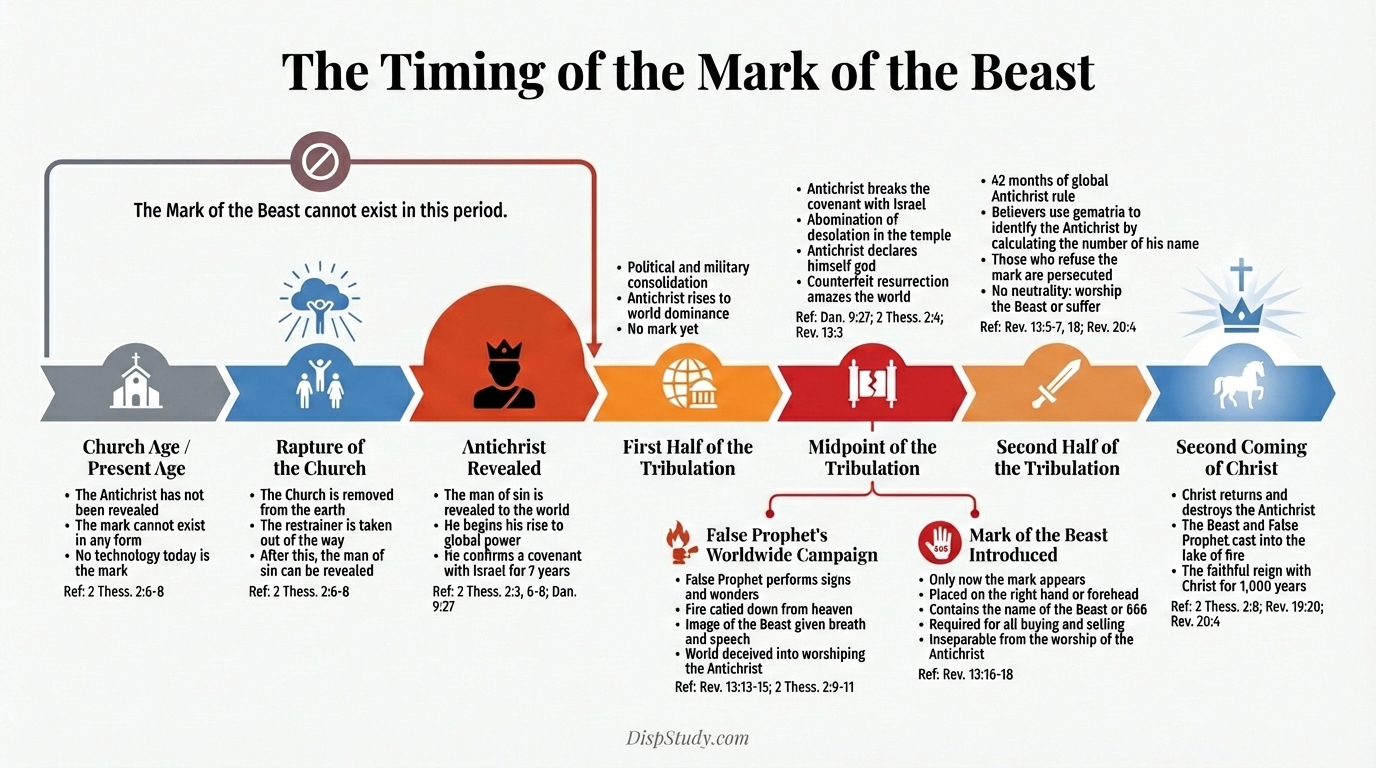
The most consistent conclusion we can draw from biblical information is that, as long as the Church is on the earth, the mark of the Beast will not yet have appeared, because during this period the Antichrist will not yet have revealed himself122, much less become ruler of the world.123 The Bible clearly states that the Antichrist's global government will last only three and a half years (Dan. 7:25; Rev. 13:5), and it also states that the end of his government will be marked by the second coming of Christ to the earth, the same event that will end the Tribulation (2 Thess. 2:8; Rev. 19:11-21).124 In view of this biblical information, the only conclusion we can draw is that the Church will no longer be on the earth during that period.
The Bible states that the identification of the Antichrist will only be possible during the Tribulation, when he reveals himself to the world. For that reason, many theologians throughout history have argued that the calculation of the number of the Antichrist's name, which is intended to identify him, can only be made after the Rapture. For example, although he does not speak specifically about the Rapture, Irenaeus of Lyons, writing in the second century of the Christian era, stated that the identity of the person represented by the number 666, in this case the Antichrist, should not become a matter of speculation until that person steps onto the world stage.125
John N. Darby believed that the name of the Antichrist can only be deciphered when the Tribulation begins and the Antichrist is revealed to the world.126 Dr. Robert L. Thomas states that if 666 is the number of the name of a future ruler, then no attempt in the past to identify the Antichrist could ever produce a true result.127 According to him, this identification will become both necessary and possible only when the Antichrist appears on the world stage, more specifically after the Rapture of the Church. Tom Constable, a teacher at Dallas Seminary, makes a similar observation:
“I think that neither the identity of the Antichrist nor the number of his name will be evident until he appears and fulfills prophecy. Then wise believers will be able to calculate his number as well as identify his person. Until then both aspects of the Antichrist's identity will remain a mystery.”128
Grant Jeffrey states that the calculation of the Antichrist's name will be relevant only for believers living during the Tribulation. He further claims:
“...The 666 identification of the Antichrist’s name will be relevant only for the Tribulation believers who are alive during the seven-year Tribulation period. The prophetic revelation regarding 666 will warn those living during the terrible time of persecution to reject the Mark of the Beast. Because they follow Christ, they will be aware of God’s warning to reject the Antichrist at all costs, even the cost of their lives. The Scripture warns that anyone who takes the Mark of the Beast (accepting him as god) will be condemned to the lake of fire (see Revelation 14:9-11).”129
If the Implantable Chips of Today Are Not the Mark of the Beast, Is There a Problem in Using Them?
The previous section made it clear that the mark of the Beast does not yet exist and that it will appear only after the Rapture of the Church. Since many people are afraid of so-called 'biochips,' and since today's biochips are not the mark of the Beast, it is natural to ask the following question: if biochips are not the mark of the Beast, does their use still present any kind of problem?
The rise of any technology, such as the 'biochip,' brings with it both positive and negative aspects — and intellectual honesty requires that we acknowledge both. On the positive side, the advances in implantable and wearable technology have produced genuine benefits for society. Medical implants have restored hearing to the deaf, regulated heartbeats through pacemakers, and enabled diabetic patients to monitor glucose levels continuously. Brain-computer interfaces hold the promise of restoring mobility to people with spinal cord injuries. Artificial intelligence is accelerating medical research, improving diagnostic accuracy, and making information more accessible to people around the world. GPS technology helps locate missing persons and coordinate emergency responses. These are real, tangible goods that improve human life, and dismissing them wholesale would be both unfair and intellectually dishonest.
At the same time, these technologies also raise concerns that deserve serious consideration. It is important to state this with precision: to say that these technologies are not the mark of the Beast is not to say that they pose no real risks. They do — and those risks deserve to be studied, discussed, and questioned on their own terms, for reasons that have nothing to do with Revelation 13. The fact that a technology does not fulfill biblical prophecy does not make it safe, ethical, or beyond scrutiny. A technology can be simultaneously beneficial in one application and dangerous in another — and the same tool that heals in a hospital can oppress in the hands of a tyrannical government. Since it is impossible to address every concern in this small book, I would like to highlight the one I consider especially important: the loss of privacy and individual liberty.
The erosion of individual liberty is one of the most significant consequences of technological advance, since never in history has so much data, personal or otherwise, been collected — whether through financial transactions or through the simple use of a cell phone equipped with GPS, which, whether we like it or not, leaves on some server somewhere in the world a record of all the places we have been.
With the advance of artificial intelligence and mass data collection, our tastes, preferences, beliefs, political opinions, medical histories, purchasing behavior, and daily movements are now being assembled into detailed profiles stored on servers around the world. Search engines, social media platforms, and smartphone applications collect and sell this data to data brokers, who aggregate it into individual dossiers available to governments, corporations, and advertisers — often without the knowledge of those being profiled. Facial recognition systems deployed in cities on multiple continents can already identify individuals in real time from public camera feeds. China's social credit system represents the most advanced operational example to date of a government using such data infrastructure to reward compliance and punish dissent: citizens with low scores can be barred from purchasing airline and train tickets, enrolling children in schools, or accessing financial services. Generative AI systems can now analyze and predict human behavior with remarkable precision. These are not hypothetical future developments — they are the current state of the surveillance infrastructure that already exists and is already being weaponized by authoritarian governments.
The honest answer is that no one knows how far artificial intelligence will go. No one knows how many jobs it will replace, how many repetitive tasks it will absorb, or how fundamentally it will reshape the relationship between citizens and institutions. What we do know is the trajectory: each generation of AI is vastly more capable than the last, and the interval between generations is shrinking. Systems that only a few years ago could barely hold a conversation can now write legal briefs, generate realistic images and video, compose music, drive vehicles, and diagnose diseases with accuracy rivaling that of trained specialists. The automation of repetitive labor — data entry, factory assembly, customer service, even software development — is no longer a distant prediction; it is underway. As AI displaces human workers from entire categories of employment, the economic and social leverage of governments over their citizens will grow proportionally. A population that depends on government-managed systems for income, housing, and access to basic services is a population far easier to control. The convergence of artificial intelligence with biometric surveillance, digital currency, and centralized data infrastructure is producing tools of social control whose scope and precision have no historical precedent.
What we can observe, without speculation, is that these capabilities would be of great value to any authoritarian government — and the Bible teaches that the government of the Antichrist will be precisely that: an authoritarian world government that demands total allegiance and controls access to the global economy (Rev. 13:16-17). Whatever tools are available at that time, the biblical text makes clear that his government will exercise comprehensive control over its subjects. George Orwell's 1984, from which the expression 'Big Brother' became popular, offers a literary illustration of the kind of surveillance state the Bible describes — though the reality of the Antichrist's government, empowered by Satan himself (Rev. 13:2), will surpass any fictional portrayal.
For this reason, the implantable biochips that exist today, although they are not the mark of the Beast and are not fulfilling any specific prophecy, raise legitimate questions about privacy and control that deserve serious consideration on their own merits. The same is true of artificial intelligence and every adjacent surveillance technology. Whether these particular technologies will play any role in the future government of the Antichrist is something no one can know. The Antichrist may arise in ten days, ten years, in a hundred years, or in a thousand — the Bible does not tell us when, and any claim to know the timing is speculation. It is equally possible that the technologies of our era will be entirely obsolete by the time the events of Revelation 13 unfold, replaced by developments we cannot yet imagine. What we can say is that these technologies present a genuine, present-day concern for human freedom — not because they fulfill biblical prophecy, but because the concentration of surveillance power and centralized control in any government, at any point in history, poses a real threat to individual liberty. That concern stands on its own, independent of any eschatological timetable.
Can the Mark of the Beast Be an Electronic Mark?
We have seen that the current (pre-Rapture) biochip is not the mark of the Beast. However, could the mark of the Beast be an electronic mark? Yes, that is possible. If we examine the Bible, we see that the mark of the Beast will be the name of the Antichrist or the number of his name, placed on the right hand or on the forehead. No current technology — whether implanted or worn on the surface — can be the mark of the Beast, for a reason that is more fundamental than any question of form: the mark is inseparably the mark of the Antichrist, and the Antichrist cannot be revealed before the Rapture of the Church (2 Thess. 2:6-8). The mark will not exist until that specific man comes to power at that specific moment in redemptive history. Even a technology that perfectly matched every formal description — placed visibly on the right hand, bearing a name, readable to the naked eye — would still not be the mark of the Beast during the present age, because it would exist outside the only context in which the mark can appear: the world government of the revealed Antichrist in the second half of the Tribulation.
As we discussed in the section on the Greek preposition epi, the most natural reading of the text favors a mark placed on the surface of the skin — but epi is a broad preposition, and we acknowledged that a subcutaneous application cannot be entirely ruled out on grammatical grounds alone. The implantable biochip of today fails as a candidate for the mark not primarily on formal grounds, but on the chronological and theological ground that the Antichrist has not yet been revealed. That said, surface-applied technologies are structurally more compatible with the most natural reading of the text. Today there are technologies placed on the skin rather than beneath it, popularly known as 'electronic tattoos' or 'smart patches.' Flexible electronics and epidermal computing have advanced considerably since this book was first written: ultra-thin, skin-adhesive sensors are now capable of monitoring biometric data, transmitting signals wirelessly, and interfacing with digital systems. Research institutions and technology companies have developed prototypes that function like temporary tattoos while containing functional electronic components.
According to the biblical information, there is nothing to prevent the mark of the Beast from being an electronic tattoo placed on the skin. In the same way, if epi in this context permits a broader application, a subcutaneous device could not be excluded either. In either case, the Antichrist could use such a technology to visibly display his name or the number of his name and, because it is electronic, also store personal, banking, and other data about those who bear it.
Here we must remember that the electronic tattoo is only one example of a technology whose characteristics are compatible with the mark of the Beast according to biblical information. Other technologies point in different directions. Brain-computer interfaces such as Neuralink — designed to help patients with paralysis regain the ability to control devices through thought — represent an entirely different category: an implanted device that interfaces with the nervous system and with digital infrastructure. RFID chips implanted beneath the skin, already used voluntarily by thousands of people for building access and contactless payments, represent yet another. Each of these technologies is structurally different from the others, and each could, in principle, serve as a platform for the mark in a future scenario — though none of them is the mark today.
The honest reality is that no one knows what specific technology the mark of the Beast will employ. The Bible describes the mark's content (the name or number of the Antichrist), its location (the right hand or forehead), its context (the Antichrist's world government), and its purpose (worship and allegiance) — but it does not specify the technological medium. It may be a technology that already exists in some form today, or it may be something that has not yet been invented. Given the speed of technological advancement, new possibilities emerge constantly, and any attempt to identify a specific current technology as the definitive platform for the mark is speculative by nature.
An analogy may help clarify this point. A knife is a neutral instrument: it can be used to prepare a meal or to commit a crime. The knife itself is not inherently criminal; its moral character depends entirely on who uses it and for what purpose. In the same way, a given technology — whether an implantable chip, an electronic skin patch, or any other device — is not the mark of the Beast simply because it exists. The very same device that today serves a legitimate medical, commercial, or identification purpose could, in a future and entirely different context, be adopted by the Antichrist as the instrument through which his mark is applied. The technology does not become the mark by virtue of what it is; it becomes the mark only when it bears the name or number of the Antichrist, is issued under his authority, is promoted by the False Prophet, and is received as an act of worship — that is, when all the biblical conditions described in this book are present simultaneously. Until then, the device remains what it is: a piece of technology, no different in moral status from a knife on a kitchen counter.
What is theologically essential, therefore, is not the specific technology employed — whether surface-applied or implanted — but the purpose the mark will serve: it will be an act of worship and allegiance to the Antichrist. Whatever form the mark ultimately takes — tattooed name, electronic skin patch, implanted device, or some technology not yet invented — its defining characteristic will not be its material composition but its function as the declaration that its bearer has submitted to the Antichrist as god.
The Four Aspects of the Mark: What the Bible Defines and What It Leaves Open
Before summarizing the conclusions of this study, it is useful to organize the biblical data about the mark of the Beast into four distinct aspects. These four categories represent everything the Bible explicitly reveals about the mark — and, just as importantly, they help identify the one dimension the Bible does not define.
1. Content — what the mark will display. The visible content of the mark will be either the name of the Antichrist or the number corresponding to his name, namely 666 (Rev. 13:17-18; 14:11). This is not an arbitrary code, a serial number, or a personal identifier. It is the specific name of a specific future man, or its numerical equivalent. The Bible is precise on this point.
2. Location — where the mark will be placed. The mark will be placed on the right hand or on the forehead (Rev. 13:16). As we have discussed, the most natural reading of the Greek preposition epi favors a mark placed on the surface of the skin, though the preposition is broad enough that a subcutaneous application cannot be entirely excluded. What the text does establish is the anatomical location: right hand or forehead — not any other part of the body.
3. Context — when and under what conditions the mark will appear. The mark is inseparably tied to the person of the Antichrist, his world government, and the specific moment of the second half of the Tribulation (Rev. 13:5-7). It will be introduced through a worldwide campaign led by the False Prophet, preceded by the Antichrist's counterfeit resurrection and the construction of the image of the Beast (Rev. 13:3, 13-15). The Antichrist cannot be revealed before the Rapture of the Church (2 Thess. 2:6-8). Therefore, the mark cannot exist during the present age, regardless of what technologies may be available.
4. Purpose — why the mark will be required. The mark is first and foremost a sign of worship and allegiance to the Antichrist, who will proclaim himself to be God (2 Thess. 2:4). Every biblical passage that mentions the mark also mentions worship (Rev. 14:9-11; 16:2; 19:20; 20:4). The economic function — the ability to buy and sell — is a consequence of this worship, not its primary purpose. Those who receive the mark will be declaring, publicly and irrevocably, that the Antichrist is their god.
What the Bible does not define: the technological medium. The Bible specifies what the mark will contain, where it will be placed, when it will appear, and why it will be required — but it does not specify how it will be physically applied. It does not prescribe a tattoo, a chip, an electronic patch, a brand, or any other particular technology. This is the one dimension left open, and it is precisely the dimension on which most popular speculation has focused. The biblical silence on this point is itself instructive: it tells us that the technology is not what matters. What matters is the content, the location, the context, and the purpose. Any technology — existing or yet to be invented — that is used by the Antichrist to apply his name or number to the right hand or forehead of his worshipers, under the conditions described in Revelation 13, will be the mark of the Beast. No technology that operates outside those conditions can be the mark, regardless of how closely it may resemble the biblical description in form.
Conclusion: A Summary of What the Mark of the Beast Is
Now, with all the information presented here in view, we can summarize what the mark of the Beast will in fact be:
-
The mark of the Beast will be both literal and symbolic. It will be the mark of a man, a future ruler known as the Antichrist, who is the Beast of Revelation 13:1 — the expression 'mark of the Beast' is essentially equivalent to 'mark of the Antichrist.' The Antichrist's kingdom will be the culmination of all previous Gentile world empires, combining the characteristics of Babylon, Medo-Persia, Greece, and Rome (Rev. 13:1-2; Dan. 7).
-
The mark cannot exist during the present age. This is the most fundamental conclusion of this book. The mark is inseparably the mark of the Antichrist — it requires his person and his world government — and the Antichrist cannot be revealed before the Rapture of the Church (2 Thess. 2:6-8). No vaccine, chip, digital currency, brain implant, biometric system, or any other technology of the present age can therefore be the mark of the Beast, regardless of how closely it may seem to resemble the biblical description. The mark does not yet exist, and it will not exist until the specific moment in history described in Revelation 13 arrives. This is the theological foundation that must govern any serious discussion of the subject.
-
The mark will be placed on the right hand or on the forehead (Rev. 13:16). The Greek preposition epi most naturally means on, and the cumulative grammatical evidence — including the genitive and accusative case constructions, the charagma historical background, and Old Testament parallels (Ezek. 9:4; Isa. 44:5; Exod. 13:9, 16) — favors surface application. However, epi is a broad preposition, and a subcutaneous application cannot be entirely excluded on grammatical grounds alone. What the Bible defines with certainty is the location (right hand or forehead) and the content (the name or number of the Antichrist); the specific technological medium — whether a visible surface mark, an implanted device, or some other form — is the one dimension the text does not prescribe.
-
As for its content, the mark will be either the very name of the Antichrist or the number corresponding to his name, namely 666 (Rev. 13:17-18). The number 666 is both literal — the numerical value of a specific future man's name, given so that Tribulation believers can identify the Antichrist (Rev. 13:18) — and symbolic, since the number 6 is associated with man (created on the sixth day) while 7 represents divine perfection. The triple repetition signals a creature who strives for divine status yet falls short, and also corresponds to the three figures of the counterfeit trinity: Satan, the Antichrist, and the False Prophet. Any attempt to identify a living person as the one whose name equals 666 during the present age is premature, since the Antichrist will be revealed only after the Rapture.
-
The mark will be imposed at some point near the middle of the Tribulation, because the global government of the Antichrist will last only three and a half years (Rev. 13:5, 7), ending with the second coming of Christ to the earth (2 Thess. 2:8; Rev. 19:11-21).
-
The mark will be presented to the world through a worldwide campaign led by the False Prophet, preceded by the Antichrist's counterfeit resurrection (Rev. 13:3) — a satanic imitation of Christ's resurrection that will trigger universal amazement — and by the construction of the image of the Beast, which will be given breath, the power to speak, and the power to kill those who refuse to worship it (Rev. 13:14-15). The means of persuasion will be signs and wonders (2 Thess. 2:9-10; Rev. 13:13-15; 19:20). Beyond these supernatural inducements, God Himself will judicially confirm the world's embrace of this deception: "For this cause God shall send them strong delusion, that they should believe a lie" (2 Thess. 2:11). Those who accept the mark will not merely be overwhelmed by Satan's power — they will be experiencing the righteous judgment of God upon a lifetime of rejected truth.
-
The mark of the Beast is inseparable from the worship of the Antichrist. It is primarily a sign of religious devotion and allegiance, not merely an economic mechanism. Every biblical passage that mentions the mark also mentions worship (Rev. 14:9-11; 16:2; 19:20; 20:4). The Antichrist will proclaim himself to be God (2 Thess. 2:4) and demand worship from every person on earth (Rev. 13:14-15; 19:20). The economic consequence of refusing the mark — inability to buy or sell — flows directly from this religious demand, not the other way around.
-
Since the Antichrist will not be revealed before the Rapture (2 Thess. 2:6), the mark of the Beast is not a concern for the Church of Christ. When he rises to world power, the Church will no longer be on the earth. Those who are genuine believers — whose names are written in the Lamb's Book of Life (Rev. 13:8) — will not be present to face this choice, and God's Word assures us they would not take the mark even if they were.
-
Through the mark, people living during the Tribulation will be able to identify the Antichrist by calculating the numerical value of his name (Rev. 13:18). This will be necessary because the Tribulation will be a period of pervasive deception (2 Thess. 2:9-11; Rev. 13:13-15; 19:20), and because accepting the mark will be an irreversible act with eternal consequences (Rev. 14:11). Those who worship the Beast and receive his mark are precisely those whose names have not been written in the Lamb's Book of Life (Rev. 13:8).
-
Those who refuse the mark will be severely persecuted — unable to buy or sell, to move freely in public, and subject to arrest and death (Rev. 20:4). Yet those who remain faithful will receive a far greater reward: they will live and reign with Christ for a thousand years (Rev. 20:4). God will not abandon His people. He who fed Elijah by ravens and sustained Israel in the wilderness for forty years will provide for those who refuse to bow to the Antichrist — sometimes miraculously, sometimes through the hands of fellow believers who risk their own lives to shelter and care for them (Matt. 25:31-46).
Notes
Footnotes
-
João Calvino. As Institutas da Religião Cristã: vol 2. Pg 500 ↩
-
Confissão de Fé de Westminster. http://www.monergismo.com/textos/credos/cfw.htm. (acesso 25/10/2014) ↩
-
Michael de Semlyen. All Roads Lead to Rome. Pg. 205. ↩
-
Spurgeon, C. H. Vol. 42: Spurgeon's Sermons: Volume 42. ↩
-
Nichol, F. D. The Seventh-day Adventist Bible Commentary (Ap 13:17). ↩
-
Nichol, F. D. The Seventh-day Adventist Bible Commentary (Ap 13:17). ↩
-
Hendriksen, William. More Than Conquerors. Pg. 150. ↩
-
C. Marvin Pate. As Interpretações de Apocalipse. Pg 71 ↩
-
Hitchcock, Mark. Who Is the Antichrist? (Kindle Locations 754-755). ↩
-
Hitchcock, Mark. Who Is the Antichrist? (Kindle Locations 754-755). ↩
-
Henry Morris. Revelation Record. Pg. 254. ↩
-
Bass, R. E. Back to the Future : A study in the book of Revelation. Pg 317 ↩
-
See Fruchtenbaum, Arnold G. The Footsteps of the Messiah. Pg. 209-212; Hitchcock, Mark. Who Is the Antichrist? (Kindle Locations 900-950). Both conclude the Antichrist will be a Gentile based on Daniel 9:26 and the sea imagery of Revelation 13:1. ↩
-
C. Marvin Pate. As Interpretações de Apocalipse. Pg 71 ↩
-
Jeffrey, Grant R. (2009-09-25). Shadow Government: How the Secret Global Elite Is Using Surveillance Against You (p. 155). ↩
-
Anthony C. Garland. (2006; 2006). A Testimony of Jesus Christ (Ap 13:16). ↩
-
Hitchcock, Mark. Who Is the Antichrist? (Kindle Location 1411). ↩
-
Horton, Stanley M. The Ultimate Victory (Kindle Location 3714). ↩
-
The date of Revelation's composition is debated, but the dominant scholarly consensus places it in the reign of Domitian (A.D. 81-96), around A.D. 95. See Thomas, R. L. Revelation 8-22: An Exegetical Commentary. Pg. 15-20; Hitchcock, Mark. The End. In loco. ↩
-
Hitchcock, Mark. The End. In loco. Hitchcock notes the prominence of the Nero-as-Antichrist identification in modern German scholarship of the 1830s. The major early fathers, such as Irenaeus, did not make Nero the standard explanation of 666, though some later Christian sources associated Nero with an end-time persecutor. ↩
-
Walvoord, John F. The Revelation of Jesus Christ. In loco (Rev. 13:1-10). See also Thomas, R. L. Revelation 8-22: An Exegetical Commentary. In loco (Rev. 13:1); MacArthur, John. Because the Time Is Near. In loco (Rev. 13:1-2). ↩
-
MacArthur, John. Because the Time Is Near. In loco (Rev. 13:1-2). ↩
-
See Walvoord, John F. The Revelation of Jesus Christ. Pg. 199; Fruchtenbaum, Arnold G. The Footsteps of the Messiah. Pg. 237-238. ↩
-
Walvoord, John F. The Revelation of Jesus Christ. In loco (Rev. 13:3). ↩
-
Thomas, R. L. Revelation 8-22: An Exegetical Commentary. In loco (Rev. 13:8). Thomas notes that the masculine pronoun αὐτόν, used with the neuter θηρίον, confirms the Beast's personal nature. ↩
-
Thomas, R. L. Revelation 8-22: An Exegetical Commentary. In loco (Rev. 13:5). See also MacArthur, John. Because the Time Is Near. In loco (Rev. 13:5-7). ↩
-
See also Constable, Tom. Notes on Revelation. In loco (Rev. 13:5-7); Feinberg, Charles L. A Commentary on Revelation. In loco (Rev. 13:5). ↩
-
Ramsay, Sir William, cited in Thomas Ice. The Mark of the Beast. In loco. ↩
-
Beckwith, I. T. The Apocalypse of John. Pg. 641. ↩
-
KJV Bible commentary. Pg. 2691 ↩
-
Thomas, R. L. Revelation 8-22: An exegetical commentary. Pg 180 ↩
-
Thomas, R. L. Revelation 8-22: An Exegetical Commentary. Pg. 180. ↩
-
Gwyn Pugh. 1, 2, 3 John & Revelation. Pg 343. ↩
-
Hitchcock, Mark. Who Is the Antichrist? (Kindle Location 1467). ↩
-
Rhodes, Ron. Unmasking the Antichrist. Pg 174 ↩
-
Thomas, R. L. Revelation 8-22: An Exegetical Commentary. Pg. 180. ↩
-
115 Alford, Greek Testament, 4:682; Moffatt, “Revelation,” 5:433; Robertson, Word Pictures, 6:405–406; Mounce, Revelation, p. 262. ↩
-
116 Alford, Greek Testament, 4:682; Scott, Revelation, p. 284; Robertson, Word Pictures, 6:405; Edwin A. Judge, “The Mark of the Beast, Revelation 13:16,” TynBul 42 (May 1991): 159–60. ↩
-
Bailey, Mark; Tom Constable. Nelson's New Testament Survey. Pg. 638. ↩
-
Garland, Anthony C. A Testimony of Jesus Christ. In loco (Rev. 13:16). See also Thomas, R. L. Revelation 8-22: An Exegetical Commentary. Pg. 179-180. ↩
-
Walter A. Elwell and Barry J. Beitzel. Baker Encyclopedia of the Bible. Pg. 1404. ↩
-
Osborne, G. R. Revelation. Pg. 517. ↩
-
Thomas Ice e Timothy Demy. O Anticristo e Seu Reino. Pg 47 ↩
-
Thomas Ice e Ed Hindsom. Enciclopedia Popular de Profecia Bíblica. Pg 49 ↩
-
A. W. Pink. The Antichrist. < http://www.pbministries.org/books/pink/Antichrist/anti_11.htm> (18/07/2014) ↩
-
Fruchtenbaum, Arnold G. The Footsteps of the Messiah: A Study of the Sequence of Prophetic Events. Rev. ed. (Tustin, CA: Ariel Ministries, 2003). In loco (Rev. 13:4). ↩
-
Pink, A. W. The Antichrist. In loco. See also Garland, Anthony C. A Testimony of Jesus Christ. In loco (Rev. 13:11-12); Walvoord, John F. The Revelation of Jesus Christ. In loco (Rev. 13:11-12). ↩
-
Bass, R. E. Back to the Future. Pg 315 ↩
-
Rhodes, Ron. Unmasking the Antichrist. Pg. 169. See also Stanley Horton, The Ultimate Victory (Kindle Locations 3701-3702); Arnold Fruchtenbaum, The Footsteps of the Messiah. Pg. 250; Robert L. Thomas, Revelation 8-22. Pg. 180. ↩
-
John MacArthur. Revelation 12-22. Pg. 63. ↩
-
Robert L. Thomas. Revelation 8-22. Pg. 182. ↩
-
Thomas, R. L. Revelation 8-22: An Exegetical Commentary. Additional Notes on Rev. 13:17. ↩
-
Beckwith, I. T. The Apocalypse of John. Pg 641 ↩
-
J. Hampton Keathley III. Studies in Revelation (Ap 13:17). ↩
-
Arnold G. Fruchtenbaum, The Footsteps of the Messiah : A Study of the Sequence of Prophetic Events, Rev. ed. (Tustin, CA: Ariel Ministries, 2003), 251. ↩
-
Arnold G. Fruchtenbaum, The Footsteps of the Messiah : A Study of the Sequence of Prophetic Events, Rev. ed. (Tustin, CA: Ariel Ministries, 2003), 251. ↩
-
Arnold G. Fruchtenbaum, The Footsteps of the Messiah : A Study of the Sequence of Prophetic Events, Rev. ed. (Tustin, CA: Ariel Ministries, 2003), 251. ↩
-
See Garland, Anthony C. A Testimony of Jesus Christ (Rev. 13:16). ↩
-
Ryrie, Charles C. Revelation: Everyman's Bible Commentary (Kindle Locations 1531-1533). ↩
-
Bailey, Mark; Tom Constable. Nelson's New Testament Survey. Pg 638 ↩
-
Robert L. Thomas. Revelation 8-22. Pg. 181. ↩
-
Yeatts, J. R. Revelation. Pg 252 ↩
-
Osborne, G. R. Revelation. Pg 519 ↩
-
Thomas, R. L. Revelation 8-22. Pg. 183. ↩
-
Barton, J., & Muddiman, J. Oxford Bible commentary (Ap 13:11). ↩
-
John F. Walvoord. Prophecy in the New Millennium. Pg. 77. ↩
-
Irenaeus. Against Heresies. 5.30. ↩
-
Tim LaHaye e Ed Hindson. Enciclopédia Popular de Profecia Bíblica. Pg. 309. ↩
-
Fruchtenbaum, A. G. The footsteps of the Messiah. Pg 251 ↩
-
Henry M. Morris, The Revelation Record. Pg 255. ↩
-
Johnson, B. W. The people's New Testament. Pg 472 ↩
-
See a short discussion on the subject in Hal Harless, Conservative Theological Journal, Vol. 7: The Beast and His Mark in Revelation 13. Pg. 345. ↩
-
Irenaeus. Against Heresies. 5.30.1. ↩
-
See Thomas, R. L. Revelation 8-22: An Exegetical Commentary. Additional Notes on Rev. 13:18; Garland, Anthony C. A Testimony of Jesus Christ. In loco (Rev. 13:18). ↩
-
Thomas, R. L. Revelation 8-22: An Exegetical Commentary. Additional Notes on Rev. 13:18. ↩
-
Fanning, Buist. Revelation. Exegetical Commentary on the New Testament. In loco (Rev. 13:18). ↩
-
Osborne, G. R. Revelation. Pg. 520. ↩
-
See, e.g., Simon Kistemaker in Exposition of the Book of Revelation. Pg. 395. ↩
-
Thomas, R. L. Revelation 8-22. Pg. 184. ↩
-
Wohlberg, Steve. Decoding the Mark of the Beast (Kindle Locations 48-50). ↩
-
Benware, Paul. Understanding End Times Prophecy (Kindle Locations 2973-2974). ↩
-
David Jeremiah. The Coming Economic Armageddon. Pg. 147. ↩
-
Warren Wiersbe. Comentário Expositivo do Novo Testamento: vol 2. Pg 771 ↩
-
Gwyn Pugh. 1, 2, 3 John & Revelation. Pg. 343. ↩
-
Rhodes, Ron. Unmasking the Antichrist. Pg 171 ↩
-
Hitchcock, Mark. Who Is the Antichrist? (Kindle Location 1559) ↩
-
Arnold Fruchtenbaum. Footsteps of the Messiah. Pg. 250-251. ↩
-
MacArthur, J. Revelation 12-22. Pg. 63. ↩
-
Duck, Daymond R. The Smart Guide to the Bible Series (Kindle Locations 3574-3575). ↩
-
MacArthur, J. F., Jr. Revelation 12-22. Pg. 41. See also Rhodes, Ron. Unmasking the Antichrist. Pg. 124. ↩
-
Ron Rhodes. 40 Days Through Revelation. Pg 156 ↩
-
Duck, Daymond. The Smart Guide to the Bible Series (Kindle Location 3534). ↩
-
Rhodes, Ron. The End Times in Chronological Order. In loco (Matt. 25:31-46). See also the discussion in Rhodes, Ron. The 8 Great Debates of Bible Prophecy. In loco. ↩
-
LaHaye, Tim; Jenkins, Jerry B. Are We Living in the End Times? (Kindle Location 2899). ↩
-
MacArthur, John. Because the Time Is Near. In loco (Rev. 13:8). ↩
-
Harris, Gregory H. "The Wound of the Beast in the Tribulation." Bibliotheca Sacra 156 (October-December 1999). In loco. ↩
-
Ryrie, Charles C., cited in Harris, Gregory H. "The Wound of the Beast in the Tribulation." Bibliotheca Sacra 156 (October-December 1999). In loco. ↩
-
Thomas, R. L. Revelation 8-22: An Exegetical Commentary. In loco (Rev. 13:4). See also Constable, Tom. Notes on Revelation. In loco (Rev. 13:4); MacArthur, John. The MacArthur New Testament Commentary: Revelation 12-22. In loco (Rev. 13:4). ↩
-
Fruchtenbaum, Arnold G. The Footsteps of the Messiah: A Study of the Sequence of Prophetic Events. Rev. ed. (Tustin, CA: Ariel Ministries, 2003). In loco (Rev. 13:3). ↩
-
Walvoord, John F. The Revelation of Jesus Christ. In loco (Rev. 13:3). ↩
-
Harris, Gregory H. "The Wound of the Beast in the Tribulation." Bibliotheca Sacra 156 (October-December 1999). In loco. See also Fruchtenbaum, Arnold G. The Footsteps of the Messiah. In loco (Rev. 13:3). ↩
-
Thomas, R. L. Revelation 8-22: An Exegetical Commentary. In loco (Rev. 13:3). Thomas notes that the Nero-redivivus interpretation was unknown to the earliest church fathers and does not fit the details of Revelation 13 and 17. ↩
-
MacArthur, John. Because the Time Is Near. In loco (Rev. 13:14-15). ↩
-
Thomas, R. L. Revelation 8-22: An Exegetical Commentary. In loco (Rev. 13:15). ↩
-
Walvoord, John F. The Revelation of Jesus Christ. In loco (Rev. 13:15). ↩
-
Garland, Anthony C. A Testimony of Jesus Christ. In loco (Rev. 13:13-14). See also Thomas, R. L. Revelation 8-22: An Exegetical Commentary. In loco (Rev. 13:13). ↩
-
Rhodes, Ron. Unmasking the Antichrist. Pg. 171. See also Tim LaHaye and Jerry Jenkins, Are We Living in the End Times? (Kindle Locations 2894-2895). ↩
-
Lothar Coenen. Dicionário Internacional de Teologia do Novo Testamento. Pg. 1263. ↩
-
John MacArthur. The MacArthur Study Bible. In loco. ↩
-
MacArthur, J. Revelation 12-22. Pg. 63. ↩
-
Ice, Thomas. The Mark of the Beast. In loco. ↩
-
David Jeremiah. The Economic Armageddon. Pg. 148-149. ↩
-
Jeffrey, Grant R. Shadow Government. Pg. 153. ↩
-
Jeffrey, Grant R. Shadow Government. Pg. 154. ↩
-
Kluttz, Jeff. The Return of The King: A Prophetic Timeline of End-Time Events. Pg 162 ↩
-
Thomas Ice. A Marca da Besta. http://www.chamada.com.br/mensagens/marca_da_besta.html. (Acesso 29/05/2013) ↩
-
Hal Harless. Conservative Theological Journal Volume 7: The Beast and His Mark in Revelation 13. Pg 345 ↩
-
Rhodes, Ron. Unmasking the Antichrist. Pg 173 ↩
-
Walvoord, John F. The Revelation of Jesus Christ. Pg. 206. ↩
-
Anthony C. Garland. A Testimony of Jesus Christ (Ap 13:16). ↩
-
Mal Couch. Dictionary of Premilenial Theology. Pg 45 ↩
-
LaHaye, Tim; Jenkins, Jerry B. Are We Living in the End Times? (Kindle Location 2911). ↩
-
Thomas, R. L. (1995). Revelation 8-22: An exegetical commentary. Pg 185 ↩
-
Thomas, R. L. Revelation 8-22. Pgs. 183-184. ↩
-
Darby, J. N. Synopsis of the books of the Bible: Colossians to Revelation. Pg 616 ↩
-
Thomas, R. L. Revelation 8-22. Pg. 184. ↩
-
Tom Constable. Notes on Revelation. Pg 125 ↩
-
Jeffrey, Grant R. Shadow Government. Pg. 155. ↩
FreeRequest: The Mark of the Beast and 666
A full book-length study on Revelation 13, the Antichrist, 666, and why current technologies are not the mark. Request it by email below.
Enter your email and we will send the PDF as an attachment. See our privacy policy.
Frequently Asked Questions
Does this study argue that the mark of the Beast is already present today?
How does this study identify the Beast of Revelation 13?
Does the article also offer a downloadable version?
Author
Leonardo A. Costa
A researcher and writer exploring dispensationalism from a progressive perspective, with a deep appreciation for the tradition's heritage.
Related Articles
Apostasia in 2 Thessalonians 2:3 and Dispensationalism
Thirteen views of apostasia in 2 Thessalonians 2:3: church apostasy, the rapture, Jewish defection, and non-dispensational readings.
The Canonical Reading Layer: A Hermeneutical Double Standard in Traditional Dispensationalism
The thousand-year millennium is not in the Old Testament — it comes from Revelation 20. Traditional Dispensationalism reads it back into Isaiah, Ezekiel.
Five Views of Hell Compared
A concise comparison of five major views of hell: universalism, annihilationism, purgatory, metaphorical, and literal.
The Chronology of Matthew 24:4–29 in Dispensationalism History
The chronology of Matthew 24:4–29 in dispensationalism: chronological views of the Olivet Discourse among dispensationalist authors — free preview, categories.