Progressive Dispensationalism has often been described and represented by secondary characteristics — many of which are not even held by all of its authors, such as Christ being seated on the throne of David. Complementary hermeneutics, Jesus on the throne of David — these are secondary features that do not represent the heart of the system, and they are not shared by all of its proponents either. So what is the true essence of Dispensationalism? Below, explained as simply as possible, is what I believe to be its real essence and the best definition I can give.
What Is Really Progressive Dispensationalism?
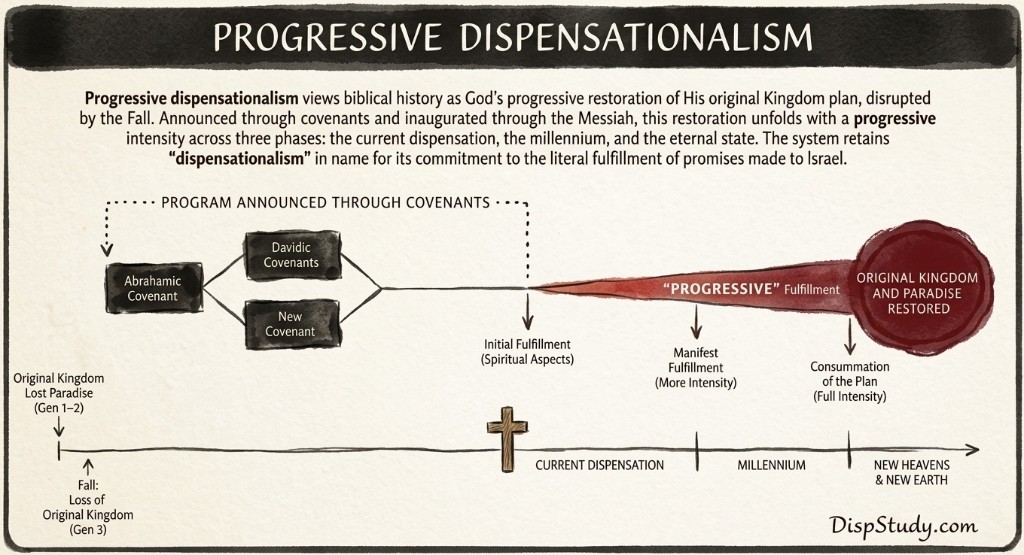
Progressive dispensationalism is a theological system that understands the biblical narrative as centered on an original plan (Kingdom/Paradise), which was good but was disrupted by the Fall. Subsequent history is understood as a process or program of restoring that Kingdom, or original plan, through holistic redemption. First, this program is announced and ratified through covenants — the announcement period. Then, with the coming and death of the Messiah, the announced program is set into motion, with its fulfillment unfolding progressively in three distinct phases: the current dispensation, the millennium, and the eternal state. In each phase, fulfillment progresses in intensity — hence the term "progressive" used to describe the system. The term "dispensationalism" is used because the system upholds the literal fulfillment of the direct promises made to Israel.
By "original kingdom plan," I refer to creation itself in its original state, before the Fall — that original creation in which there was harmony between man and God and between man and nature, and which God looked upon and said was very good (Genesis 1:31). This original plan is recorded in Genesis 1-2, the first two chapters of the Bible, and reclaimed again in Revelation 21-22, the last two chapters of the Bible. Between these two moments lies the plan of redemption. Redemption implies something that was lost, something corrupted, and therefore something in need of being redeemed. In Revelation 21-22, redemption is complete and Paradise is restored — the Kingdom fully implemented, now not only very good, but also perfect, without the possibility of ever being corrupted again.
Why the Term "Progressive"?
The term "progressive," however, carries a more specific significance, particularly in relation to the present dispensation. Many dispensationalists understand the present dispensation as an interval, an intercalation, or a parenthesis in God's plan. In this framework, the church has little or no relationship to the Old Testament plan promised through the covenants. The church has a separate plan, parallel to the Old Testament covenantal plan. Progressive dispensationalism arises precisely from seeing the present era not as an intercalation or interval, but as a progression of God's covenantal plan. Therefore, the church, united to Christ, is seen as participating in the "covenants of promise" (Eph. 2:12), as heir and co-heir of the promise (Eph. 3:6) — that is, not as belonging to a separate plan alongside the Old Testament covenantal program, but as being integrated into that very plan through union with the Messiah.
Paul's metaphor in Romans 11 makes the same point from another angle. To be grafted into the olive tree, whose root is Abraham or the Abrahamic covenant, is not to be placed into a second tree, a parallel people, or an unrelated redemptive program. It is to be inserted into the already existing covenantal plan that comes from the Old Testament itself, and therefore to partake of the sap, nourishment, and blessings that flow from that Abrahamic root. In this sense, the ingathering of Gentiles into Christ does not signal a suspension of the covenantal plan, but a progression within it. Therefore, the present era should be seen, in a real sense, as an initial fulfillment and expansion of that Old Testament covenantal plan rather than as an intercalation external to it.
Generally speaking, the apostles never treat what happens in the present era as totally disconnected from the Old Testament. Of course, there has been some discontinuation, but not a total discontinuation. They consistently cite the OT to explain what is taking place — which would be strange if the current era were an intercalation unrelated to that program. In Acts 2:16–21, Peter at Pentecost quotes Joel 2 and says "this is what was spoken by the prophet Joel," directly connecting the present event to the OT prophetic program — meaning that somehow the church itself is born within the context of Old Testament fulfillment. In Hebrews 8, the author quotes Jeremiah 31 (the new covenant) and applies it to the present era, demonstrating continuity within the covenantal plan. In Galatians 3:14, 29, Paul states explicitly that in Christ the Gentiles receive "the blessing of Abraham" and are "Abraham's offspring, heirs according to the promise" (Gen. 12:3).
Therefore, the testimony of the New Testament is not that the church replaces Israel in God's plan, nor that the church receives a separate, parallel plan disconnected from Israel's — one earthly and the other heavenly, as many traditional dispensationalists have taught. Rather, the movement the NT presents is precisely this: Gentiles in the church being integrated into the same covenantal plan of the Old Testament. It is as simple as that — and that is Progressive Dispensationalism.
I believe Vlach has indeed captured the essence of Progressive Dispensationalism. After affirming that PD holds to the core beliefs of dispensationalism, he then describes the real emphasis of PD in two points:
Progressive dispensationalism holds to the core beliefs of dispensationalism as found in the lists of Ryrie and Feinberg above. But there are certain noteworthy emphases. First, PD traces God's workings in history mostly from the unfolding of the biblical covenants in history, and less on the traditional seven dispensations. Many progressive dispensationalists believe in the traditional dispensations of dispensationalism but choose to focus more on the biblical covenants and the implications of Jesus's two comings for tracking God's workings in history.
Second, PD believes the church of this age experiences partial and realized fulfillments of the Abrahamic, Davidic, and New covenants. These covenants were made with Israel and will be fulfilled in all their dimensions with Israel, but since these covenants were also intended to bless Gentiles someday (see Gen 12:3; 2 Sam 7:19; Isa 52:15), it is accurate to see the church as experiencing spiritual blessings of the covenants of promise. Thus, PD uses the word "fulfill" for what God is doing with the church regarding the covenants. This fulfillment involves the arrival of Jesus and spiritual blessings associated with the covenants. Yet the fulfillment of physical and national promises, including those related to national Israel, awaits Jesus's return. (Michael J. Vlach, "Progressive Dispensationalism" in JBTS Vol. 9)
A Proposed Chart for Progressive Dispensationalism
Now that I have proposed my definition of the system, I would also like to suggest a chart for it. It is worth acknowledging upfront that Traditional Dispensationalism, when it comes to charts, is vastly superior to Progressive Dispensationalism. This is one of the areas where PD clearly needs to improve.
FreeRequest: Matthew 24:4–31 — Chronology in Dispensationalism
The chronological view of more than 60 dispensational authors on Matthew 24 — request it by email below.
Enter your email and we will send the PDF as an attachment. See our privacy policy.
Frequently Asked Questions
What is the true essence of progressive dispensationalism?
Why is it called progressive dispensationalism?
How does progressive dispensationalism view the church in relation to the Old Testament covenantal plan?
Author
Leonardo A. Costa
A researcher and writer exploring dispensationalism from a progressive perspective, with a deep appreciation for the tradition's heritage.
Related Articles
Traditional Dispensationalism and Replacement Theology: An Unexpected Convergence
Traditional dispensationalism and replacement theology travel by different routes but arrive at the same practical destination — dispossessing Israel of her.
The Canonical Reading Layer: A Hermeneutical Double Standard in Traditional Dispensationalism
The thousand-year millennium is not in the Old Testament — it comes from Revelation 20. Traditional Dispensationalism reads it back into Isaiah, Ezekiel.
The Church Is Not Another Ethnic or Anthropological Category in Progressive Dispensationalism
The Church is not a third anthropological category beside Israel and the Gentiles — it is a trans-ethnic, soteriological reality in Christ.
Who Are the Main Authors of Progressive Dispensationalism?
A guide to the main authors of Progressive Dispensationalism, including its primary architects, secondary contributors, and scholars broadly sympathetic.