1. Dispensationalist View (Futurist)
Key Proponents: Sir Robert Anderson, Harold Hoehner, John Walvoord, J. Dwight Pentecost, Charles Ryrie, C.I. Scofield, Hal Lindsey, Tim LaHaye, David Jeremiah, Thomas Ice, Amir Tsarfati, Leon Wood, Alva J. McClain, S.R. Miller, Paul Feinberg, C.L. Feinberg, James A. Borland, J. Paul Tanner
Hermeneutical Principle: Literal interpretation. Uses a "prophetic year" of 360 days (based on a 12-month lunar calendar of 30 days each, cf. Rev 11:2–3; 12:6, 14; 13:5). Maintains a strict distinction between Israel and the Church.
Starting Decree: The decree of Artaxerxes I to Nehemiah to rebuild the walls of Jerusalem (Neh 2:1–8).
Within the dispensationalist framework, two main chronological calculations have been proposed, differing in their starting date and terminus. Both use the 360-day prophetic year and arrive at a precise day-level fulfillment, but they reach different conclusions about which specific year and event mark the end of the 69th week.
Anderson's Sub-Variant (445 BC → AD 32)
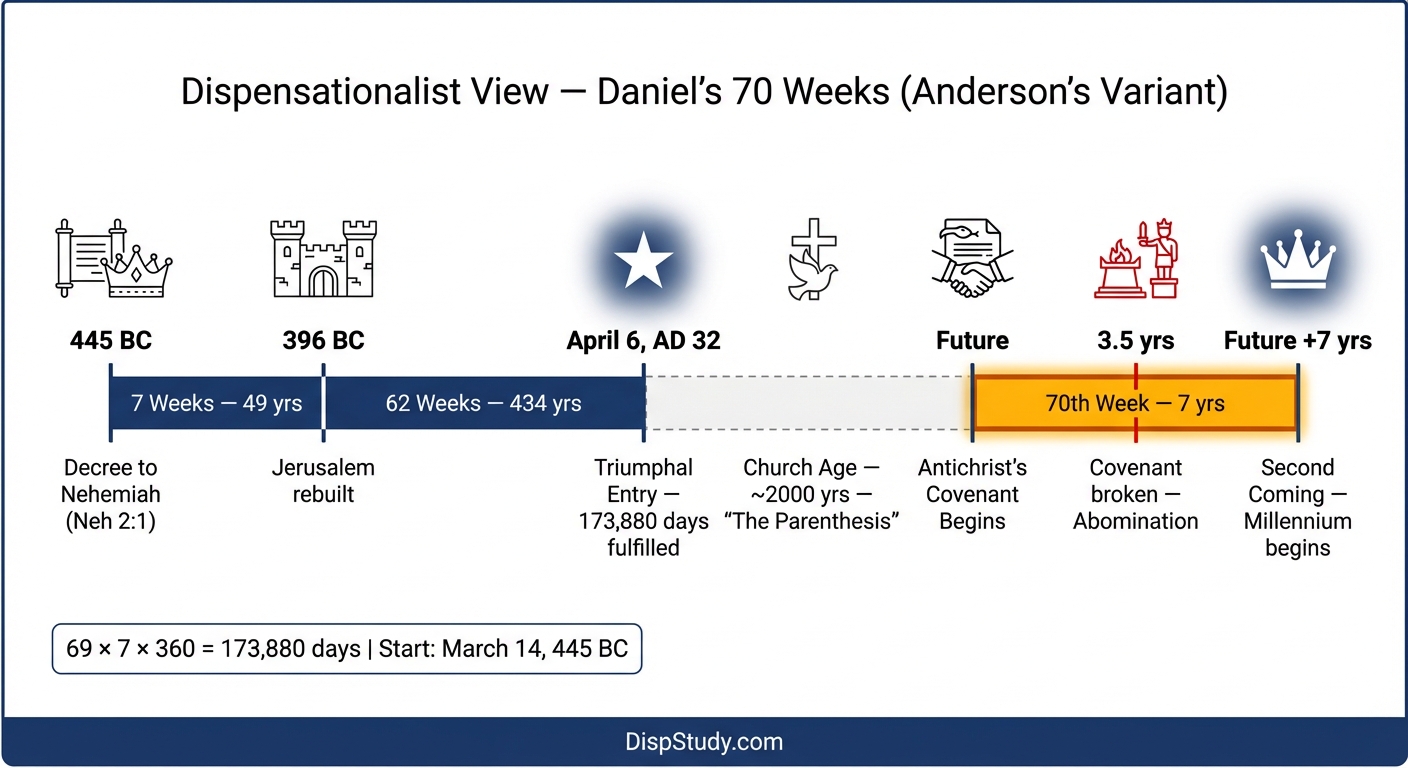
Sir Robert Anderson, in his landmark 1895 work The Coming Prince, proposed that the decree was issued on Nisan 1 (March 14), 445 BC. Using the 360-day prophetic year, he calculated 173,880 days from that date to April 6, AD 32 — the day of Jesus' Triumphal Entry into Jerusalem (Palm Sunday).
69 weeks × 7 = 483 prophetic years
483 × 360 days = 173,880 days
From March 14, 445 BC → April 6, AD 32
(476 Julian years + 116 leap-year days + 24 adjustment days)
Hoehner's Sub-Variant (444 BC → AD 33)
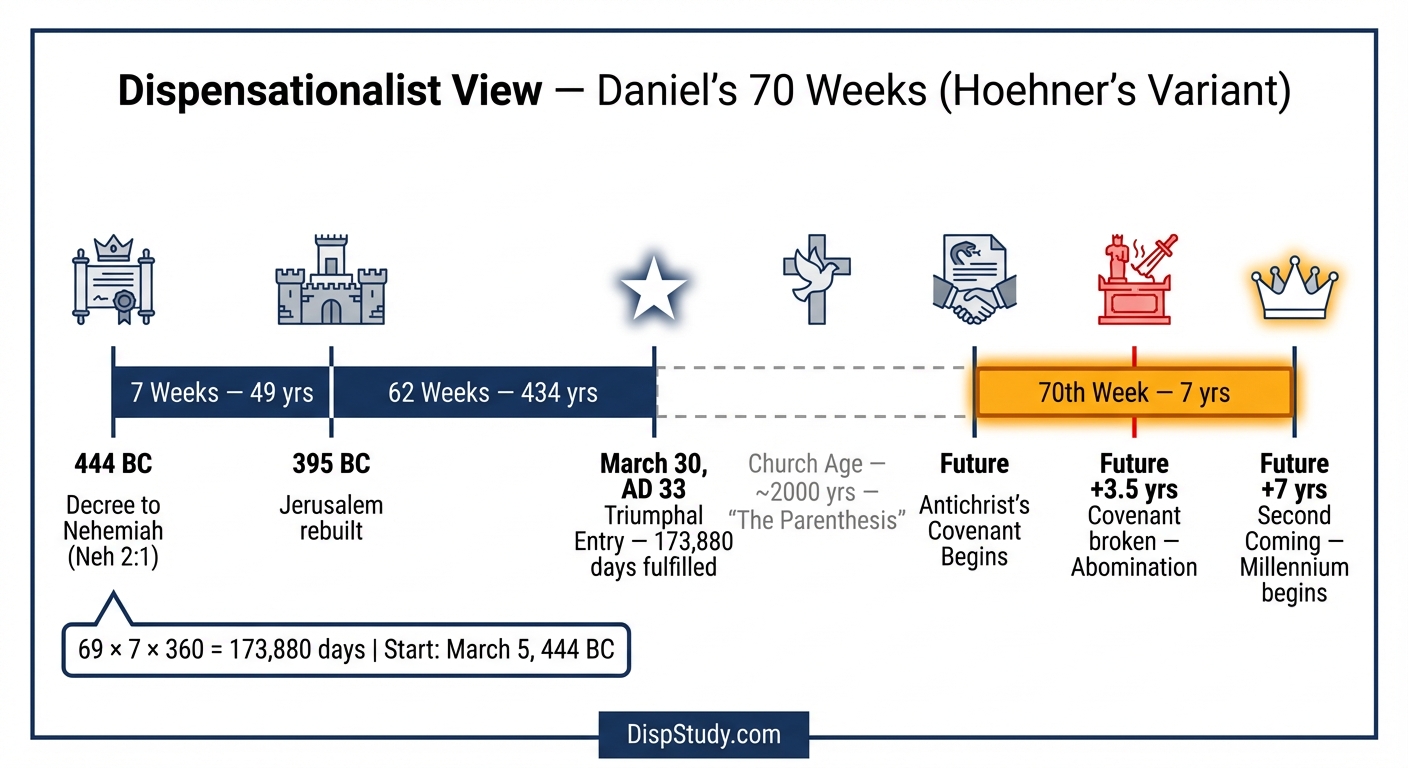
Harold Hoehner, in his 1978 study Chronological Aspects of the Life of Christ, refined Anderson's calculation. He dated the decree to Nisan 1 (March 5), 444 BC and arrived at March 30, AD 33 — the date of the Triumphal Entry according to Hoehner's chronology of Christ's life. Hoehner's revision corrected certain calendar issues in Anderson's original computation while preserving the same prophetic-year methodology.
Shared Chronological Structure
Chronological structure
- 7 weeks (49 years): 445/444–396/395 BC — Rebuilding of Jerusalem in troubled times (Ezra and Nehemiah)
- 62 weeks (434 years): 396/395 BC–AD 32/33 — Waiting period until the Messiah
- End of the 69th week: AD 32 or 33 — Jesus' Triumphal Entry into Jerusalem (Palm Sunday)
- Post-69th week events: The Messiah is "cut off" (the crucifixion); Jerusalem and the Temple destroyed in AD 70 by the Romans
- THE GAP (Parenthesis): The Church Age — an unspecified interval (~2,000 years to the present). The Church is a "mystery" not foreseen in the Old Testament
- 70th week: FUTURE — 7 years of Great Tribulation
- Beginning: The Antichrist makes a peace covenant with Israel; the Temple is rebuilt; sacrifices are restored
- Midpoint (+3.5 years): The Antichrist breaks the covenant, desecrates the Temple (the Abomination of Desolation)
- End (+7 years): The Second Coming of Christ; destruction of the Antichrist; beginning of the literal 1,000-year Millennium
| Element | Interpretation |
|---|---|
| "Anointed one" cut off (v.26) | Jesus Christ, rejected by Israel. |
| "He" of 9:27 | The future Antichrist — makes a covenant with Israel and then breaks it. |
| "Prince who is to come" (v.26b) | The Antichrist (or Titus as a type/precursor). |
| Continuity of the 70 weeks | The 70 weeks are not continuous; there is a genuine gap between the 69th and 70th weeks. |
| Six purposes of Dan 9:24 | All will be fulfilled in the future — during the Tribulation and the Millennium. |
2. Jehovah's Witnesses' View
Key Proponents: The Watchtower Bible and Tract Society.
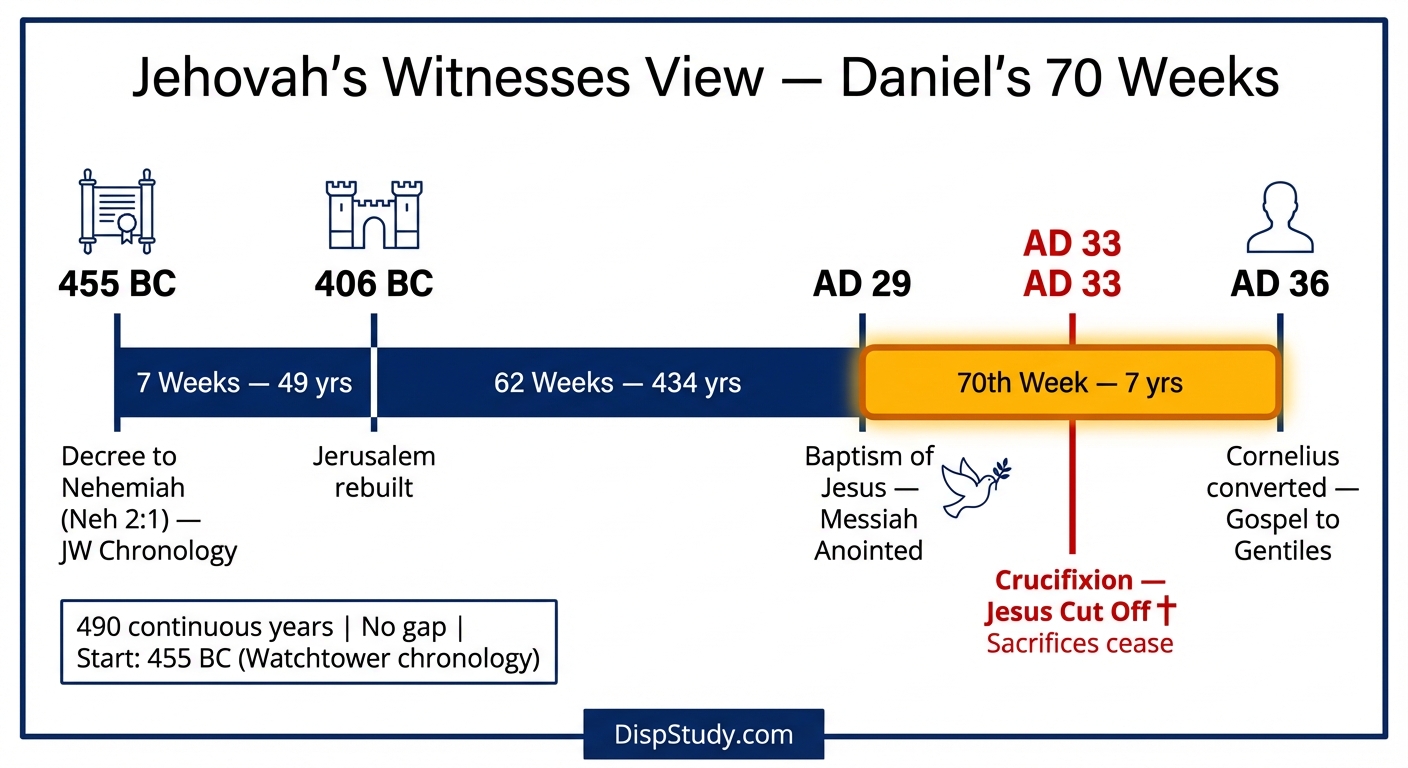
Hermeneutical Principle: Literal interpretation of 490 years using standard solar years. The Society employs its own chronology for the reign of Artaxerxes (placing his first year at 474 BC, unlike most historians who date it to 465 BC).
Starting Decree: The decree of Artaxerxes I to Nehemiah (Neh 2:1–8), dated to 455 BC (based on the Watchtower's internal chronology).
Chronological structure
- 7 weeks (49 years): 455–406 BC — Rebuilding of Jerusalem
- 62 weeks (434 years): 406 BC–AD 29 — Period leading up to the Messiah
- End of the 69th week: AD 29 — Baptism of Jesus (anointed as Messiah by the Holy Spirit)
- 70th week (7 years): AD 29–36
- Middle of the week (AD 33): The crucifixion of Jesus — he is "cut off"; sacrifices and offerings cease
- End of the week (AD 36): Conversion of Cornelius — the gospel extends to the Gentiles; Israel's exclusive favor comes to an end
| Element | Interpretation |
|---|---|
| "Anointed one" cut off (v.26) | Jesus Christ. |
| "He" of 9:27 | Jesus Christ, confirming the covenant with Israel during the 70th week. |
| Gap between 69th and 70th weeks | No gap — the 70 weeks are continuous (490 uninterrupted years). |
| Critical note on dating | The date of 455 BC is rejected by the overwhelming majority of secular historians. Astronomical evidence (the cuneiform tablet VAT 5047, dated to the 11th year of Artaxerxes = 454 BC) confirms that the 20th year of Artaxerxes fell in 445/444 BC, not 455 BC. The Watchtower adjusts Persian chronology to fit its prophetic scheme. |
3. Seventh-day Adventist View (SDA / Historicist)
Key Proponents: William Miller, Ellen White, Siegfried Horn, William Shea, Gerhard Pfandl, Ángel Manuel Rodríguez, official Adventist theology.
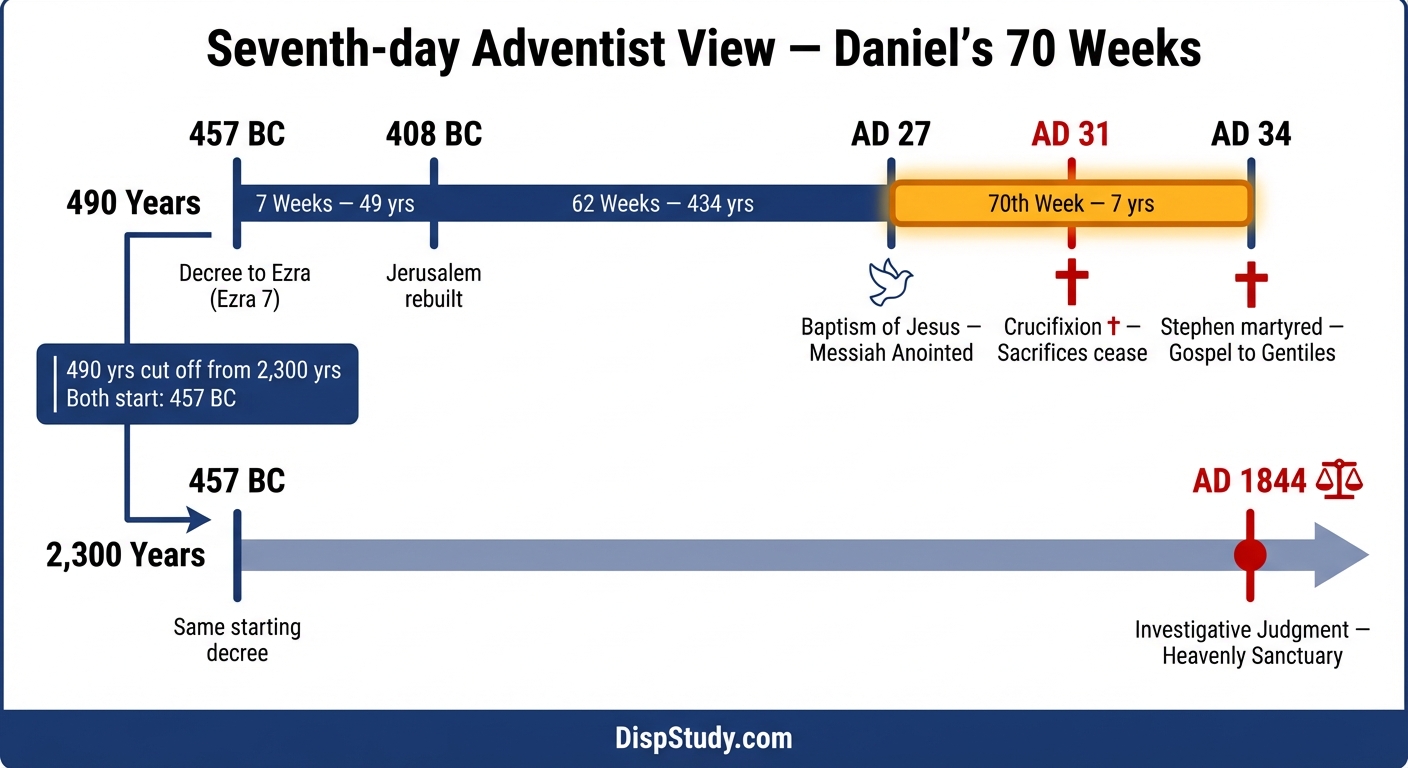
Hermeneutical Principle: Historicism. The day-year principle (Num 14:34; Ezek 4:6). The 70 weeks are "cut off" (chatak) from the larger prophecy of 2,300 days/years in Dan 8:14.
Starting Decree: The decree of Artaxerxes I to Ezra (Ezra 7:12–26), in 457 BC — the third and most comprehensive decree, which included the restoration of Jewish autonomy, the legal system, and the temple worship.
Chronological structure
- 7 weeks (49 years): 457–408 BC — Rebuilding of Jerusalem in troubled times (Ezra and Nehemiah)
- 62 weeks (434 years): 408 BC–AD 27 — Period leading up to the Messiah
- End of the 69th week: Autumn AD 27 — Baptism of Jesus (anointed by the Holy Spirit; start of his public ministry)
- 70th week (7 years): AD 27–34
- Middle of the week (Spring AD 31): The crucifixion of Jesus — the Temple veil is torn; sacrifices and offerings cease in their theological sense
- End of the week (Autumn AD 34): The martyrdom of Stephen; Paul's conversion; the gospel goes to the Gentiles
| Element | Interpretation |
|---|---|
| "Anointed one" cut off (v.26) | Jesus Christ. |
| "He" of 9:27 | Jesus Christ, confirming the New Covenant. |
| Gap between 69th and 70th weeks | No gap — the 70 weeks are continuous. |
| Connection to Dan 8:14 | The 70 weeks (490 years) are "cut off" from the 2,300 years, both beginning in 457 BC. The 2,300 years end in AD 1844 (the beginning of the Investigative Judgment in the heavenly sanctuary — a central doctrine of Adventism). |
| Historical evidence cited for 457 BC | Ptolemy's Canon, Babylonian tablets, Elephantine papyri, and the Jewish autumn-to-autumn (Tishri) calendar. |
Common Criticisms: Ezra's decree (Ezra 7) does not explicitly mention the rebuilding of the city; the connection to Daniel 8:14 and the year 1844 is contested by virtually every other interpretive tradition; no New Testament writer mentions a fulfillment of a 490-year period.
4. Historical-Messianic / Classical Historicist View (Continuous)
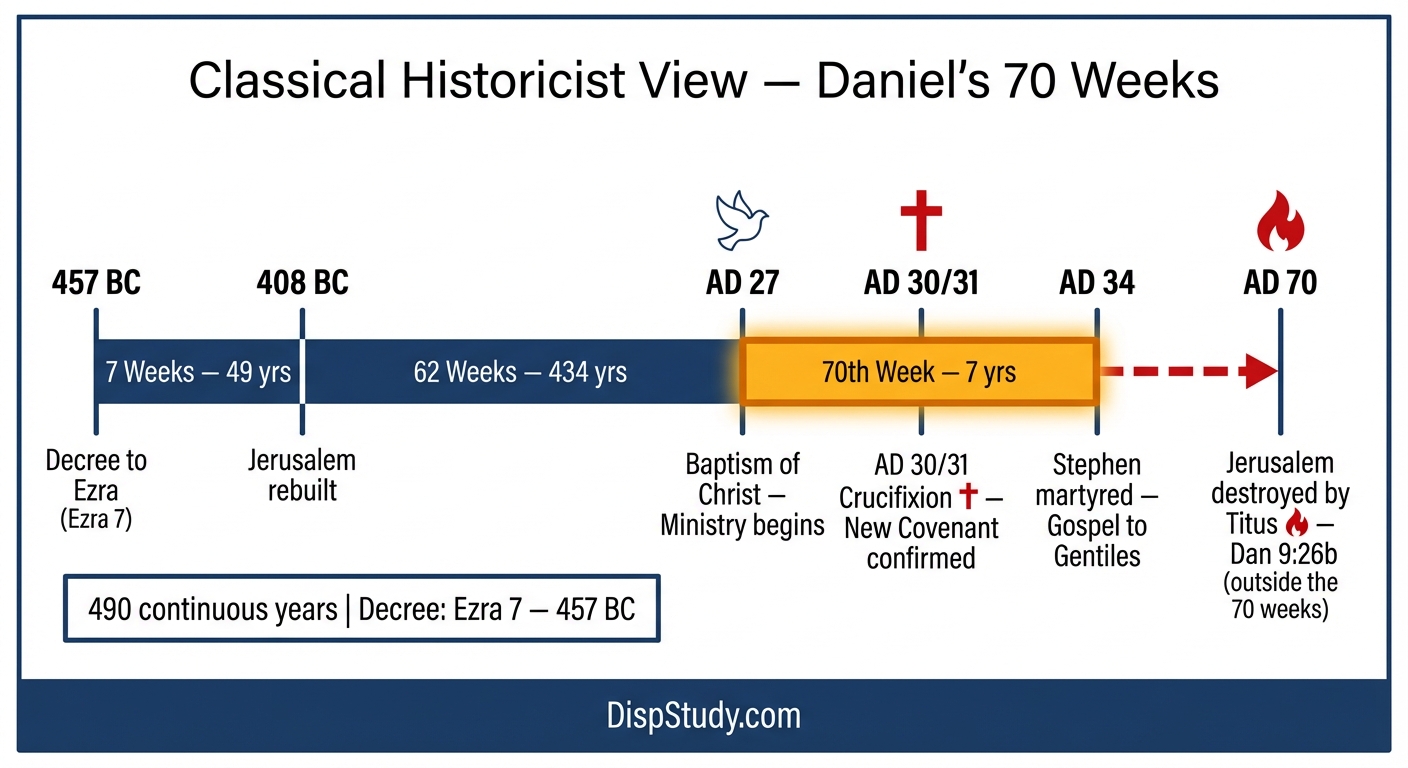
Key Proponents: Jerome, Martin Luther, John Calvin, William Tyndale, Matthew Henry, E.J. Young, J. Barton Payne, E.B. Pusey, E.W. Hengstenberg, Adam Clarke, Philip Mauro, Charles Boutflower, Dean Prideaux, R.J.M. Gurney, G. Hasel, P.J. Gentry, J.T. Parry, various Puritan commentators, Isaac Newton (in part).
Hermeneutical Principle: Literal interpretation of years, but without requiring day-for-day precision. A Christocentric, covenantal approach. No rigid distinction between Israel and the Church. Christ fulfills the promises made to Israel.
Starting Decree: The decree of Artaxerxes I to Ezra (Ezra 7:11–26), in 458/457 BC. A minor variant uses Cyrus's decree of 538/536 BC.
Chronological structure
- 7 weeks (49 years): 457–408 BC — Rebuilding of Jerusalem in troubled times (the ministries of Ezra and Nehemiah)
- 62 weeks (434 years): 408 BC–AD 27 — The intertestamental period, leading up to the Messiah
- End of the 69th week: ~AD 27 — Baptism of Jesus / beginning of his public ministry
- 70th week (7 years): ~AD 27–34
- Middle of the week (~AD 30/31): The crucifixion — the Messiah is "cut off"; he confirms the New Covenant; sacrifices cease in their theological sense
- End of the week (~AD 34): The gospel spreads to the Gentiles (martyrdom of Stephen, the dispersion, Paul's conversion)
- Subsequent event: AD 70 — Destruction of Jerusalem by Titus (fulfillment of Dan 9:26b, but outside the 70 weeks)
| Element | Interpretation |
|---|---|
| "Anointed one" cut off (v.26) | Jesus Christ. |
| "He" of 9:27 | Jesus Christ — confirming the New Covenant through his ministry and through his apostles. |
| Relationship of vv. 26 and 27 | Often understood as parallel passages (both describing events of the final week, rather than a strict chronological sequence). |
| Gap between 69th and 70th weeks | No gap — the 70 weeks are continuous; the dispensational gap theory is rejected. |
| Six purposes of Dan 9:24 | Fulfilled in Christ at his first coming — atonement for iniquity, the bringing in of everlasting righteousness, etc. Applied to the Church as the fulfillment of Old Testament promises. |
Note: This view is very close to the Preterist view (#6) in its chronology of the 70 weeks. The main difference is eschatological: classical historicists may retain future elements (the Second Coming, the final judgment) as not yet fulfilled, while preterists tend to see more prophecies as already accomplished.
Common Criticisms: Difficulty demonstrating that all six purposes of Dan 9:24 were fully accomplished; Ezra's decree does not explicitly mention rebuilding the city; some date variants do not align precisely.
5. Allegorical / Amillennial / Covenantal View (Symbolic)
Key Proponents: Augustine (in part), Meredith Kline, Kim Riddlebarger, Sam Storms, Lee Irons, H.C. Leupold, C.F. Keil, covenant theologians, some Reformed postmillennialists.
Hermeneutical Principle: The number seven symbolizes completeness or perfection. The 490 years are not a literal chronology but a theological framework. The covenantal character of Daniel 9 is central (it is the only chapter in Daniel to use the name "Yahweh"). The "seventy sevens" evoke the Sabbath (Lev 25), the Jubilee, and the Exile (2 Chr 36:21). Jesus employs the same formula in Matt 18:22 ("seventy times seven").
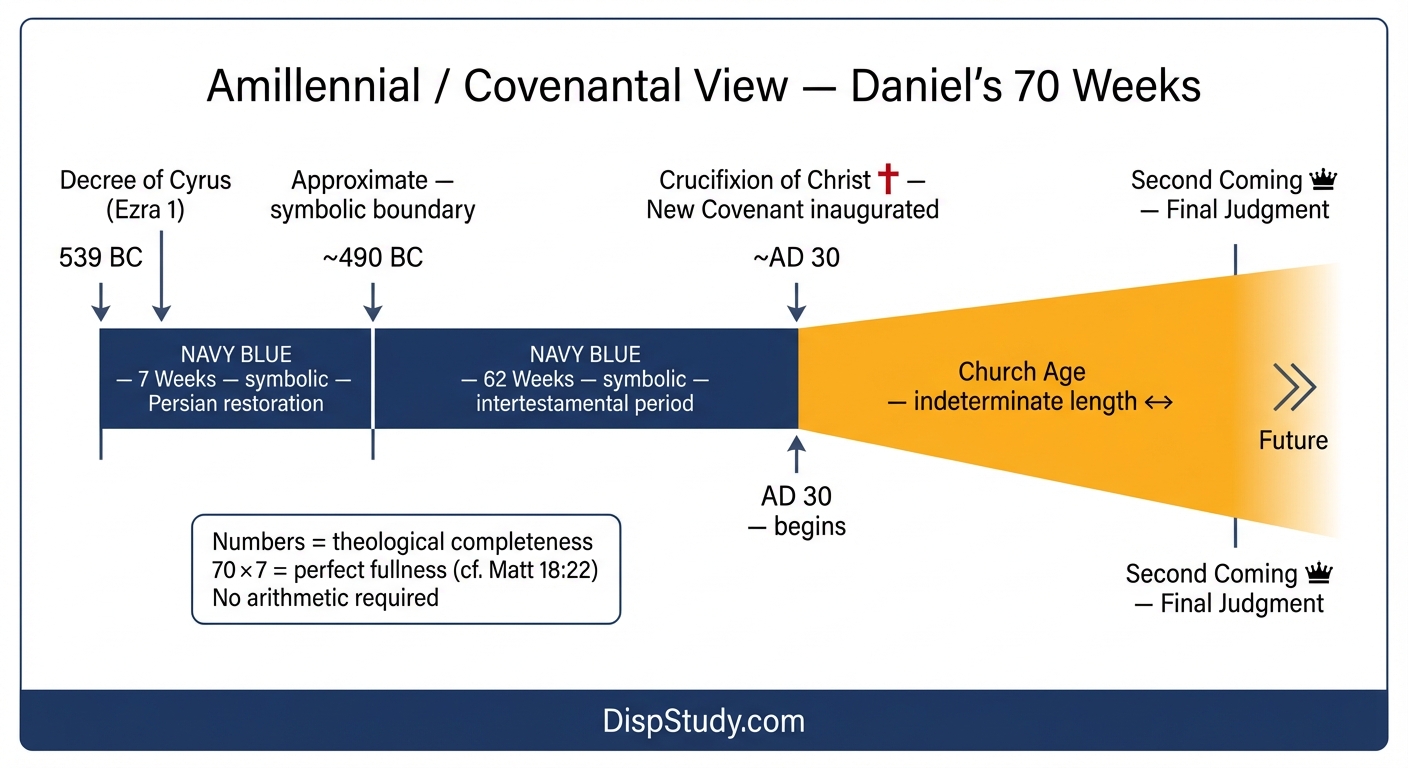
Starting Decree: Cyrus's decree of 539/538 BC, or the divine "word" that went forth when Daniel prayed (Dan 9:23). Some accept Artaxerxes's decree (458/457 BC) but do not insist on arithmetic precision.
Chronological structure
- 7 weeks: Symbolic period — the rebuilding of Jerusalem under the Persians
- 62 weeks: Symbolic period — leading up to the coming of Christ
- End of the 69th week: The ministry and/or death of Christ (~AD 30)
- 70th week: An indeterminate period
- First half: Christ's earthly ministry, culminating in the crucifixion
- Second half: The Church Age (the present era, of undefined length)
- End: The Second Coming of Christ and the Final Judgment
Internal sub-variants
- Historical variant (Young, Leupold, Keil): Attempts to date the starting point historically and maintain some degree of chronological correspondence, but with flexibility in the numbers
- Symbolic variant (Kline, Riddlebarger, Storms): The 490 years are entirely theological — they point toward the "final Jubilee," the eternal Sabbath, and the complete redemption accomplished in Christ
| Element | Interpretation |
|---|---|
| "Anointed one" cut off (v.26) | Jesus Christ. |
| "He" of 9:27 | Jesus Christ, establishing the New Covenant. |
| Gap (dispensational sense) | No gap in the dispensationalist sense, though the 70th week may encompass the entire Church Age until the Parousia. |
| Six purposes of Dan 9:24 | Fulfilled in Christ — inaugurated at the first coming, consummated at the second. |
Common Criticisms: Accused of vagueness; if the numbers are symbolic, the prophecy loses its predictive force; it can appear to be a way of sidestepping chronological difficulties; Gabriel seems to communicate specific numbers that call for specific interpretation.
6. Preterist View (Partial)
Key Proponents: Gary DeMar, Kenneth Gentry, R.C. Sproul (partial preterism), Hank Hanegraaff, Philip Mauro (also classified under #4).
Hermeneutical Principle: All of Daniel's prophecies (and much of Revelation) were already fulfilled in first-century history. The "last things" refer to the end of the Old Covenant and the destruction of Jerusalem in AD 70, not to the end of the world. Partial preterists still affirm a future Second Coming.
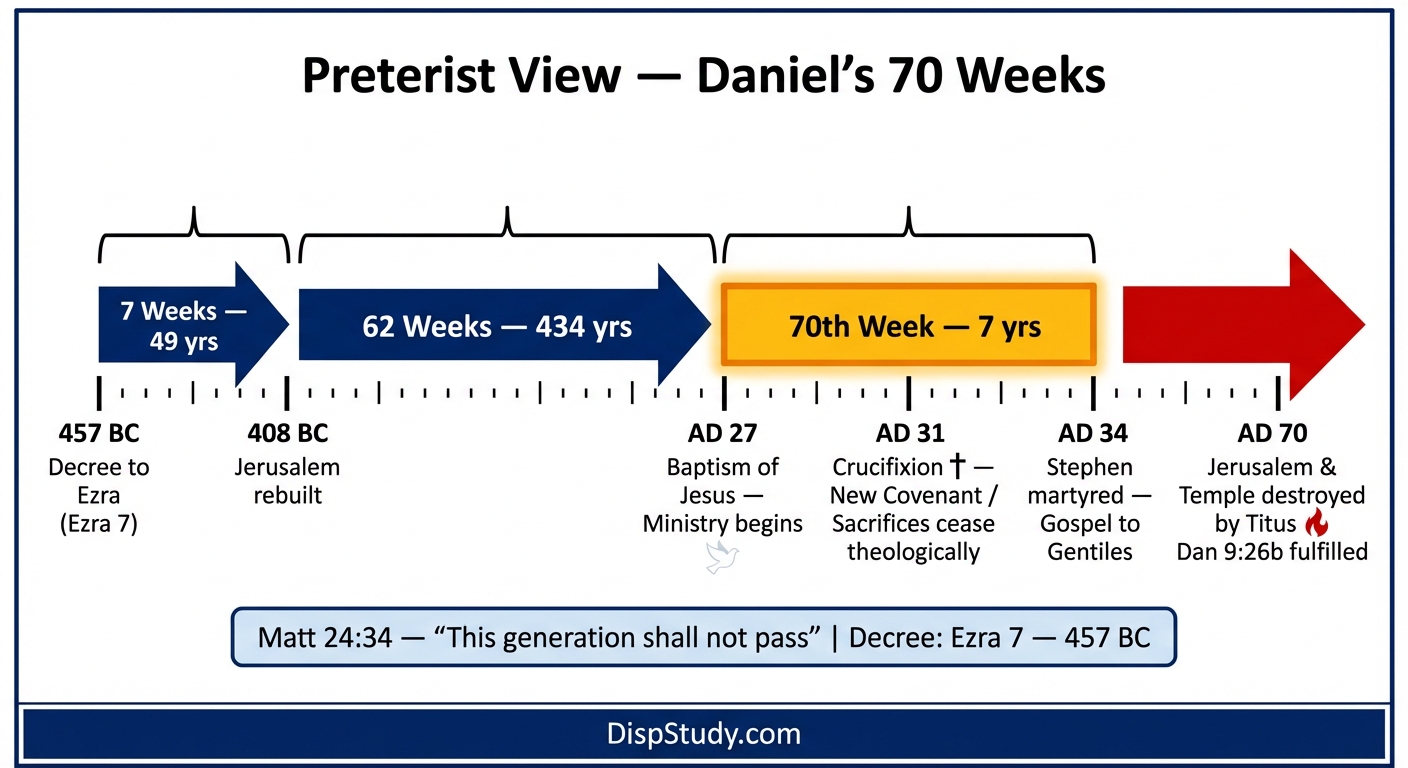
Starting Decree: The decree of Artaxerxes I to Ezra (Ezra 7), in 458/457 BC. Some use the decree to Nehemiah (445/444 BC).
Chronological structure
- 7 weeks (49 years): 457–408 BC — The ministries of Ezra and Nehemiah; the rebuilding of Jerusalem
- 62 weeks (434 years): 408 BC–AD 27 — The intertestamental period
- End of the 69th week: ~AD 27 — Baptism of Jesus
- 70th week (7 years): ~AD 27–34
- Middle of the week (~AD 30/31): The crucifixion — the Messiah is "cut off"; sacrifices and offerings cease; he confirms the New Covenant
- End of the week (~AD 34): The gospel goes to the Gentiles (martyrdom of Stephen)
- Subsequent event (v.26b): AD 70 — Destruction of Jerusalem and the Temple by the Roman general Titus ("the people of the prince who is to come")
| Element | Interpretation |
|---|---|
| "Anointed one" cut off (v.26) | Jesus Christ. |
| "He" of 9:27 — majority | Jesus Christ confirming the New Covenant during the 70th week. |
| "He" of 9:27 — minority | The "prince who is to come" (v.26b) is Titus/Vespasian; the Abomination of Desolation is the Roman destruction of AD 70. |
| Gap between 69th and 70th weeks | No gap — the 70 weeks are continuous and entirely fulfilled within the first century AD. |
| Six purposes of Dan 9:24 | Fulfilled at Christ's first coming. The Church is the fulfillment of Israel, not a "Plan B." |
| Difference from View #4 | The chronology of the 70 weeks is identical. The difference lies in the broader eschatological picture — preterists tend to see Matthew 24 and Revelation as predominantly fulfilled in AD 70. |
Common Criticisms: Not all six purposes of Dan 9:24 appear to have been fully accomplished by AD 34; some eschatological elements of the New Testament require allegorization; full preterists (who deny a future Second Coming) are considered heterodox by most Christian traditions.
7. Historical-Critical / Maccabean View
Key Proponents: J.A. Montgomery, John J. Collins, John Goldingay, P.M. Casey, Michael F. Bird, L. Hartman, A. Di Lella, contributors to the International Critical Commentary (ICC), the majority of modern historical-critical scholars. Historically followed by many Catholic exegetes (though it is not the official position of the Catholic Church).
Hermeneutical Principle: The book of Daniel was composed in the second century BC (c. 167–164 BC) as a theological response to the Maccabean crisis. The prophecy is vaticinium ex eventu (prophecy-after-the-fact). The numbers are approximate ("chronography"), not precise chronology.
Starting decree / reference point (two variants)
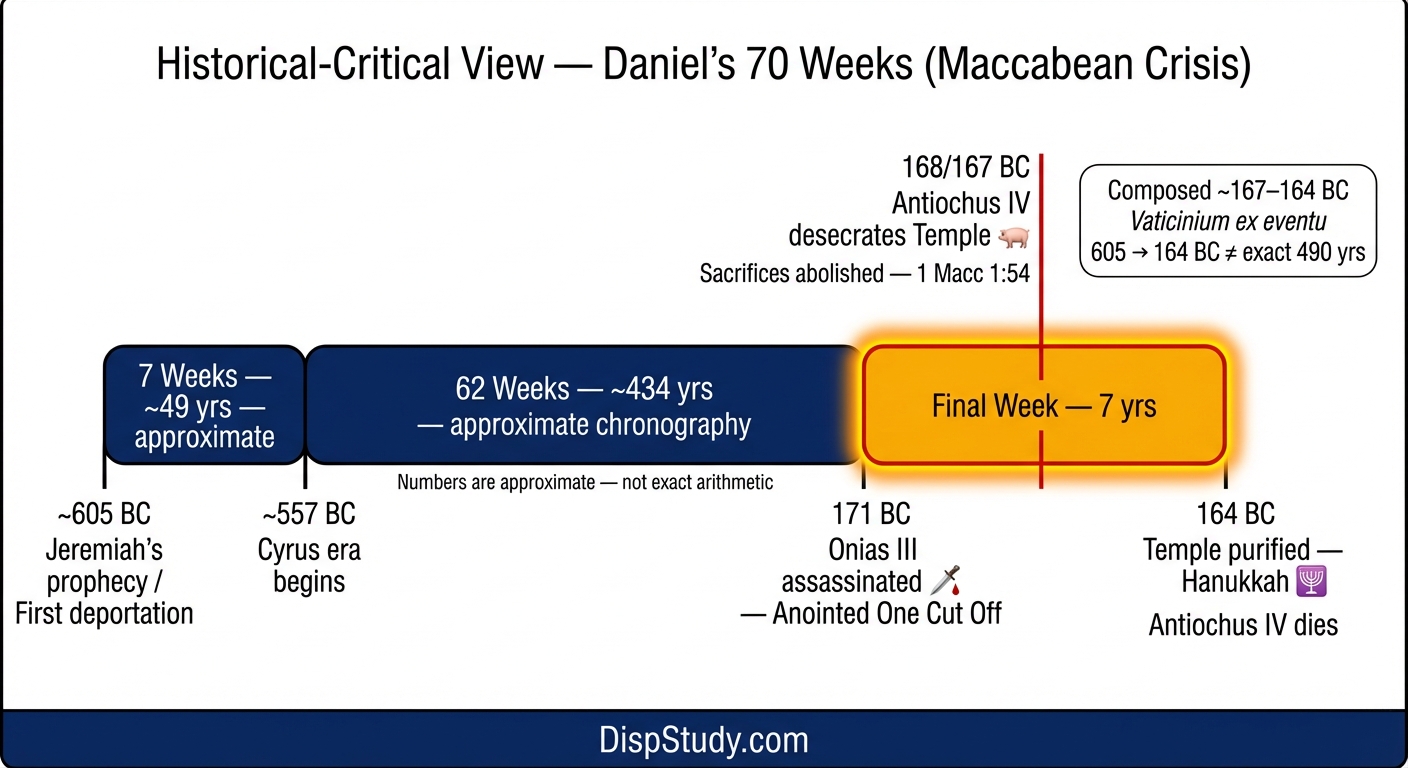
- Variant A: ~605/606 BC — Jeremiah's prophecy or the first Babylonian deportation
- Variant B: ~538/537 BC — The decree of Cyrus
Chronological structure (Variant A — most common)
- 7 weeks (49 years): ~605–557 BC — From the Exile to Cyrus
- 62 weeks (434 years): ~557–171 BC — The Persian and Hellenistic periods (the numbers do not add up precisely; they function as "chronography")
- "Anointed prince" (v.25): Cyrus the Persian (Isa 45:1), or Jeshua the post-exilic High Priest
- "Anointed one cut off" (v.26): Onias III, the legitimate High Priest, deposed c. 175 BC and assassinated c. 171/170 BC (2 Macc 4:30–38)
- Final week (7 years): ~171–164 BC (or 167–164 in Variant B)
- Middle of the week (168/167 BC): Antiochus IV Epiphanes desecrates the Temple; abolishes the daily sacrifice (1 Macc 1:45–54); erects an altar to Zeus Olympius; sacrifices pigs
- "Covenant with many": Antiochus allies himself with Hellenizing Jews (apostate Jews)
- End (164 BC): Purification of the Temple by Judas Maccabeus and the Maccabees (Hanukkah); death of Antiochus
Chronological structure (Variant B)
- 7 weeks (49 years): 538–489 BC
- 62 weeks (434 years): 489–171 BC (still does not add up to exactly 483 years)
- Remainder same as Variant A
| Element | Interpretation |
|---|---|
| "He" of 9:27 | Antiochus IV Epiphanes. |
| "Prince who is to come" (v.26b) | Antiochus IV Epiphanes. |
| Chronological problem (605 → 171 BC) | From 605 to 171 BC spans approximately 434 years, not 483. Scholars account for this as: an authorial calculation error (Montgomery), non-literal chronography (Goldingay), or round numbers (Collins). |
The Six Purposes of Dan 9:24:
| Purpose | Status |
|---|---|
| Finish the transgression | Partial (Maccabees) |
| Make an end of sin | Partial |
| Make atonement for iniquity | Limited |
| Bring in everlasting righteousness | Limited |
| Seal up vision and prophecy | Fulfilled |
| Anoint the Most Holy Place | Fulfilled (rededication of the Temple — Hanukkah) |
Common Criticisms: The dates do not sum to 490 years; denies the genuine authorship and predictive prophecy of Daniel; ignores the Messianic fulfillment in Christ; contradicts Jesus's own view of Daniel (Matt 24:15–16); this is expressly NOT the interpretation Jesus held.
8. Traditional Jewish (Rabbinic) View
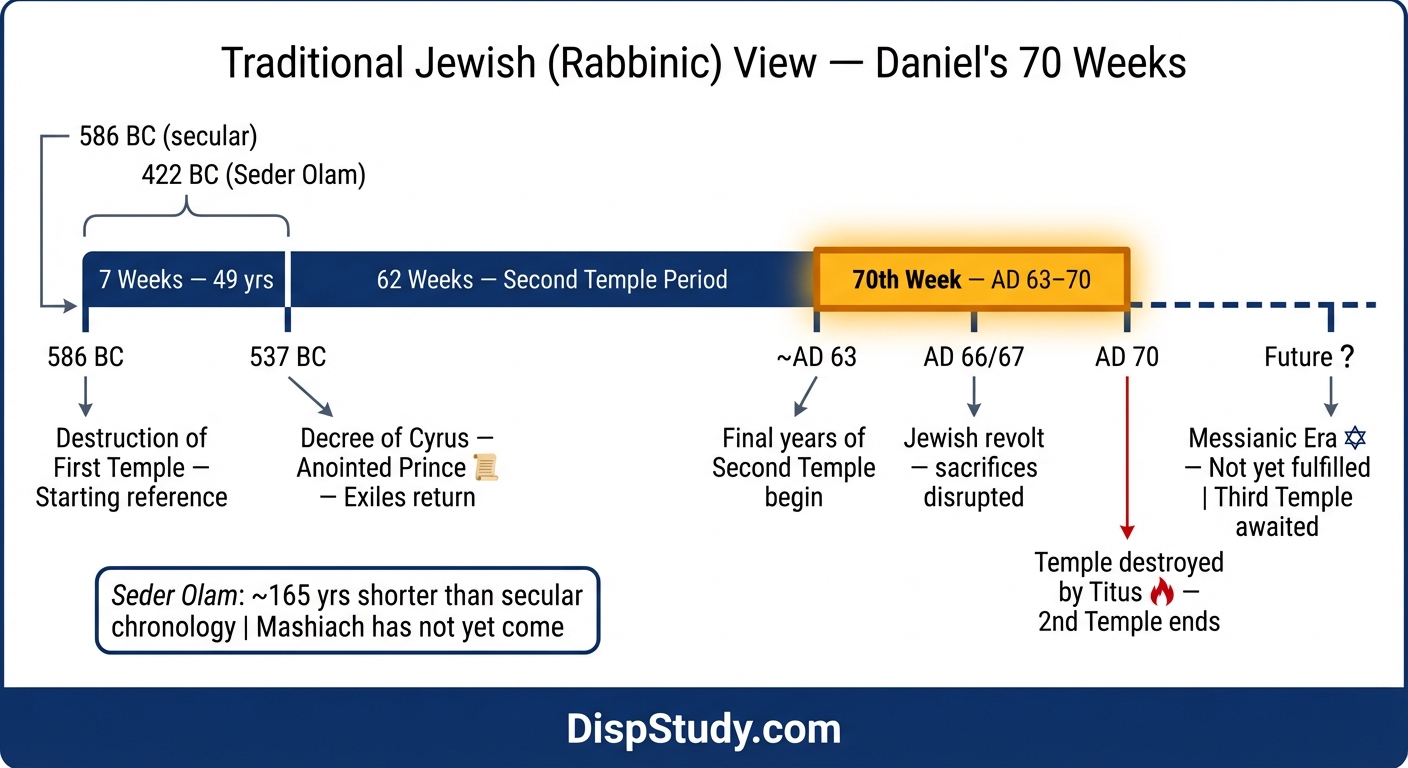
Key Proponents: Rashi (11th century), Ibn Ezra, Abarbanel (15th century), Malbim (19th century), Maimonides, Rabbi Tovia Singer, the Seder Olam Rabbah, Talmudic and Midrashic tradition, Orthodox Judaism.
Hermeneutical Principle: Interpretation within the Jewish tradition. The term mashiach ("anointed") does not refer to the Christian eschatological Messiah, but to any king or high priest anointed with oil. The 490 years cover the era of the two Temples. The Christological application to Jesus of Nazareth is entirely rejected.
Starting point — destruction of the First Temple
- 586 BC (secular chronology)
- 422 BC (the rabbinic chronology of the Seder Olam, which shortens the Persian period by ~165 years — the so-called "missing years")
Chronological structure
- 7 weeks (49 years): 586–537 BC — The Babylonian Exile until the return under Cyrus
- "Anointed prince" (v.25): Cyrus the Persian (Isa 45:1), who decreed the return of the Jews
- 62 weeks: ~537 BC–AD 70 — The period of the Second Temple
- Includes the ~18 years until the Temple's inauguration + the 420 years the Second Temple stood (according to the Talmud/Seder Olam)
- "In times of distress" — under the Persians, Greeks, and Romans
- "Anointed one cut off" (v.26): King Agrippa II (the last Herodian king), or the high priest at the time of the Temple's destruction, or the general concept of priesthood/kingship. NOT Jesus.
- 70th week: ~AD 63–70 — The final years of the Second Temple
- "He confirms a covenant": A king or priest of the era
- Middle of the week (~AD 66–67): The cessation of sacrifices (during the Jewish revolt)
- End (AD 70): Destruction of the Second Temple and Jerusalem by Titus/Vespasian
| Element | Interpretation |
|---|---|
| "Prince who is to come" (v.26b) | Titus or Vespasian. |
| "He" of 9:27 | A king or priest of the era — not the Messiah, not Jesus, not a future Antichrist. |
The Six Purposes of Dan 9:24 — NOT yet fulfilled:
| Purpose | Status in the Jewish View |
|---|---|
| Finish the transgression | Unfulfilled — Israel still sins |
| Make an end of sin | Unfulfilled |
| Make atonement for iniquity | Unfulfilled — awaiting the Messiah |
| Bring in everlasting righteousness | Unfulfilled |
| Seal up vision and prophecy | Partially fulfilled |
| Anoint the Most Holy Place | Unfulfilled — awaiting the Third Temple |
Note: After the 490 years had run their course, the Messianic era could have begun, but the sins of the Second Temple period delayed the final redemption.
Chronological Problem: The Seder Olam assigns only 420 years to the Second Temple, whereas modern historians calculate approximately 586 years (516 BC–AD 70). There is a discrepancy of ~165 years.
Common Criticisms (from a Christian perspective): The Seder Olam chronology is artificially compressed; identifying the "anointed one" with minor figures fails to satisfy the six lofty purposes of Dan 9:24; ignores the remarkable chronological fulfillment in the life of Jesus.
Summary Comparison Table
| View | Start | Decree/Event | End of 69th Week | 70th Week | "He" of 9:27 | Anointed One Cut Off | End | Gap? |
|---|---|---|---|---|---|---|---|---|
| Dispensationalist | 445/444 BC | Nehemiah (Neh 2) | AD 32/33 (Triumphal Entry) | Future (Tribulation) | Antichrist | Christ | Second Coming | YES |
| Jehovah's Witnesses | 455 BC | Nehemiah (Neh 2) | AD 29 (Baptism) | AD 29–36 | Christ | Christ (AD 33) | AD 36 (Cornelius) | NO |
| Adventist (SDA) | 457 BC | Ezra (Ezra 7) | AD 27 (Baptism) | AD 27–34 | Christ | Christ (AD 31) | AD 34 (Stephen) | NO |
| Historical-Messianic | 457 BC | Ezra (Ezra 7) | ~AD 27 (Baptism) | ~AD 27–34 | Christ | Christ (~AD 31) | ~AD 34 + AD 70 | NO |
| Allegorical/Amillennial | 539/538 BC | Cyrus (Ezra 1) | ~AD 30 (Christ) | Church Age | Christ | Christ | Second Coming | NO* |
| Preterist | 457 BC | Ezra (Ezra 7) | ~AD 27 (Baptism) | ~AD 27–34 | Christ/Titus | Christ (~AD 31) | ~AD 34 + AD 70 | NO |
| Historical-Critical | 606/538 BC | Jeremiah/Cyrus | ~171 BC (Onias III) | 171–164 BC | Antiochus IV | Onias III | 164 BC (Hanukkah) | NO |
| Traditional Jewish | 586/422 BC | Destruction of 1st Temple | Varies | ~AD 63–70 | King/Priest | Agrippa II/Priest | AD 70 | NO |
(* The 70th week is symbolic and extends to the Second Coming, but this is not a "gap" in the dispensationalist sense.)
Candidate Decrees for the Starting Point of the Prophecy
| Decree | Date | Reference | Content | Used By |
|---|---|---|---|---|
| Destruction of the First Temple | 586 BC | 2 Kgs 25 | Destruction by Nebuchadnezzar | Jewish view, Critical (variant) |
| Decree of Cyrus | 538 BC | Ezra 1:1–4; Isa 45:1 | Rebuild the Temple; return of the exiles | Allegorical/Amillennial, Critical (Variant B) |
| Decree of Darius I | ~520 BC | Ezra 6:1–12 | Reaffirms Cyrus's decree (Temple) | Rarely used |
| Decree of Artaxerxes to Ezra | 458/457 BC | Ezra 7:12–26 | Restore governance, law, worship, and autonomy | SDA, Historical-Messianic, Preterist |
| Decree of Artaxerxes to Nehemiah | 445/444 BC | Neh 2:1–8 | Rebuild the city walls | Dispensationalist |
| Same decree (JW chronology) | 455 BC | Neh 2:1–8 | Same (chronology adjusted by the Watchtower) | Jehovah's Witnesses |
The Identity of "He" in Daniel 9:27
| View | "He" = | Action |
|---|---|---|
| Dispensationalist | Antichrist (future) | Makes a covenant with Israel → breaks it → desecrates the Temple |
| Jehovah's Witnesses | Christ | Confirms the covenant with Israel during the 70th week |
| Adventist | Christ | Confirms the New Covenant; offers himself as the sacrifice |
| Historical-Messianic | Christ | Confirms the New Covenant (Last Supper, the Cross) |
| Allegorical/Amillennial | Christ | Establishes the New Covenant |
| Preterist | Christ (majority) / Titus (minority) | Confirms the New Covenant / Destroys Jerusalem |
| Historical-Critical | Antiochus IV | Forms a covenant with Hellenizing Jews → desecrates the Temple |
| Traditional Jewish | King/Priest of the era | A contextual anointed figure, not eschatological |
The "Covenant with Many" in Daniel 9:27
| View | "Covenant with many" = |
|---|---|
| Dispensationalist | A future political covenant made by the Antichrist at the start of the 70th week, understood by some as a pact with Israel and by others as a broader agreement with many nations that includes peace/security guarantees for Israel |
| Jehovah's Witnesses | The covenant Christ confirms with Israel during the 70th week, culminating in the gospel's extension beyond ethnic Israel |
| Adventist | The New Covenant confirmed by Christ through his ministry and sacrificial death |
| Historical-Messianic | The New Covenant ratified by Christ (in his ministry, death, and apostolic proclamation) |
| Allegorical/Amillennial | The New Covenant in its redemptive-historical and covenantal sense, inaugurated by Christ |
| Preterist | The New Covenant confirmed by Christ during the 70th week (majority view); in minority variants, the verse is tied instead to the Roman crisis ending in AD 70 |
| Historical-Critical | Antiochus IV's alliance/agreement with Hellenizing Jews |
| Traditional Jewish | A covenantal or political-religious arrangement associated with a ruler or priest in the late Second Temple period |
This document has been compiled and synthesized from multiple academic, confessional, encyclopedic, and denominational sources. Dates and interpretations reflect the majority consensus within each tradition. Internal variations exist within each school of thought.
FreeRequest: Matthew 24:4–31 — Chronology in Dispensationalism
The chronological view of more than 60 dispensational authors on Matthew 24 — request it by email below.
Enter your email and we will send the PDF as an attachment. See our privacy policy.
Author
Leonardo A. Costa
A researcher and writer exploring dispensationalism from a progressive perspective, with a deep appreciation for the tradition's heritage.
Related Articles
Two Prophets, Two Crises, One Method: Acts 2, Acts 15, and Partial Fulfillment in Progressive Dispensationalism
Peter and James both answer crises by citing fulfilled prophecy—not mere analogy. Why Acts 2 and Acts 15 demand partial fulfillment, the key insight.
Peter's Use of Joel 2 in Acts 2 in Dispensationalism: Analogy or Partial Fulfillment?
A survey showing that many traditional dispensationalists affirm the same partial/inaugurated fulfillment of Joel 2 in Acts 2 that progressive.
You Already Believe in "Already / Not Yet" (You Just Didn't Know It Yet)
Traditional dispensationalists already accept 'already / not yet' in Luke 4, Zech. 9, and Dan. 9.
Apostasia in 2 Thessalonians 2:3 and Dispensationalism
Thirteen views of apostasia in 2 Thessalonians 2:3: church apostasy, the rapture, Jewish defection, and non-dispensational readings.