To understand the dispensationalist interpretation of Isaiah 65:17-25, one must first understand how this passage has been read within the broader dispensational tradition. Based on the dispensationalist works surveyed, five broad interpretive categories emerge. This does not mean these are the only views found within dispensationalism, but they are representative enough to serve as useful examples for this article.
1 - Isaiah 65:17-25 Refers Exclusively to the Millennium
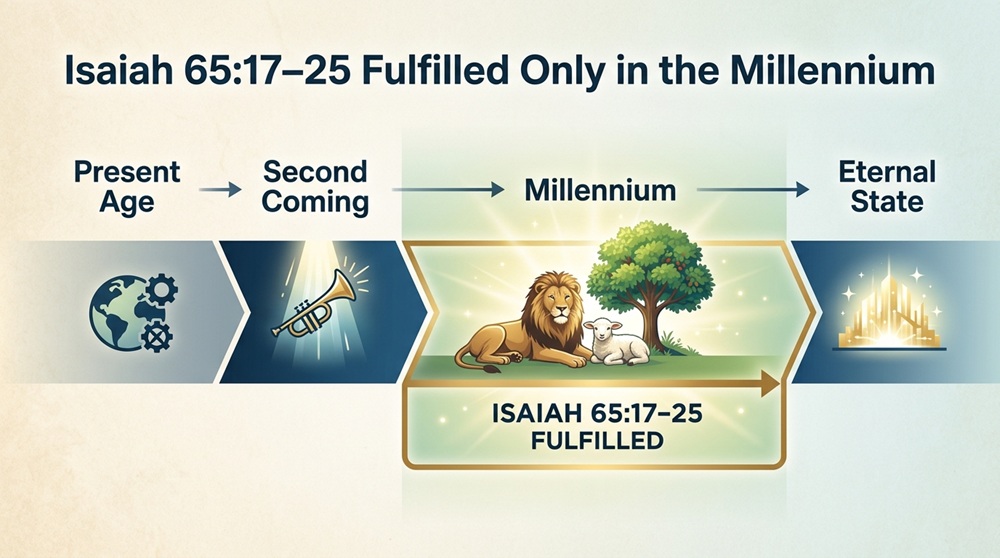
Lewis Sperry Chafer stated:
"In Isaiah 65:17 God declared, 'For, behold, I create new heavens and a new earth: and the former shall not be remembered, nor come into mind.' This verse occurs in a context of the millennial earth..."
Charles C. Ryrie stated that verses 17-25 are:
"description of the millennial kingdom, which is preliminary to the new heavens and a new earth (v. 17). Characteristics include Jerusalem's being a joy instead of a burden (v. 18; cf. Zech. 12:2-3), longevity (v. 20; notice that sin will be punished in the Millennium), peace and security (vv. 21-23), and removing of the animosity in nature (v. 25; cf. 11:7-9)."
Arnold Fruchtenbaum similarly wrote:
"While many believe this refers to the eternal order, these new heavens and new earth are not to be confused with those of Revelation 21-22. The latter describes the new heavens and new earth of the eternal order, while the Isaiah passage describes those of the messianic kingdom, which will actually be a renovation of the present heavens and earth."
William MacDonald stated:
"The closing verses of chapter 65 describe millennial conditions. The new heavens and the new earth here refer to Christ's kingdom on earth; in Revelation 21 they refer to the eternal state. In Isaiah's new heavens and new earth there is still sin and death; in Revelation 21, these have passed away."
Warren Wiersbe wrote:
"God saves the best for the last: His description of 'the new heavens and new earth' (the millennial kingdom) in 65:17-66:24. This is not the same as John's 'new heaven and new earth' (Rev. 21:1ff), because the characteristics Isaiah gives do not fit the eternal state. As far as we know, in the eternal state, people will not get old or die (Isa. 65:20), nor will there be any danger of losing anything to invaders (vv. 21-23)."
Tim LaHaye wrote:
"Since death appears in the Isaiah 65 passage, Isaiah was obviously not talking about the eternal order, but the millennial Kingdom." (Tim LaHaye, Revelation Unveiled)
Dr. Roy Gingrich also limited this section of Isaiah to the Millennium, naming it: "The Millennial blessedness of the redeemed Israelites (65:17-25)."
Gleason L. Archer stated:
"Here is given a foreview of the Millennial felicity of earth after it has been purged of unbelievers. ... The designation new heavens and a new earth is applied to the Millennial kingdom only as a stage preliminary to the eternal glories of heaven (the New Jerusalem of Rev 21; 22)." (Gleason L. Archer, The Wycliffe Bible Commentary)
2 - Isaiah 65 Refers to the Eternal State (v. 17) and to the Millennium (vv. 18-25)
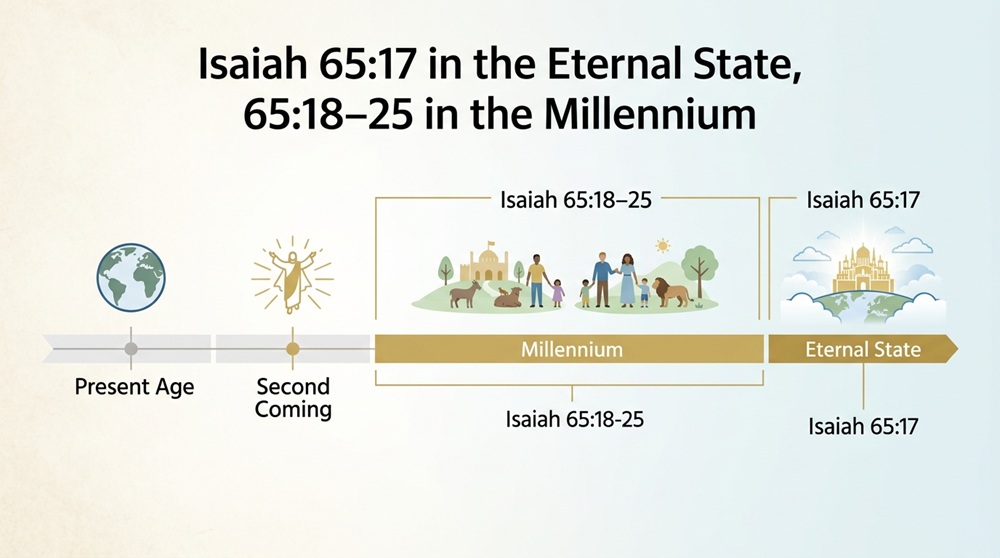
This second category is represented by C. I. Scofield, who stated:
"Verse 17 looks beyond the kingdom-age to the new heavens and the new earth (see refs. at 'create'), but verses 18-25 describe the kingdom-age itself. Longevity is restored, but death, the 'last enemy' (1 Cor. 15:26), is not destroyed till after Satan's rebellion at the end of the thousand years (Rev. 20:7-14)."
Charles H. Dyer wrote:
"God promised to 'create new heavens and a new earth.' This prophecy ultimately looked beyond the millennial kingdom to the Lord's new creation (Rev. 20:4-6; 21:1). However, Isaiah stated it first because he wanted to focus on the 'new' things that will come to pass. Some of these 'new' things will be prosperity, longevity, and peace." (Charles H. Dyer, Nelson's Old Testament Survey)
3 - Isaiah 65 Refers to the Eternal State (vv. 17-19) and to the Millennium (vv. 20-25)
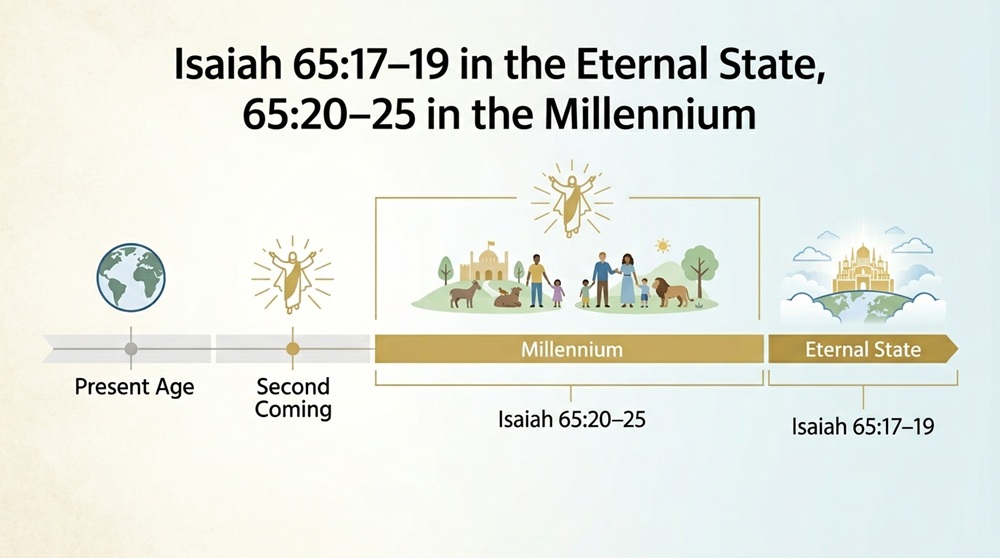
This view is defended by Dr. John F. Walvoord, who wrote:
"A glorious picture was presented of the ultimate new heavens and new earth (vv. 17-19). The prophet then returned to the theme of Jerusalem in the millennial kingdom in which there will be longevity but also death. One who will die at 100 years will be considered still in one's youth. The millennial earth will provide Israel with security."
Walvoord recognizes that the prophets of the Old Testament often viewed the Millennium and the Eternal State together; however, the details help distinguish which elements belong to each period:
"In expressing Israel's future hope, the Old Testament often mingled prophecies of the millennial kingdom with that of the New Jerusalem in eternity. The distinctions are made clear when the details are observed. Here, obviously, the millennial kingdom was being described because in the New Jerusalem there will be no death, no sin, and no judgment. In the millennial kingdom it will be a time of great joy and rejoicing and deliverance for the people of God, but death and sin will still be present."
William R. Newell wrote:
"Because Isaiah 65:17, 18, which belongs to the new creation, has been confused with the millennial verses (20-25)..." (William R. Newell, Revelation: A Complete Commentary)
Peter A. Steveson wrote:
"17-20 The Lord will create 'new heavens and a new earth.' This looks to the eternal ages to come ... The prophecy now blends the millennial kingdom with the eternal state. Death is not a part of the eternal state ... Verse 20, therefore, must refer to the kingdom." (Peter A. Steveson, A Commentary on Isaiah)
David H. Sorenson wrote:
"The focus now leaps beyond the church age and even past the Millennium to the eternal kingdom. For, behold, I create new heavens and a new earth ... The thought now seems to shift to the Millennium." (David H. Sorenson, Understanding the Bible Commentary)
4 - Isaiah 65 Refers to Both the Eternal State and the Millennium, but the Text Focuses on the Millennium
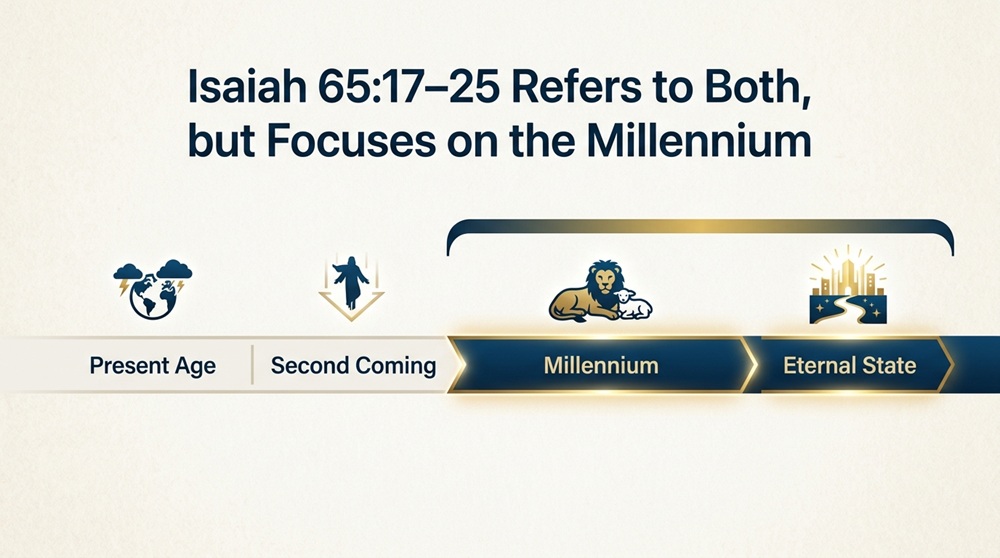
Alva J. McClain expresses this view especially well:
"The prophets sometimes saw future events not only together; but in expanding their description of these events, they seem occasionally to reverse the time sequence in their record of the vision. An example of this may be seen in Isaiah 65:17-25, which opens with a divine announcement: 'For, behold, I create new heavens and a new earth.' Then follows a remarkable picture of the millennial bliss which clearly is on earth... Now over in the New Testament, the Apostle John is found using the very words of Isaiah's prophecy: 'And I saw,' he writes, 'a new heaven and a new earth' (Rev. 21:1). The description which follows, however, is unmistakably a record of things in the eternal state where all sin and death have been abolished (21:3-8). It is apparent, therefore, that Isaiah saw together on the screen of prophecy both Millennial Kingdom and the Eternal Kingdom; but he expands in detail the former because it is the 'nearest-coming' event and leaves the latter for fuller description in a later New Testament revelation."
John MacArthur wrote:
"new heavens and a new earth. Israel's future kingdom will include a temporal kingdom of a thousand years (see notes on Rev. 20:1-10) and an eternal kingdom in God's new creation (51:6, 16; 54:10; 66:22; cf. Rev. 21:1-8). The prophet uses the eternal kingdom here as a reference point for both. Isaiah's prophecy does not make clear the relationship between the kingdom's two aspects as does later prophecy (Rev. 20:1-21:8). This is similar to the compression of Christ's first and second advents, so that in places they are indistinguishable (cf. 61:1, 2)."
Paul Lee Tan, following the same view, stated:
"Isaiah 65:17-25 introduces first the new heaven and the new earth (eternal state), and then paints a picture of millennial bliss - whereas the reverse sequence would have been chronologically correct."
Michael A. Rydelnik wrote:
"These descriptions frequently fuse together the earthly millennium ... and the eternal state ('a new heaven and a new earth' ...)." (Michael A. Rydelnik, The Moody Bible Commentary)
"65:17-25. At the outset, God's glory descends with a new creation for His people, a reference to what He does at the conclusion of the millennial kingdom and the start of the eternal state ... Although it is possible for people to die in the messianic age ... these peoples will all be able to reproduce and, as Is 65:20 indicates, even die." (Michael A. Rydelnik, The Moody Bible Commentary)
John A. Martin wrote:
"In these verses the Lord described the millennial kingdom, which is seemingly identified here with the eternal state (new heavens and a new earth). In Revelation, however, the new heavens and new earth (Rev. 21:1) follow the Millennium (Rev. 20:4). Most likely Isaiah did not distinguish between these two aspects of God's rule; he saw them together as one. After all, the Millennium, though 1,000 years in duration, will be a mere pinpoint of time compared with the eternal state." (John A. Martin, The Bible Knowledge Commentary)
Ed Hindson wrote:
"At this point the prophet Isaiah sees further into the future than any other Old Testament prophet. He looks down beyond the church age, the Tribulation Period, and the millennial kingdom, to the new heavens and a new earth (cf. Rev 21:1ff.). This brand new world is the result of the creation of God... the reference here may be taken as an overview to all that follows: for the child dying in verse Isa 65:20 is certainly not an experience of the eternal state, but of the earthly millennial kingdom."
Thomas L. Constable wrote:
"This verse is an overview of what follows. God announced ... that He would create a restored and renovated universe ... Isaiah's use of 'new heavens and a new earth' is not identical with the Apostle John's." (Thomas L. Constable, Notes on Isaiah)
Tony Garland wrote:
"The OT prophets saw glimpses of the eternal state. The Holy Spirit revealed through them that there would be a new heavens and a new earth (Isa. 65:17; 66:22) and that death would eventually be no more (Isa. 25:8; Hos. 13:14). But their visions of the eternal state were often intertwined with revelation concerning the Millennial Kingdom making it difficult to draw a clear distinction between the two (e.g., Isa. 65:17-20). Now, John is shown aspects of the eternal state which are markedly different from the Millennial Kingdom."
H. A. Ironside wrote:
"In chapters 65 and 66 the prophet lifts his telescope a little higher ... and gets a momentary glimpse of what God has in store for His people for all eternity. He sees the new heavens and the new earth." (H. A. Ironside, Expository Notes on the Prophet Isaiah)
5 - Isaiah 65 Refers to Both the Eternal State and the Millennium, with a Relation of Continuity
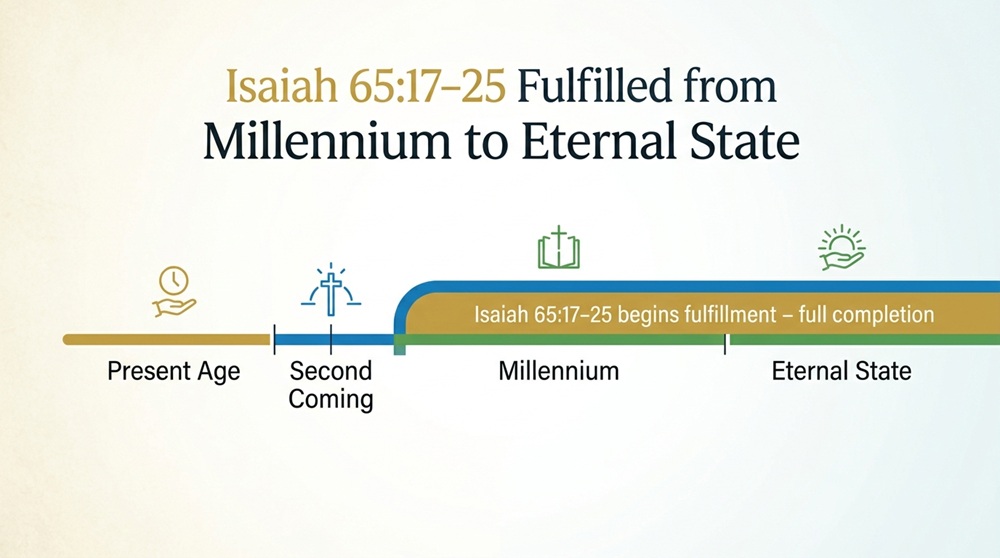
This view is similar to the previous one, since it also holds that Isaiah refers to both the Millennium and the Eternal State. It differs, however, in that it affirms a genuine continuity between the two. By "continuity" we mean that what appears partially in the Millennium reaches its full realization in the Eternal State. This is the key distinction between the fourth and fifth views.
In other words, the fourth view mainly says that Isaiah sees both horizons together but concentrates his description on the nearer millennial phase. The fifth view goes further: it argues that the millennial phase is not merely juxtaposed with the eternal state, but organically ordered toward it. What begins in partial form in the Millennium extends into eternity in consummated form. On this reading, Isaiah 65 is not only telescoping two eras together; it is presenting the renewal of creation as a single redemptive movement that advances from millennial restoration to eternal new creation.
Commenting on Isaiah 65, Merrill F. Unger said:
"Isaiah's vision, while glimpsing the Kingdom age... is projected into eternity... So the prophecy employs language that, although applicable to a degree to millennial conditions, will be fully realized on the regenerated Earth, which will follow upon the postmillennial renovation by fire."
One of the major proponents of this view is Paul Enns. He wrote:
"Since Isaiah (Isa. 65:17) and John (Rev. 21:1) both describe the new heaven and the new earth, it is reasonable to conclude that many of the conditions Isaiah describes in chapter 65 refer not only to the millennium, but also to the eternal state on the new earth. God's original purpose also demands this."
Michael J. Svigel wrote:
"This messianic age itself will be so radically different from the present world that it will be called 'a new heaven and a new earth'... suffering and death will first become but a trickle... and then it will be swallowed up forever." (Michael J. Svigel, The Fathers on the Future)
J. Vernon McGee wrote:
"Here Isaiah is definitely speaking of the millennial blessings as well as the eternal blessings. The millennial Kingdom is a phase of the eternal Kingdom, but it is also a time of judgment." (J. Vernon McGee, Thru the Bible)
William Kelly wrote:
"It is plain that the prophet sees in the vast change when Messiah reigns in power, the introduction and sure pledge of the new heavens and earth, rather than the absolute fulfilment."
"Of these quotations the one belongs to the commencement of the Millennial blessedness, the other to a post Millennial state. The blessing of Jerusalem is the earnest of the blessing of the earth when it shall be altogether renovated..."
Conclusion
These five views show that dispensationalists have not read Isaiah 65:17-25 in only one way. Some restrict the passage to the Millennium, some divide the paragraph between eternal-state language and millennial details, and others argue that Isaiah presents both realities together in prophetic compression.
The fourth and fifth views are the ones most naturally aligned with Progressive Dispensationalism, but the fifth is more specific. It does not merely say that Isaiah sees both the Millennium and the eternal state together. It says there is continuity between them: the renewal that begins in the millennial kingdom reaches its fullness in the eternal state. In that sense, the fifth view is closely aligned with what is often called the New Creation Model, a framework to which many contemporary dispensationalists (Darrell Bock, Craig Blaising, and Robert Saucy) have increasingly gravitated.
The implications of this continuity perspective are significant for our understanding of the Eternal State. It challenges the common claim that Scripture says very little about the Eternal State, because on this reading what begins in the Millennium extends into eternity. It also reinforces the idea that God's covenants are eternal and that the promised Kingdom is eternal as well, not merely a thousand-year phase. This line of thought also complements the argument developed in Kingdom-Millennium Reductionism and the restorative Kingdom emphasis highlighted in Michael J. Svigel's master insight on the Kingdom of God.
FreeRequest: Matthew 24:4–31 — Chronology in Dispensationalism
The chronological view of more than 60 dispensational authors on Matthew 24 — request it by email below.
Enter your email and we will send the PDF as an attachment. See our privacy policy.
Frequently Asked Questions
Does Isaiah 65:17-25 describe the Millennium or the eternal state in dispensationalism?
What are the main dispensational views of Isaiah 65?
Which view best fits Progressive Dispensationalism?
Author
Leonardo A. Costa
A researcher and writer exploring dispensationalism from a progressive perspective, with a deep appreciation for the tradition's heritage.
Related Articles
The Canonical Reading Layer: A Hermeneutical Double Standard in Traditional Dispensationalism
The thousand-year millennium is not in the Old Testament — it comes from Revelation 20. Traditional Dispensationalism reads it back into Isaiah, Ezekiel.
Two Prophets, Two Crises, One Method: Acts 2, Acts 15, and Partial Fulfillment in Progressive Dispensationalism
Peter and James both answer crises by citing fulfilled prophecy—not mere analogy. Why Acts 2 and Acts 15 demand partial fulfillment, the key insight.
You Already Believe in "Already / Not Yet" (You Just Didn't Know It Yet)
Traditional dispensationalists already accept 'already / not yet' in Luke 4, Zech. 9, and Dan. 9.
Matthew 13 in Dispensationalism: Three Interpretive Patterns
A three-part survey of how dispensational interpreters read Matthew 13, ranging from strictly future views to organic continuity with the promised kingdom.