Arrabōn and Progressive Dispensationalism — Four Lessons
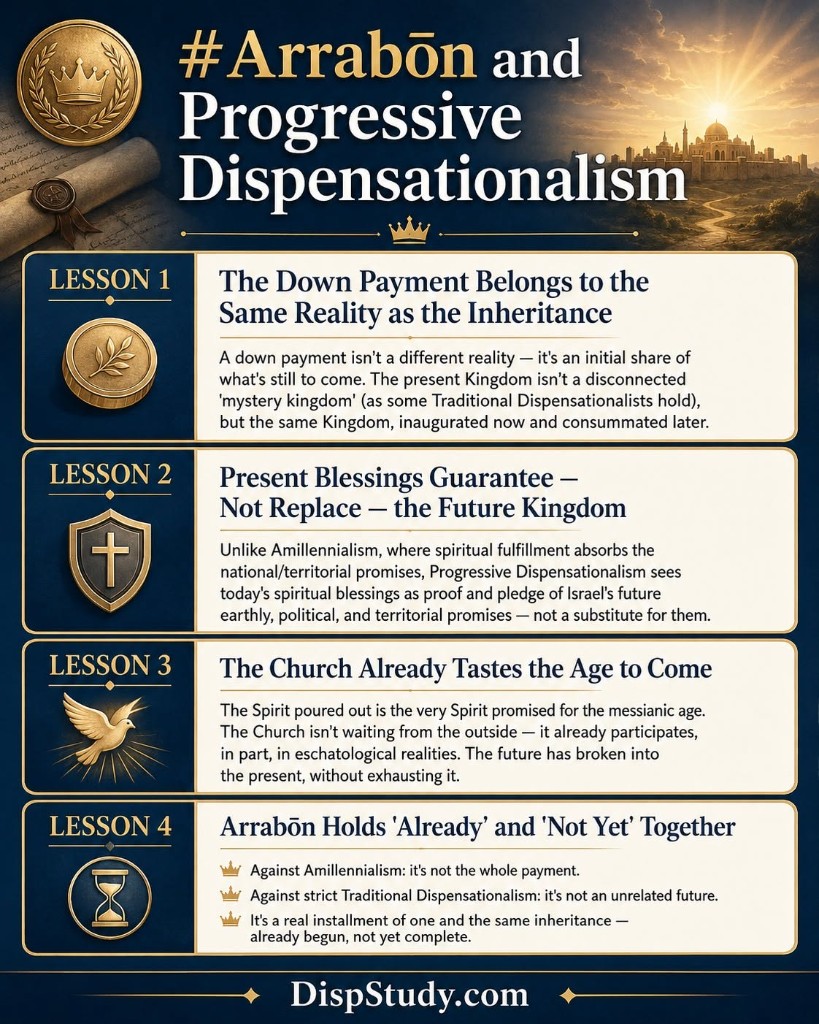
This infographic summarizes four lessons from Paul's use of arrabōn—a pledge, deposit, or down payment—for the Holy Spirit (2 Cor. 1:22; 5:5; Eph. 1:13–14). Strictly speaking, Paul does not call the present form of the Kingdom itself the arrabōn; the Spirit is the down payment. Yet the image supplies a framework for relating present and future fulfillment in Progressive Dispensationalism: what has been given now genuinely belongs to the eschatological inheritance, without exhausting it.
Text equivalent of the chart (for accessibility)
| Lesson | Claim | Contrast |
|---|---|---|
| 1 | The down payment belongs to the same reality as the inheritance | Not a disconnected "mystery kingdom" (as some Traditional Dispensationalists hold), but the same Kingdom, inaugurated now and consummated later |
| 2 | Present blessings guarantee — not replace — the future Kingdom | Unlike amillennialism, today's spiritual blessings are proof and pledge of Israel's future earthly, political, and territorial promises |
| 3 | The Church already tastes the age to come | The Spirit poured out is the Spirit promised for the messianic age; the future has broken into the present without exhausting it |
| 4 | Arrabōn holds "already" and "not yet" together | Against amillennialism: not the whole payment. Against strict Traditional Dispensationalism: not an unrelated future. A real installment of one inheritance |
Purpose and context
The four lessons hold together inauguration and consummation. A down payment is neither the totality of the future Kingdom nor a reality unrelated to it. It is a genuine initial participation in the same messianic reign that will later be manifested in its full earthly, national, political, and eschatological dimensions.
For the full argument, see the companion article Arrabōn and Progressive Dispensationalism.