There is a point of genuine agreement between most traditional dispensationalists (TD) and progressive dispensationalists (PD): the biblical covenants are organically related to one another, and the Abrahamic Covenant is the foundational one. In this scheme — affirmed by authors on both sides — the Land Covenant, the Davidic Covenant, and the New Covenant do not stand alone. Each takes up one strand of the Abrahamic promise and develops it.
What I want to highlight is a single link in that chain: the New Covenant amplifies the blessing strand of the Abrahamic Covenant — and that strand was, from the beginning, explicitly universal in scope ("in you all the families of the earth shall be blessed," Gen 12:3).
Both sides affirm this. My argument is that only one side follows it through. Traditional dispensationalism grants the premise and then refuses the conclusion; progressive dispensationalism grants the premise and lets it govern how it reads the participation of Gentiles in the covenant program and in the kingdom of God.
The Anatomy of the Covenants
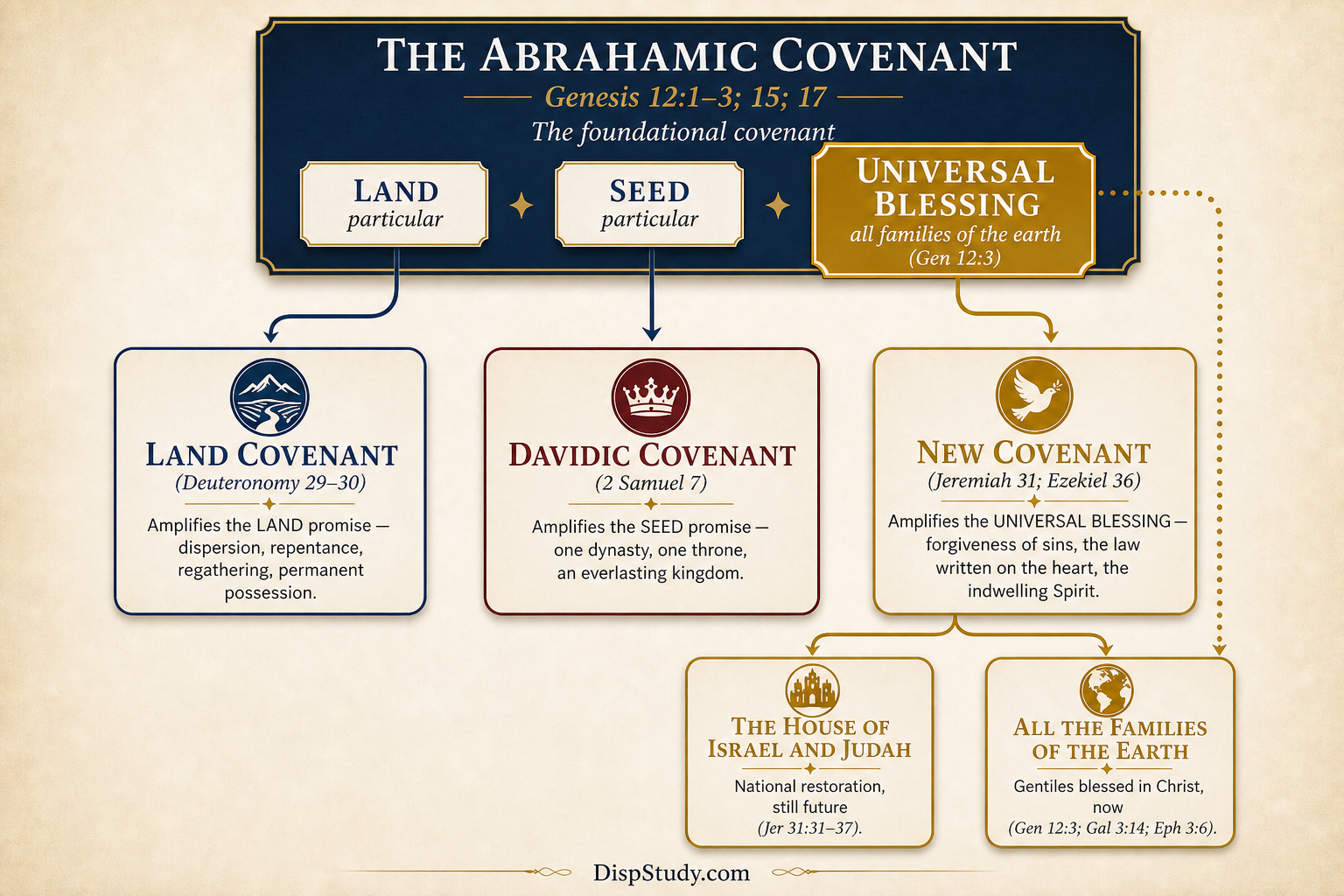
The Abrahamic Covenant is not one promise but a cluster of promises given to one man (Gen 12:1–3, 7; 15; 17). Genesis 12 states them in seed form, and the rest of the covenant program unfolds them. Three strands are usually identified:
- Land — "to your offspring I will give this land" (Gen 12:7; 15:18–21; 17:8).
- Seed — a great nation, kings coming from his own body (Gen 12:2; 17:6, 16).
- Blessing — blessing to Abraham, and through him "all the families of the earth" (Gen 12:2–3).
The subsequent covenants are not new programs added alongside this one. They are the same program brought into focus, one strand at a time, each supplying the particulars that Genesis left unspecified. This is what dispensational writers mean when they call the later covenants "outgrowths," "branches," or "sub-covenants" of the Abrahamic.
The Land Covenant amplifies the land strand. Genesis promised a territory; Deuteronomy 29–30 specifies the terms of possession — dispersion for unfaithfulness, national repentance, regathering, and permanent enjoyment of the land. What was a boundary line in Genesis 15 becomes a history with a guaranteed outcome.
The Davidic Covenant amplifies the seed strand. Genesis promised offspring and said that "kings shall come from you" (Gen 17:6). Second Samuel 7 names the house: the seed narrows to one dynasty, one throne, one everlasting kingdom. The promise of descendants becomes the promise of a ruler through whom the whole program is administered.
The New Covenant amplifies the blessing strand. Genesis promised blessing but did not say how a sinful people could receive it. Jeremiah 31:31–34 supplies the mechanism: forgiveness of sins, the law written on the heart, direct knowledge of God — and, in the parallel texts, the indwelling Spirit (Ezek 36:26–27; Isa 59:21). The New Covenant is how the blessing actually reaches anyone at all.
The logic of the amplification is cumulative, and each covenant depends on the one that precedes it: there is no land to inherit without the Land Covenant, no king to inherit it without the Davidic Covenant, and no people fit to live under that king without the New Covenant. The Davidic king is the one through whom the blessing is mediated; the New Covenant is the means by which the blessing is applied. This is why the covenants must be read together rather than in isolation.
And this is precisely where the decisive point emerges. The strand the New Covenant amplifies is the one strand of the Abrahamic promise that was never restricted to Abraham's physical descendants. Land and seed are, by their nature, particular. Blessing, by God's own stipulation, is not: it reaches "all the families of the earth."
The Problem with Traditional Dispensationalism
The difficulty is not that traditional dispensationalists deny the correlation. As the citations at the end of this article show, they assert it repeatedly and in strong terms. The difficulty is that the correlation is affirmed in the abstract and then quietly suspended when the question turns to Gentiles in the present age.
The tension is real and must be resolved by someone. Jeremiah 31:31 announces a covenant "with the house of Israel and with the house of Judah," set in a context of national restoration. Yet in the New Testament, Jesus pours out the blood that ratifies that covenant (Luke 22:20), Paul calls himself a minister "of a new covenant" while writing to a predominantly Gentile congregation (2 Cor 3:6), and Hebrews expounds Jeremiah 31 at length to a church that is enjoying the forgiveness it promises (Heb 8:6–13; 10:15–18).
Traditional dispensationalism has tried to relieve this tension in several incompatible ways, which is itself a diagnostic sign. At least four distinct positions have emerged within the system: two new covenants (one for Israel, one for the church); a single new covenant made exclusively with Israel, with no present relation to the church; indirect participation, in which the church enjoys the benefits without being a party to the covenant; and progressive revelation with genuine Gentile inclusion. I compare these in detail in New Covenant Views Compared in Dispensationalism.
The proliferation of solutions is telling. A framework that has settled its own premises does not need four mutually exclusive answers to the same question.
The Implication of the Universal Blessing and Progressive Dispensationalism
Here is the heart of the matter. The traditional position holds three claims that cannot all stand together:
- The New Covenant develops the blessing strand of the Abrahamic Covenant.
- The blessing strand is, by the plain wording of Genesis 12:3, universal in scope — "all the families of the earth."
- Yet the New Covenant's blessings are restricted to Israel, so that Gentiles today cannot be genuine participants in it.
The first two are asserted by traditional authors themselves. The third contradicts what the first two entail. Progressive dispensationalism simply declines to hold the third. It is not adding a premise to the system; it is refusing to abandon one halfway through the argument.
Jeremiah 31 names the covenant partner, not the outer limit of the beneficiaries. This is the point at which the objection usually surfaces: when a PD says that Gentile believers participate in New Covenant blessings, the reply is that Jeremiah 31 restricts the covenant to Israel and Judah, so any reading that finds Gentiles in it today must be a spiritualization. But the inference does not follow, and it does not follow on the traditional system's own terms. Every covenant in this program is made with a particular party while reaching beyond that party. The Abrahamic Covenant is made with one man and blesses all the families of the earth. The Davidic Covenant is made with one king, yet under his reign "nations that you do not know shall run to you" (Isa 55:3–5; cf. Ps 72:17, which deliberately echoes Gen 12:3). Naming the covenant partner establishes through whom God will work; it does not exhaust for whom. To treat "the house of Israel and Judah" as a restriction on beneficiaries is to apply to the New Covenant a rule that is applied to no other covenant in the series. The distinction between contracting parties and intended beneficiaries is developed further in The New Covenant Beneficiaries Analogy in Dispensationalism.
The New Covenant does not appear only in Jeremiah 31. The restriction depends on reading a single verse as though it were the whole of the covenant's revelation. But the Servant is given "as a covenant for the people, a light for the nations" (Isa 42:6; 49:6–8); foreigners who hold fast the covenant are brought to the holy mountain, "for my house shall be called a house of prayer for all peoples" (Isa 56:6–8); the everlasting covenant of Isaiah 59:21 and 61:8–9 carries the same universal horizon. The prophetic witness to the New Covenant is broader than its most famous text, and where it is broader, it is universal.
The New Testament states the connection explicitly. Paul does not leave the reader to infer it: Christ redeemed us "so that in Christ Jesus the blessing of Abraham might come to the Gentiles, so that we might receive the promised Spirit through faith" (Gal 3:14). The blessing of Abraham reaching the Gentiles is the gift of the Spirit — which is New Covenant content (Ezek 36:26–27; Isa 59:21; 2 Cor 3:6–8). That is why Progressive Dispensationalism treats Spirit baptism as a New Covenant blessing rather than a Church-Age parenthesis; see Spirit Baptism as a New Covenant Blessing in Progressive Dispensationalism. Ephesians says the same in covenantal terms: Gentiles were once "strangers to the covenants of promise" (Eph 2:12) and are now "fellow heirs, members of the same body, and partakers of the promise in Christ Jesus" (Eph 3:6). The category is not proximity to the covenants but participation in them, and the ground of that participation is union with Christ, the Abrahamic seed and Davidic heir in whom the promises are Yes (2 Cor 1:20; Gal 3:16, 29). Paul's syn- compounds in this passage are treated at length in Gentiles and Co-Participation in the Covenants of Promise. That this Gentile participation is the mystery of progressive revelation, rather than a spiritualization of Jeremiah 31, is the argument of The Mystery and Progressive Revelation: Gentiles in the New Covenant and the Kingdom.
So when the progressive dispensationalist affirms that Gentile believers participate in the New Covenant, he is not applying to the church a promise made to Israel. He is applying to the church the one part of the Abrahamic promise that was addressed to the nations from the start, through the covenant instrument God appointed to deliver it. That is not spiritualization, and it is not sensus plenior. It is a canonical reading of a promise whose universal intent is present in the literal sense of Genesis 12:3.
And this does not collapse Israel into the church. The distinction is between the blessing strand and the land and seed strands. Gentiles share in the forgiveness, the new heart, and the Spirit because those blessings were promised to all the families of the earth. They do not thereby inherit the national restoration of Jeremiah 31:35–37, the territorial promises, or Israel's distinct future. Present participation in the covenant's blessings is not the fulfillment of Israel's national hope; it is the first installment of a program whose consummation still awaits the kingdom. Progressive dispensationalism can say both because it distinguishes the strands. The traditional position, having flattened the blessing strand into the national one, is left with a covenant whose stated universal purpose has no present operation — and must then explain, by one of four competing theories, how the church is enjoying blessings it is said not to possess.
This same distinction of strands is what positions progressive dispensationalism against the errors on both sides. Against replacement theology — and non-dispensational readings generally — PD preserves Israel's identity without qualification: Gentile participation in the covenants is participation, not replacement. The church does not become Israel, and Israel does not dissolve into the church. The nation remains the covenant partner of Jeremiah 31, with blessings and promises that are specifically hers — land, throne, and national restoration — still awaiting the kingdom. Gentile believers are grafted into the blessing that was always intended for the nations; they are not substituted for the people to whom the national promises were made. Against traditional dispensationalism, the difference runs in the opposite direction: PD recognizes that Gentiles genuinely participate now in the very program the Old Testament itself announced as universal in scope, instead of protecting Israel by dividing God's purpose into two separate programs — one earthly, one heavenly — between which the New Covenant must then be awkwardly suspended. In short, PD keeps what each side is trying to protect: Israel's distinct future and the Gentiles' present participation. It secures the first without denying the second.
The charge of inconsistency, then, runs in the opposite direction from the way it is usually pressed. It is not the progressive dispensationalist who reads Jeremiah 31 loosely; it is the traditional dispensationalist who reads it in isolation — as though the New Covenant appeared in that text alone and had no Abrahamic root — in order to limit the scope of blessings that his own system says the covenant exists to deliver.
Documenting the Correlation in Traditional Dispensationalism
It remains to document that the premise argued above is not a progressive innovation. It is the settled teaching of traditional dispensational authors themselves, stated in their own words.
The New Covenant amplifies the blessing aspect of the Abrahamic Covenant, especially in relationship to salvation. In relationship to the Church, the New Covenant is the basis for the Dispensation of Grace. In relationship to Israel, it will be the basis for the Dispensation of the Kingdom. The New Covenant, being an unconditional covenant, is still very much in effect. — Arnold Fruchtenbaum, Chafer Theological Seminary Journal 5, p. 41
The New Covenant was prophesied in Jeremiah 31 and through many other Old Testament verses… the New Covenant was launched by the outpouring of the Holy Spirit at Pentecost (Acts 2)… The Abrahamic Covenant, and the three sub-covenants already referred to, are going forward to ultimately be fulfilled in the Kingdom. But as shown several times in this article, the Gentiles are now being blessed by the New Covenant. Remember that this blessing was prophesied to Abraham in Genesis 12:3. — Mal Couch, "The Relationship Between the Dispensations and Covenants," Conservative Theological Journal 2:7 (1998), pp. 424–425
This covenant clearly seems to be an extension of the Abrahamic covenant as mentioned in the seed promise in Genesis 12:3. God would someday, through the Abrahamic promise, bless "all the families of the earth." … it appears that this instrument of blessing for the nations is the new covenant. — Mal Couch, An Introduction to Classical Evangelical Hermeneutics
The new covenant, providing God's grace for Israel as well as for all who trust in Christ, is another major outgrowth of the Abrahamic covenant. Although it stands as a separate covenant, obviously its roots come from the promise of God to bless all people of the earth through Abraham. — John F. Walvoord, Major Bible Prophecies
The Abrahamic covenant is not only inclusive of many of the main features of God's program for the ages, but it is the ground for many future covenants. The covenant in respect to the land is enlarged in the Palestinian covenant… The covenant in respect to the future kings to issue from Abraham is given a specific turn in the promises to David in the Davidic covenant… The ground of all these covenants is the Abrahamic, and for this reason the principles illustrated in its fulfillment and the content of its revelation constitute one of the important determining factors of all prophecy. — John F. Walvoord, "The Fulfillment of the Abrahamic Covenant," Bibliotheca Sacra 102:405 (1945), p. 29
The Abrahamic covenant establishes the foundational framework: God promises to make Abram great, to make Israel great through him, to bless all believing peoples through him, and to give the land eternally (Gen. 12:7; 17:8; Jer. 23:5–8; 31:4–11; 35–37; Ezek. 20:33–38; 47–48). The Land covenant, Davidic covenant, and New covenant all flow from and develop specific dimensions of this Abrahamic promise — land, royal dynasty, and forgiveness/heart transformation respectively. — John F. Walvoord, "The New Covenant," in Integrity of Heart, Skillfulness of Hands, eds. Dyer & Zuck (Baker, 1994), pp. 186–200
Within the original Abrahamic Covenant were promises concerning land, seed, and blessings. The Palestinian Covenant developed the land promises; the Davidic covenant furthers the seed promises. Now it is the New Covenant that develops and guarantees the blessing promises of the original Abrahamic Covenant. — J. Dwight Pentecost, Thy Kingdom Come, p. 170
This covenant becomes the seed from which are brought forth the later covenants made with Israel. The essential areas of the Abrahamic covenant, the land, the seed, and the blessing, are enlarged in the subsequent covenants made with Israel. — J. Dwight Pentecost, Things to Come
The New Covenant is a branch or outgrowth of the Abrahamic Covenant. In the Abrahamic Covenant God promised Abraham a piece of real estate for his descendants, an incalculable number of descendants, and blessing for his descendants and for all people through his descendants (Gen. 12:1–7; et al.). Deuteronomy 29 and 30, sometimes called the Palestinian Covenant, gave more information about the land that God had promised Abraham. The Davidic Covenant gave more information about God's promises regarding descendants (2 Sam. 7). The New Covenant revealed the particulars of the promised blessing (Jer. 31). Each of the later covenants relates to the earlier Abrahamic Covenant organically; each is an outgrowth of it in the progress of revelation. — Thomas L. Constable, Notes on Jeremiah
This brief survey of the various Old Testament covenants suggests how foundational and central the Abrahamic Covenant is to the whole apparatus of God's dealings with a fallen world… The covenants to follow are either subsidiary to it or elaborate upon it. — Eugene H. Merrill, "The Covenant With Abraham: The Keystone of Biblical Architecture," Journal of Dispensational Theology 12 (2008), pp. 8, 13
The Abrahamic Covenant initiated the major revelatory themes of the biblical covenants. Each subsequent covenant focused on one or more of those themes, providing further development of those themes pertinent to the times in which the recipients were living. — William Barrick, "The Mosaic Covenant," Master's Seminary Journal 10/2 (1999), p. 217
The New Covenant is God's appointed vehicle for fulfilling the Abrahamic blessings to Israel. But the Abrahamic Covenant also promised universal blessing, so the New Covenant becomes as well God's vehicle of salvation for believers since the Cross. To say this is not to say anything more than Jesus did when He declared that "salvation is from the Jews" (John 4:22). — Zane C. Hodges, "Hebrews," in Walvoord & Zuck (eds.), The Bible Knowledge Commentary, vol. 2, p. 800
The Abrahamic Covenant involves a promise of a land to Abraham and Israel, a nation (seed), and a worldwide blessing. The implication is that the Abrahamic Covenant will be fulfilled in the form of three sub-covenants: (1) the Land [Palestinian] Covenant; (2) the Davidic Covenant; and (3) the New Covenant. — Ron Bigalke, "The Abrahamic Covenant"
The New Covenant not only enlarges and fulfills all the promises of the Abrahamic Covenant, but also supersedes the Mosaic Covenant (the Law). — Stephen R. Lewis, "The New Covenant: Enacted or Ratified?"
The third (Abrahamic) is the central covenant, containing four promises which summarize the whole of God's future program for humanity. From this central covenant came a group of four specialized pacts, which further elaborate what God will do for His people. — Stanley A. Ellisen, 3 Worlds in Conflict
Conclusion
Both systems begin from the same architecture: the Abrahamic Covenant is foundational, and the New Covenant develops its blessing promise. Both acknowledge that this promise was universal in its stated intent. The difference lies in what each system does once the premise is granted.
Traditional dispensationalism holds the premise and then constrains its consequence, and the strain shows in the multiplication of competing accounts of how the church can enjoy what it is said not to share. Progressive dispensationalism holds the premise and follows it: Gentiles in Christ are genuine participants in the New Covenant, because the New Covenant is God's appointed instrument for delivering the blessing promised to all the families of the earth — while Israel's land, throne, and national restoration remain her own, still awaiting the kingdom.
That is not a looser hermeneutic. It is the same hermeneutic, applied consistently to the end.
FreeRequest: Matthew 24:4–31 — Chronology in Dispensationalism
The chronological view of more than 60 dispensational authors on Matthew 24 — request it by email below.
Enter your email and we will send the PDF as an attachment. See our privacy policy.
Frequently Asked Questions
How does the New Covenant relate to the Abrahamic Covenant?
How can Gentiles participate in the New Covenant if Jeremiah 31 names Israel and Judah?
Does Gentile participation in the New Covenant collapse Israel into the church?
Why do traditional dispensationalists have several incompatible views of the New Covenant?
Author
Leonardo A. Costa
A researcher and writer exploring dispensationalism from a progressive perspective, with a deep appreciation for the tradition's heritage.
Related Articles
Belonging to the Church in Dispensationalism: The Before and After of Ephesians 2-3
A dispensational reading of Ephesians 2-3 showing how Gentile believers move from alienation to participation in the covenants of promise.
The Church Is Not Another Ethnic or Anthropological Category in Progressive Dispensationalism
The Church is not a third anthropological category beside Israel and the Gentiles — it is a trans-ethnic, soteriological reality in Christ.
Gentiles and Co-Participation in the Covenants of Promise
Paul's repeated use of the prefix syn in Ephesians 2-3 grounds a theology of Gentile co-participation in the covenants of promise, against both replacement.
The Mystery and Progressive Revelation: Gentiles in the New Covenant and the Kingdom
From a Progressive Dispensationalist perspective: Gentile participation in the New Covenant and in the present phase of the Kingdom is precisely what the New.