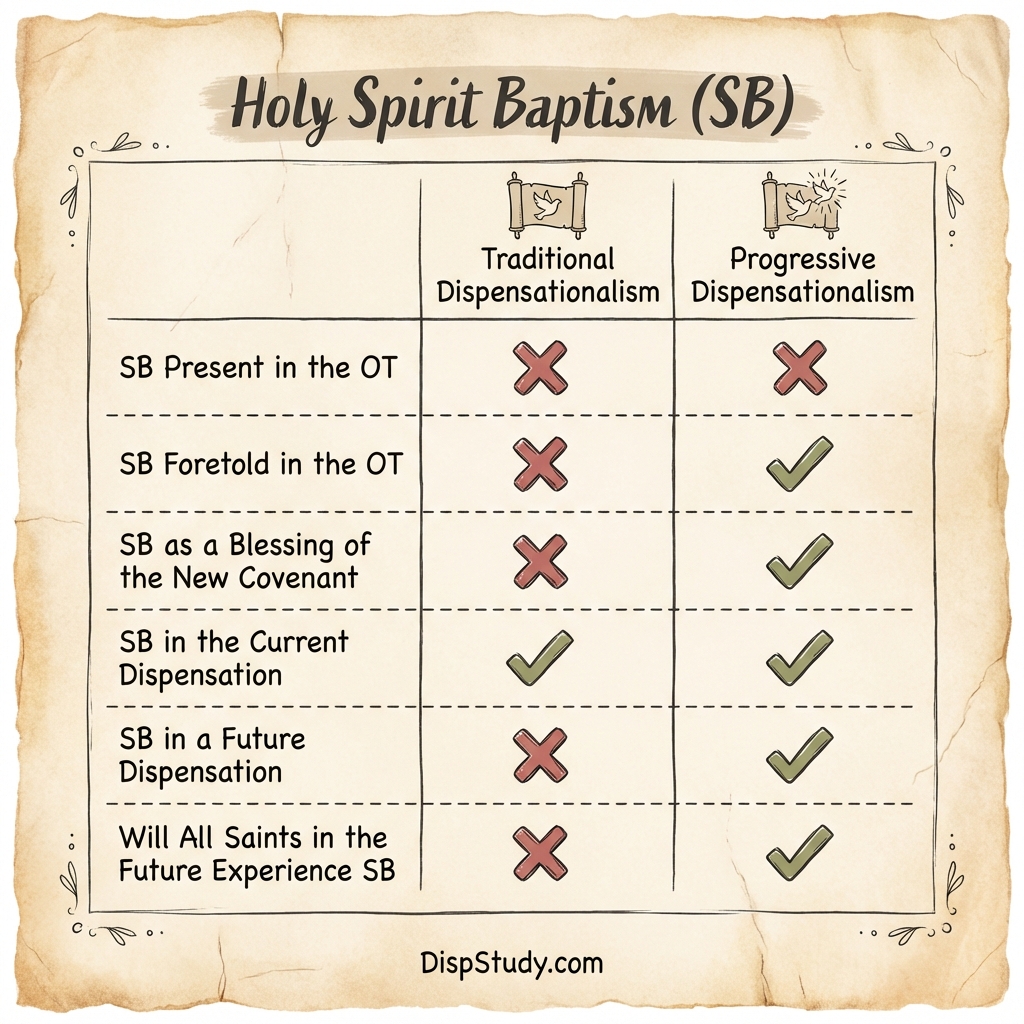
To understand the Baptism with the Holy Spirit in Progressive Dispensationalism, one must first recognize that it is a New Covenant blessing rather than something separate from it. Traditional Dispensationalism treats Spirit Baptism as distinct from the New Covenant, viewing it as a benefit exclusive to the Church Age that will cease at the Rapture. Progressive Dispensationalism, by contrast, regards Spirit Baptism as an integral part of the New Covenant and therefore maintains that it will continue into future dispensations, where the New Covenant will reach its ultimate and complete fulfillment — of which the present age represents only a partial realization.
The Church as the First Stage of the New Covenant Community
The Church represents the first stage of the eschatological New Covenant community. Ultimately, the New Covenant community is nothing less than the new humanity — restored humanity itself. What God is building through the New Covenant is not merely an ecclesiastical institution destined to conclude at the Rapture, but a new humanity, and the Church stands as the inaugural expression of that larger redemptive reality. In this sense, the Church is best understood as a category within a greater category — it is not the New Covenant community in its entirety, but rather its first and present manifestation.
The New Covenant and the Abrahamic Promise
The New Covenant is the means by which the universal blessings of the Abrahamic Covenant — summarized in Genesis 12:3 — are ultimately accessed and realized. The eschatology of the Church is not a separate eschatology detached from what was promised in the Old Testament; rather, it is an eschatology deeply rooted in it. This rootedness, however, is not to be understood in terms of replacement or allegorization, but in terms of co-participation — through Christ, the Church shares in the covenants of promise, participating alongside Israel in the unfolding fulfillment of God's covenantal plan.
Within this covenantal framework, Gentiles partake of the universal blessings of the Abrahamic promise, while Israel receives its particular blessings. Yet both communities access these blessings through one and the same means — the New Covenant, mediated by the Baptism with the Holy Spirit.
Why Spirit Baptism Cannot Be Separated from the New Covenant
Traditional Dispensationalism treats Spirit Baptism as a distinct blessing separate from the New Covenant. Yet this separation is exegetically unsustainable. Joel 2:28–32 — the very prophecy Peter cited at Pentecost — is contextually a New Covenant prophecy, describing the eschatological outpouring of God's Spirit. Ezekiel 36:26–27's promise "I will put my Spirit within you" is not an appendix to the covenant but part of its very definition. Paul draws the same thread in Galatians 3:14, weaving together the Abrahamic blessing, its reach to the Gentiles, and the reception of the Spirit as a single reality. If the Spirit belongs to the New Covenant, then so does the means by which He is received.
FreeRequest: Matthew 24:4–31 — Chronology in Dispensationalism
The chronological view of more than 60 dispensational authors on Matthew 24 — request it by email below.
Enter your email and we will send the PDF as an attachment. See our privacy policy.
Author
Leonardo A. Costa
A researcher and writer exploring dispensationalism from a progressive perspective, with a deep appreciation for the tradition's heritage.
Related Articles
Why Progressive Dispensationalism Makes Better Sense
Why the New Covenant amplifies Abraham's universal blessing—and why only progressive dispensationalism follows that premise through.
Arrabōn and Progressive Dispensationalism
Paul's arrabōn of the Spirit frames Progressive Dispensationalism: present Kingdom blessings guarantee the future earthly inheritance, not replace it.
Belonging to the Church in Dispensationalism: The Before and After of Ephesians 2-3
A dispensational reading of Ephesians 2-3 showing how Gentile believers move from alienation to participation in the covenants of promise.
Can the Church Be Unrelated to the New Covenant? A Response to Christopher Cone
A point-by-point response to Christopher Cone's SCIO New Covenant view: 2 Corinthians 3, the Lord's Supper, Abrahamic.