The name of the system is a compound: Progressive Dispensationalism. Each half of the compound names something essential, and the union of the two is the distinctive mark of the system. Progressive Dispensationalism is the system that holds continuity and discontinuity together in harmony. The continuity side is what the word Progressive names. The discontinuity side is what the word Dispensationalism names. The joining of the two, held in harmony, is what allows the system to avoid the two opposite extremes.
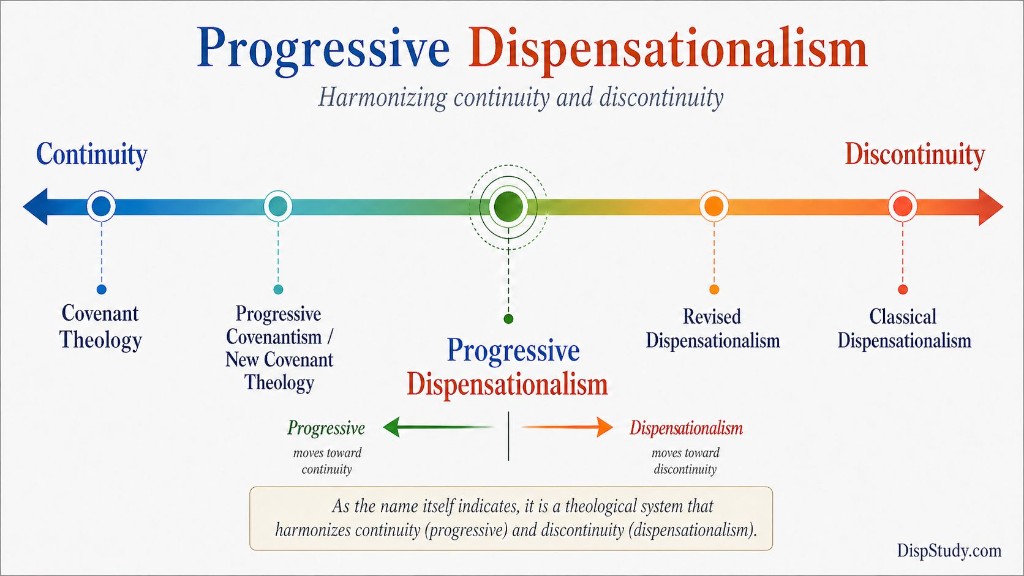
The Progressive Side: Continuity in God's Plan
On the Progressive side of the system stands the recognition that there is genuine progression in God's plan from one dispensation to the next. Each dispensation is not a sealed compartment standing alongside the others. Each is a phase of the one unfolding plan, building on what came before and opening toward what comes after. The plan moves forward. It develops. It progresses.
Still on the side of progression, the present age of the Church is neither a parenthesis nor an intercalation in God's plan. The argument of this book has shown, from passages such as Ephesians 2:12 and 3:6, that the Church now participates in the covenants of promise. She has been grafted into the olive tree whose root is the promises made to the patriarchs and whose trunk is the unfolding succession of the covenants. The Church does not merely benefit from the new covenant; she is, as we have seen, a product of the new covenant. This is what most clearly distinguishes Progressive Dispensationalism from the traditional form: the present age is read as a partial fulfillment of the covenants of promise, and the Church is read as the new covenant community and as a preview of the new creation. The Church is not a third anthropological group alongside Jews and Gentiles. It is a different kind of category: the one body in Christ in which both Jews and Gentiles are represented in their redeemed state.
The Dispensationalist Side: Discontinuity Preserved
On the Dispensationalist side, continuity exists in harmony with discontinuity. The word Dispensationalism preserves what Progressive alone would not preserve: genuine distinctions between dispensations and a real future for ethnic Israel. Progressive Dispensationalism insists that the Gentiles of the Church participate alongside Israel — not in the place of Israel — in the covenants of promise and in the messianic blessings. The theology of Ephesians 2–3 is, as we have seen at length, a theology of co-participation, expressed with unusual density by the prefix syn- ("together with"). Gentiles are incorporated into the people of God, into the new covenant community — not into ethnic Israel and not as a substitute for ethnic Israel. The promises Gentiles receive are not spiritualizations of literal promises made to Israel. They are the literal fulfillment of the promised messianic blessings that were always to reach all the families of the earth. Progressive Dispensationalism is firm on this point: Gentiles in the Church share together with Israel, not in the place of Israel.
Two Halves, One Coherent Vision
The two halves of the name therefore do complementary work. Progressive points to the unity of the plan: one cosmic story moving forward through its dispensations, with the Church already inside the covenants of promise and already tasting the messianic age. Dispensationalism points to the integrity of the parts: the dispensations remain genuinely distinct, Israel remains genuinely Israel, and the present participation of the Church does not collapse the future that still belongs to her. Held together, the two halves describe a single coherent vision — a plan that progresses without dissolving its distinctions, and distinctions that endure without fragmenting the plan.
Progressive Dispensationalism therefore stands against both extremes at once. Against Covenant Theology, it refuses the supersessionist collapse that would dissolve Israel's distinct vocation and future into a generalized people of God. Against the Traditional Dispensationalism tendency, it refuses the parenthesis reading that would sever the Church from the covenants of promise and reduce the messianic plan to a future national-territorial program only. The two extremes share a single underlying mistake — they cannot hold continuity and discontinuity together at the same time. Progressive Dispensationalism holds them together because the text itself does.
FreeRequest: Matthew 24:4–31 — Chronology in Dispensationalism
The chronological view of more than 60 dispensational authors on Matthew 24 — request it by email below.
Enter your email and we will send the PDF as an attachment. See our privacy policy.
Author
Leonardo A. Costa
A researcher and writer exploring dispensationalism from a progressive perspective, with a deep appreciation for the tradition's heritage.
Related Articles
Gentiles and Co-Participation in the Covenants of Promise
Paul's repeated use of the prefix syn in Ephesians 2-3 grounds a theology of Gentile co-participation in the covenants of promise, against both replacement.
Progressive Dispensationalism and the Mystery: Gospel, Newness, and Fulfillment
Progressive Dispensationalism reads Paul's mystery in Ephesians 3 and Romans 16 as both new revelation and fulfillment of prophetic Scripture.
Why Progressive Dispensationalism Makes Better Sense
Why the New Covenant amplifies Abraham's universal blessing—and why only progressive dispensationalism follows that premise through.
Belonging to the Church in Dispensationalism: The Before and After of Ephesians 2-3
A dispensational reading of Ephesians 2-3 showing how Gentile believers move from alienation to participation in the covenants of promise.