Progressive Dispensationalism is a theological system that offers a balanced view of two aspects of the Word of God: continuity and discontinuity. Instead of favoring one at the expense of the other, PD seeks balance, which is already embedded in its very name: PROGRESSIVE (continuity) DISPENSATIONALISM (discontinuity).
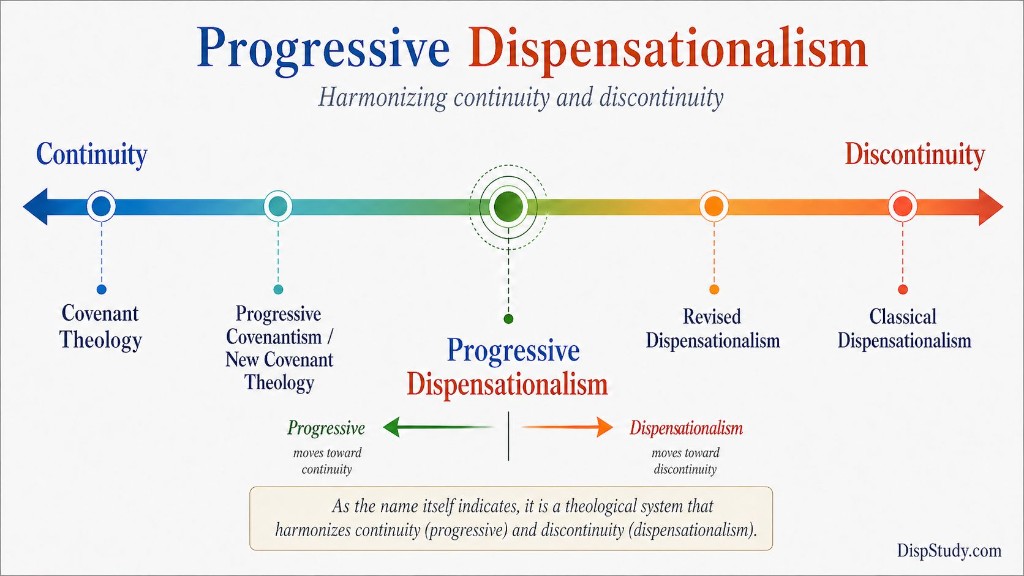
Progressive Dispensationalism: A Theology of Harmony
Human beings, by nature, tend toward ease and toward the extremes. Balance and harmony are virtues forged through considerable effort. To stand in the middle—at the center, at the point of harmony and equilibrium—is the more arduous task.
This calls to mind Aristotle's concept of virtue. Aristotelian ethics treated this matter with remarkable depth: virtue, for Aristotle, is the golden mean (mesotēs) between two vices—one of excess and one of deficiency. Courage stands between cowardice and recklessness; generosity between stinginess and prodigality; magnanimity between vanity and pusillanimity. The virtuous life is not a passive avoidance of error but the deliberate, habitual cultivation of the mean, requiring practical wisdom (phronēsis) to discern in each particular circumstance. The extremes are easy precisely because they demand no discernment—one simply leans into an impulse. The mean must be hewn out of character through repeated, costly choice.
I am also reminded of an illustration Martin Luther used in one of his sermons. A drunken man was trying to mount his horse. He climbed up one side and fell off the other, unable to keep his balance. He tried again from the opposite side and tumbled back the first way, never able to remain in the middle. Luther applied the image pastorally: the devil does not particularly care which side we fall off—he only wants to ensure that we do not remain in the center, the place of equilibrium.
Luther's pastoral illustration and Aristotle's moral teaching point toward the same truth: human beings, by nature, tend toward the extremes—toward whichever pole is easiest to grasp, simplest to defend, and most economical of mental and spiritual labor. We are creatures who prefer the cleanly resolved over the patiently held, the slogan over the paradox.
And in Theology
Theology is no exception. The Bible is a book filled with tensions (not contradictions). These tensions appear in many forms:
- The Kingdom of God is announced as future; the Kingdom of God is announced as a present reality.
- God is absolutely sovereign over all things; human beings are genuinely responsible for their choices.
- Christ is fully God; Christ is fully man.
- The believer is already justified; the believer is yet to be glorified.
But the tension I have been wrestling with lately, in a book I am writing, is the tension of the New Covenant:
- The New Covenant is announced in the Old Testament as being for Israel and Judah (Jeremiah 31:31–34); the New Testament connects the Church to the New Covenant (Luke 22:20; 1 Cor 11:25; 2 Cor 3:6; Hebrews 8).
Tension is not contradiction. Tension is the simultaneous holding of two truths whose precise relation is not yet fully transparent to us—two affirmations the text itself refuses to collapse into one. When we encounter such a tension, human nature, in its preference for the easier path, seeks to choose one side and suppress the other. It is far easier to elect one pole and silence the other than to walk the arduous road of harmony and reconciliation. And so it happens:
On one side, traditional Dispensationalists (TD) elect the Old Testament witness and silence—in the sense of reinterpreting—the New Testament witness, reading it in light of the Old in order to deny the Church's participation in the New Covenant. Jeremiah 31 says that the New Covenant will be made with Israel. Problem solved.
On the other side, Supersessionism tends to elevate the New Testament and impose it upon the Old. It annuls the restoration of Israel and the national promises, because it is easier to apply everything to the Church than to resolve the real tension.
The same pattern occurs with the Kingdom:
On one side, TD elects the texts that speak of a future Kingdom and silences the others—reinterpreting present-Kingdom passages as something less than, or other than, the Kingdom itself: a "mystery christendom," an interim arrangement, anything but the actual reign.
On the other side, Amillennialists elect only the texts that speak of a present Kingdom and reinterpret the rest, going so far as to claim that we are already in the millennial reign. The future is dragged into the present in order to silence the tension—not to resolve it.
The Four Tensions: Already and Not Yet
Some texts speak of aspects of the Old Testament Messianic plan that are already present; others speak of aspects still future. This is the famous "already and not yet" tension, and it shows up in at least four points:
- Already ↔ Not Yet
- Continuity ↔ Discontinuity
- Kingdom as Present ↔ Kingdom as Future
- Gentile Inclusion in the Promise Covenants ↔ Future for Israel
In practice — not in theory — both Covenant Theology and Traditional Dispensationalism tend to treat these tensions as either/or. Covenant Theology tips the scale to the left of each tension, emphasizing it to the point of neglecting the other side. Traditional Dispensationalism tips it to the right, neglecting the other side as well. But what about when Scripture itself affirms both?
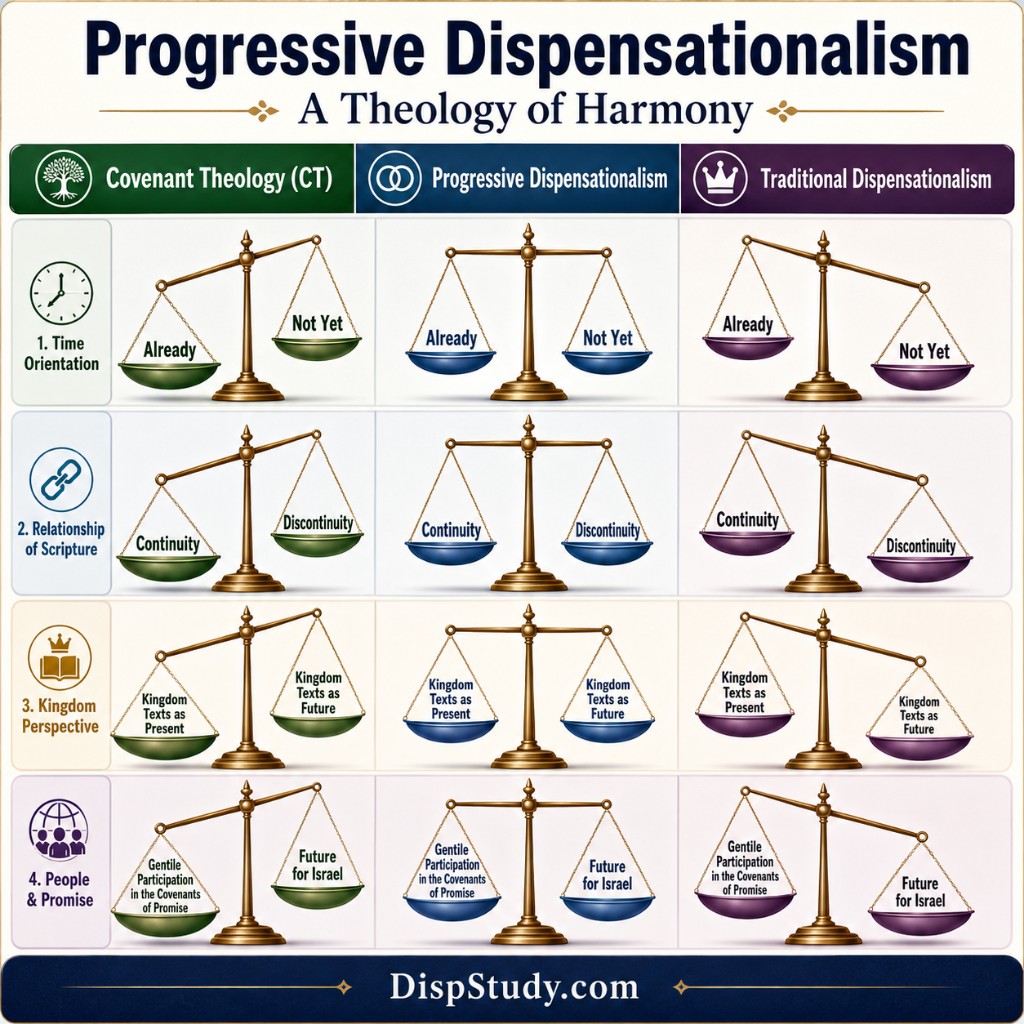
That is where Progressive Dispensationalism comes in: it reads these tensions as AND — Already and Not Yet — exactly as the biblical narrative does, holding texts on both sides together. In this context of extremes, it could rightly be called a Theology of Harmony.
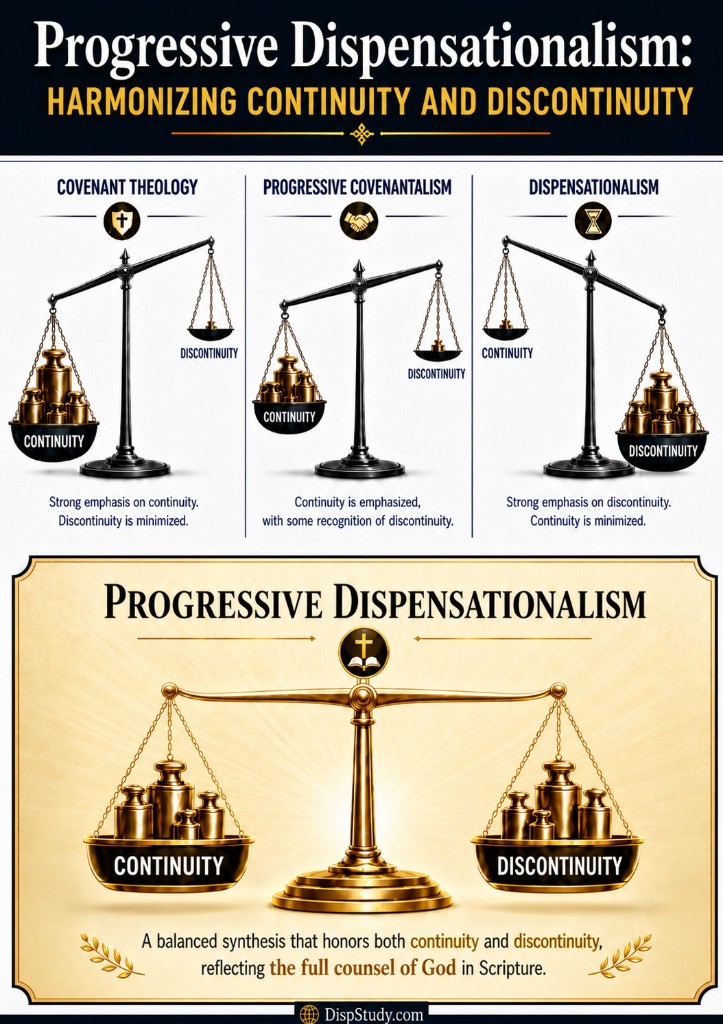
Progressive Dispensationalism (PD) is a system of harmony, of equilibrium. It is a system that seeks to genuinely resolve tensions rather than electing one side to silence the other. PD pursues the more difficult path, the more arduous road, not the path of ease. It is the path of Aristotelian virtue. It is the very equilibrium that the drunken man in Luther's analogy lacks.
In this harmonious, balanced theology, discontinuity and continuity are treated with mutual respect, with each given its proper weight. The data of the Old and New Testaments are harmonized rather than having their tensions "silenced," as one who solves a problem by sweeping it under the rug. PD harmonizes; it does not silence. It harmonizes the New Covenant without compromising either side. Against TD, it affirms with the New Testament that the Church genuinely participates in the New Covenant—that the blood of Christ inaugurated this covenant, and that all who are united to him by faith partake of its blessings: the forgiveness of sins, the indwelling of the Spirit, and the law written on the heart. Against Supersessionists, it insists with the Old Testament that the New Covenant was originally announced to the houses of Israel and Judah, and that this national, ethnic dimension has not been absorbed into the Church but awaits its eschatological fulfillment in the restoration of Israel. The Church's present participation does not displace Israel; it anticipates the day when the same covenant will be consummated with the people to whom it was first promised.
The same approach holds with the Kingdom of God. Rather than defending a Kingdom that is only future, as TD does, or a Kingdom that is merely present, as Amillennialism does, PD affirms a Kingdom that is already inaugurated but not yet consummated. The reign of Christ has truly begun—he is enthroned at the right hand of the Father, the Spirit has been poured out as the firstfruits of the age to come, and the powers of that age are already at work in his Church. And yet the Kingdom in its full, visible, earthly manifestation—when the meek shall inherit the earth, when the wolf shall lie down with the lamb, when the nations shall stream to Zion and the knowledge of the Lord shall cover the earth as the waters cover the sea—remains future. The "already" does not swallow the "not yet"; the "not yet" does not empty the "already." Both are held together in the patience of faith.
This, finally, is what theological maturity looks like: not the rush to resolve every tension through amputation, but the willingness to remain seated firmly in the middle of the saddle—even, and especially, when the easier choice would be to fall comfortably to one side or the other.
FreeRequest: Matthew 24:4–31 — Chronology in Dispensationalism
The chronological view of more than 60 dispensational authors on Matthew 24 — request it by email below.
Enter your email and we will send the PDF as an attachment. See our privacy policy.
Author
Leonardo A. Costa
A researcher and writer exploring dispensationalism from a progressive perspective, with a deep appreciation for the tradition's heritage.
Related Articles
The Already-Not Yet in Dispensationalism Was Never Foreign to the Tradition
An argument that already-not yet reasoning has always existed inside dispensationalism, especially in its treatment of prophecy and the New Covenant.
You Already Believe in "Already / Not Yet" (You Just Didn't Know It Yet)
Traditional dispensationalists already accept 'already / not yet' in Luke 4, Zech. 9, and Dan. 9.
The Canonical Reading Layer: A Hermeneutical Double Standard in Traditional Dispensationalism
The thousand-year millennium is not in the Old Testament — it comes from Revelation 20. Traditional Dispensationalism reads it back into Isaiah, Ezekiel.
God's Holistic Kingdom and Israel's Mediatorial Role in Dispensationalism
A dispensational argument that the Church's present participation in Kingdom blessings is explained by God's holistic plan and Israel's mediatorial vocation.