One objection to the partial-fulfillment view of Progressive Dispensationalism operates at the level of linguistics. In a Facebook group, a dispensationalist author and professor told me that "fulfillment" in English cannot carry a partial or initial sense. There is no such thing, they argued, as "partial fulfillment" or "initial fulfillment": English supposedly allows fulfillment only in the sense of completion.
The theologian even suggested I find another word, since fulfillment supposedly resists any meaning short of completion. He read the "partial fulfillment" expression used by Progressive Dispensationalists and told me:
"We can't just make words mean what we want. That's postmodernism. LOOK up the word. Think through the semantic domain. Come up with a better English term. It's not that difficult."
But the suggestion misreads the very language it claims to defend. "Partial fulfillment" is not theological jargon awkwardly pressed into English. It is one of the ordinary collocations of the language.
What Dissertation Title Pages Say
Open the title pages of theses and dissertations across the English-speaking academic world and a familiar formula appears again and again: "submitted in partial fulfillment of the requirements for the degree of…" The phrasing has been standard in much of Anglophone higher education for well over a century — used at Yale, Princeton, MIT, Columbia, Cornell, and virtually every research university in the English-speaking world. The screenshot below shows a sample of results from a corpus search of that very expression:
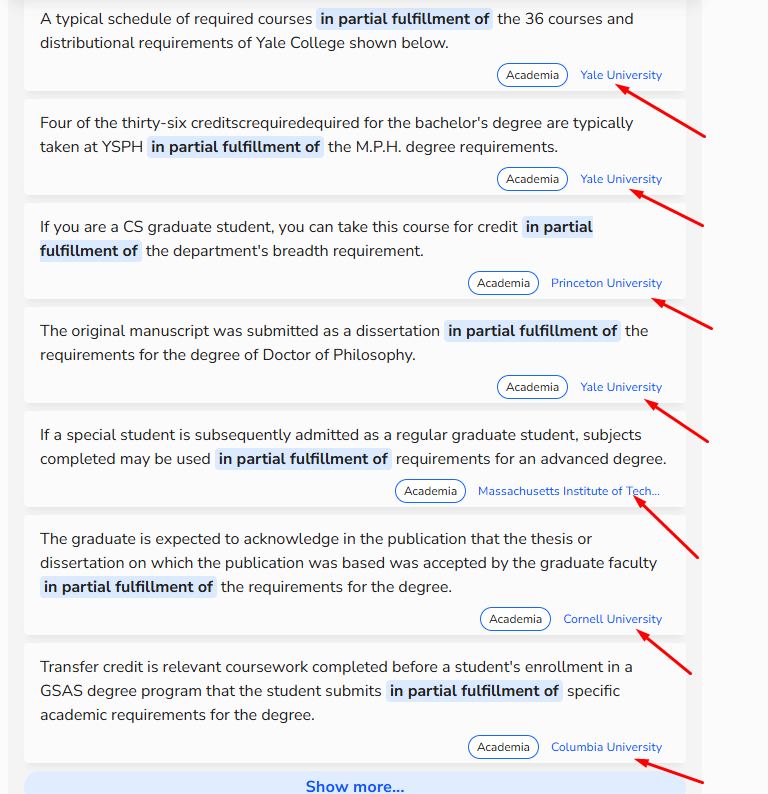
Each result is a real dissertation or thesis from a major university. The phrase appears hundreds of thousands of times in academic writing alone.
What Dictionaries Say
Fulfillment is a noun and nouns can be modified by adjectives — including initial, partial, complete, and final. The Merriam-Webster dictionary itself supplies an example with exactly this kind of modification: "final fulfillment." If there is no such thing as initial or partial fulfillment, then "final fulfillment" makes no sense either — and Merriam-Webster would be using a defective example. The dictionary's own usage demolishes the objection.
What Contracts and Commerce Say
The same usage runs through English law (partial fulfillment of contractual obligations), business prose, and ordinary speech ("she has partly fulfilled her promise"). Many e-commerce platforms display an order status of "partially fulfilled" when some items in an order have shipped but others have not. This is not esoteric jargon — it is plain commercial English understood by millions of consumers every day.
The Linguistic Verdict
If "partial fulfillment" offends English usage, then countless dissertation title pages, contracts, and dictionaries have been offending it for generations. The phrase is not strained theology imposed on an unwilling language. It is the language's own — and theology is free to use it without apology.
The debate about whether Progressive Dispensationalism's reading of Acts 2 and Acts 15 constitutes partial fulfillment is a genuine theological discussion worth having. But it cannot be settled by claiming that the English language prohibits the very words used to frame it. Language does not work that way, and the evidence from academic, legal, commercial, and lexicographic usage makes that clear.
For those interested in the broader hermeneutical question of how fulfillment unfolds in phases, see You Already Believe in 'Already / Not Yet' — which shows that even traditional dispensationalists regularly affirm phased prophetic fulfillment in their own exegesis of Luke 4, Zechariah 9, and Daniel 9. And for the complementary hermeneutics framework that underlies the Progressive Dispensationalist approach, see Revised Complementary Hermeneutics.
FreeRequest: Matthew 24:4–31 — Chronology in Dispensationalism
The chronological view of more than 60 dispensational authors on Matthew 24 — request it by email below.
Enter your email and we will send the PDF as an attachment. See our privacy policy.
Frequently Asked Questions
Is 'partial fulfillment' grammatically correct English?
Can the English word 'fulfillment' only mean complete fulfillment?
Where does the phrase 'in partial fulfillment of the requirements' come from?
Author
Leonardo A. Costa
A researcher and writer exploring dispensationalism from a progressive perspective, with a deep appreciation for the tradition's heritage.
Related Articles
Two Prophets, Two Crises, One Method: Acts 2, Acts 15, and Partial Fulfillment in Progressive Dispensationalism
Peter and James both answer crises by citing fulfilled prophecy—not mere analogy. Why Acts 2 and Acts 15 demand partial fulfillment, the key insight.
Peter's Use of Joel 2 in Acts 2 in Dispensationalism: Analogy or Partial Fulfillment?
A survey showing that many traditional dispensationalists affirm the same partial/inaugurated fulfillment of Joel 2 in Acts 2 that progressive.
You Already Believe in "Already / Not Yet" (You Just Didn't Know It Yet)
Traditional dispensationalists already accept 'already / not yet' in Luke 4, Zech. 9, and Dan. 9.
Progressive Dispensationalism and Partial Fulfillment
Does πληρόω rule out partial fulfillment? Progressive Dispensationalism answers the all-or-nothing objection from logic, usage, and Scripture.