What actually marks someone as a dispensationalist? The answer is not as obvious as it might seem. For more than half a century, dispensationalist authors themselves have offered competing lists of essentials, characteristics, tenets, common features, or sine qua non — some short and tightly defined, others wide and almost encyclopedic. Reading them side by side is one of the most useful exercises for anyone who wants to understand what dispensationalism actually is at its core.
This article gathers, in alphabetical order by each author's first name, the most representative quotations in which dispensationalist authors propose lists of the characteristics or essential elements of dispensationalism. Each entry presents a structured enumeration.
This article corresponds to Chapter 1 of my new book, Defining Dispensationalism: A Descriptive Anthology — Definitions, Essences, and Descriptions, an anthology of dispensationalist quotations organized by theme. A direct link to the book is provided at the end of the article.
Dispensationalist authors
B. K. Meyer
First, dispensationalism provides a framework (structure) for understanding God's plan as it unfolds within Scripture (a philosophy of history) that centers in God's glory.
The second essential of dispensationalism is the consistent application of a literal hermeneutic.
Third, dispensationalism allows for biblical distinctions between Israel and the church, arising from a consistently literal hermeneutic. The church has not supplanted nor merged into Israel, but rather Israel remains a nation (גּוֹי) not just a people (עַם) in which God will work in the future (Rom 9–11), drawing them to salvation in Christ.
— B. K. Meyer, Maranatha Is Dispensational, Maranatha Baptist Theological Journal
Bruce A. Baker
Thus, if one were to list the essentials, those things upon which dispensationalism are 'necessarily dependent,' one would have to list the following:
- Ethnic Israel preserved to the end.
- The promises of the OT still valid for ethnic Israel.
- Ethnic Israel being distinct from the Gentiles.
- The church as distinct from Israel.
- The church being related to Christ in a way that is unique.
- The church as unified by the Holy Spirit which has come down from heaven.
- A pre-tribulational rapture of the church.
— Bruce A. Baker, Israel and the Church, Journal of Ministry and Theology
C. Marvin Pate
The hallmark of dispensationalism has been its commitment to a literal interpretation of prophetic Scripture. This has resulted in three well-known tenets cherished by adherents of the movement.
- A distinction between the prophecies made about Israel in the Old Testament and the church in the New Testament must be maintained. In other words, the church has not replaced Israel in the plan of God. The promises he made to that nation about its future restoration will occur. The church is, therefore, a parenthesis in the outworking of that plan.
- Dispensationalists are premillennialists; that is, Christ will come again and establish a temporary, one-thousand-year reign on earth from Jerusalem.
- Dispensationalists believe in the pretribulation rapture; that is, Christ's return will occur in two stages: the first one for his church, which will be spared the Great Tribulation; the second one in power and glory to conquer his enemies.
— C. Marvin Pate, Four Views on the Book of Revelation
With regard to the essentials of classical dispensationalism, however, progressives are in complete agreement, of which there are three:
- Israel will be restored to God in the future (that is to say, there is a distinction, though not a dichotomy, between Israel and the church).
- Christ will return to establish his millennial reign on earth (the premillennial view).
- The church will not go through the Great Tribulation (the pretribulation interpretation).
— C. Marvin Pate, Four Views on the Book of Revelation
Charles C. Ryrie
What, then, is the sine qua non of dispensationalism? The answer is threefold.
- A dispensationalist keeps Israel and the Church distinct.… This is probably the most basic theological test of whether or not a man is a dispensationalist, and it is undoubtedly the most practical and conclusive. A man who fails to distinguish Israel and the Church will inevitably not hold to dispensational distinctions; and one who does, will.
- This distinction between Israel and the Church is born out of a system of hermeneutics which is usually called literal interpretation. Therefore, the second aspect of the sine qua non of dispensationalism is the matter of plain hermeneutics. The word literal is perhaps not so good as either the word normal or plain, but in any case it is interpretation that does not spiritualize or allegorize as nondispensational interpretation does. …
- A third aspect of the sine qua non of dispensationalism … concerns the underlying purpose of God in the world. The covenant theologian in practice makes this purpose salvation, and the dispensationalist says the purpose is broader than that, namely, the glory of God.
— Charles C. Ryrie, Dispensationalism Today
The essence of dispensationalism, then, is the distinction between Israel and the Church. This grows out of the dispensationalist's consistent employment of normal or plain interpretation, and it reflects an understanding of the basic purpose of God in all His dealings with mankind as that of glorifying Himself through salvation and other purposes as well.
— Charles C. Ryrie, Dispensationalism Today
Dispensational theology is a system that embodies two essential concepts:
- The church is distinct from Israel, and
- God's overall purpose is to bring glory to Himself (Eph. 1:6, 12, 14).
— Charles C. Ryrie, Dictionary of Premillennial Theology
Christopher Cone
Key elements of normative dispensational theology include those identified by Guer:
- Literalism (the basic hermeneutic principle).
- Diversity of classes in the body of the redeemed (distinction between Israel and the church).
- The literal usage of day in prophecy.
Perhaps the most effective characterization of foundational elements are found in Ryrie's sine qua non:
- Distinction between Israel and the church.
- Consistent use of a literal hermeneutic.
- Doxological purpose of God at the center.
— Christopher Cone, Prolegomena: Introductory Notes on Bible Study & Theological Method
Cory M. Marsh and James I. Fazio
Dispensationalism is thoroughly evangelical but does not fit into categories often assumed by evangelicals. It is not a systematic theology (though it has recognizable patterns like a system). Nor is it merely a historical theology (though it is historical). What is it then? Dispensationalism is best understood as a biblical theology. It shares the accepted criteria for the specific discipline called biblical theology.
— Cory M. Marsh and James I. Fazio, Retrospect and Prospect of Dispensational Thought
At its core, dispensationalism is not soteriological or even eschatological. While it has its views on these important matters, dispensationalism is probably most instructive as a biblical view of history.
— Cory M. Marsh and James I. Fazio, Retrospect and Prospect of Dispensational Thought
Commonality can be detected throughout church history that would today be codified under the theological system known as 'dispensationalism.' These include:
- A synchronic use of the biblical term 'dispensation.'
- A literal interpretive approach to Scripture.
- Premillennial eschatology.
- A future and personal antichrist.
- The imminent appearing of Christ being distinct from His second coming (i.e., rapture).
- A future tribulation period.
- History advanced through divine economies (dispensations).
- Jewish salvation and restoration.
- A distinction between national Israel and the church.
- An emphasis on original languages and inductive Bible study.
— Cory M. Marsh and James I. Fazio, Retrospect and Prospect of Dispensational Thought
Craig A. Blaising and Darrell L. Bock
The common features of dispensationalism include:
- 'The authority of Scripture'
- 'Dispensations'
- 'The uniqueness of the church'
- 'The practical significance of the universal church'
- 'The significance of biblical prophecy'
- 'Futurist premillennialism'
- 'The imminent return of Christ'
- 'A national future for Israel.'
— Craig A. Blaising and Darrell L. Bock, Progressive Dispensationalism
We speak of dispensationalism as a tradition within American Evangelicalism, sharing common features of evangelical orthodoxy. It is a tradition that has emphasized the universal church as the framework for Christian unity and spirituality, seeking its practical manifestation in ways that do not conflict with the concept of the local church. It has advocated the authority of Scripture and has emphasized the theological relevance of biblical apocalyptic and prophecy. It is a futurist premillennialism that has strongly maintained the imminent return of Christ and a national and political future for Israel in the divine plan for history. It is characterized by a canonical approach to Scripture that interprets discontinuities of the Old and New Testaments as historical changes in divine-human dispensations reflecting different purposes in the divine plan. As an element of dispensational change, it has emphasized unique features in grace for the present dispensation of the church.
— Craig A. Blaising and Darrell L. Bock, Dispensationalism, Israel and the Church: Assessment and Dialogue
Darrell L. Bock
A more comprehensive way to define the movement has been proposed by Mark S. Sweetnam. He proposed five elements, the full combination of which makes for dispensationalism:
- A commitment to evangelical doctrine.
- A commitment to a literal Biblical hermeneutic.
- A recognition of distinction in manifestations of divine dealing with mankind, which insists on the uniqueness and importance of both Israel and the church in the divine plan.
- An expectation of the imminent return of Christ in the rapture.
- An emphasis on apocalyptic and millennial expectation.
— Darrell L. Bock, Dispensationalism, St Andrews Encyclopaedia of Theology
These include:
- The authority of scripture...
- The unique position of the church as the place where the Spirit of God indwells believers in a new and fresh way...
- Dispensationalism has not been tied to a specific denomination but has functioned across traditions in a more ecumenical manner...
- Its focus on biblical prophecy and discussion of the future...
- Dispensationalism possesses a futurist premillennial perspective...
- Dispensationalists often discuss the imminent return of Jesus as the next event in the eschatological program of redemption...
- Israel has occupied a special place of attention in dispensational theology.
— Darrell L. Bock, Dispensationalism, St Andrews Encyclopaedia of Theology
In describing dispensationalism, allow me to highlight five of its important traits.
- Attending to discontinuity. The term "dispensation" emerges from the administrative arrangement that Paul refers to in Ephesians 3:1, a "stewardship." The Greek term οἰκονομία is translated as dispensatio in Latin. It refers to how one administers something. Dispensationalists will speak about the periods of the law, grace, and millennium (or better, Israel, church, and millennium), distinguishing what is unique to each era.
- Emphasis on the covenants. Dispensationalism emphasizes the role of the covenants in the Bible, as well as the significant place of Israel in the program of God through which the covenants and messiah emerged. In particular, the Abrahamic covenant (Gen 12:1–3) made commitments to the world through Israel and her seed.
- The enduring election of Israel. This set of promises to Israel is read in the dispensational tradition as preserving a place for the restoration of the people and nation of Israel in the midst of Jesus's return to redeem the world.
- A literal interpretation of God's promises. Dispensationalists often contend this means taking the promises of God literally with the argument that the commitments God makes, such as to Israel, he is faithful to keep.
- Premillennial eschatology. Dispensationalism tends to be premillennial in its apocalyptic eschatology, expecting a thousand year rule of Christ on the earth from Israel before the new heavens and earth. Further details of this system include the timing of Jesus's return to gather the saints in salvation, a position that often is called pretribulationalism.
— Darrell L. Bock, What Is Dispensationalism?
David Olander
- A consistent literal interpretation (a normal use of the language)
- A complete distinction between Israel and the church
- A consistent doxological principle
— David Olander, The Greatness of the Rapture
Elmer Towns and Thomas Ice
Dispensationalism is actually a multifaceted system of thought. Dispensationalists believe the following:
The Bible is God's inspired and inerrant revelation to humanity. Scripture provides the framework through which we interpret the past and the future. God's written Word tells us of His plan for His creation, and His plan will surely come to pass.
Because the Bible is God's literal Word and His plan for history, we should interpret it literally.
The Bible reveals God's plan for history. God's plan includes different dispensations, ages, or epochs of history through which He tests His creatures (people and angels). God is instructing His creatures through history as His creation progresses from the Garden of Eden to the heavenly city.
All humanity fell into sin, so each person must individually receive God's provision of salvation through the death and resurrection of Christ by believing the gospel. Thus, Jesus Christ is the only way to a relationship with God.
Scripture teaches that because of mankind's fall into sin, all humanity is naturally rebellious toward God and the things of God. This is why only genuine believers in Christ are open to the teachings of the Bible. Thus, salvation through Christ is a prerequisite to properly understanding God's Word.
God's plan for history includes a purpose for the descendants of Abraham, Isaac, and Jacob—that is, the nation of Israel. This plan for Israel includes promises that they will have the land of Israel, they will have a seed, and they will be a worldwide blessing to the nations. Many of the promises to national Israel are yet to be fulfilled. Therefore, God is not finished with Israel.
God's plan from all eternity also includes a purpose for the church. However, this is a temporary phase that will end with the rapture. After the rapture, God will complete His plan for Israel and the Gentiles.
God's main purpose in His master plan for history is to glorify Himself through Jesus Christ. Therefore, Jesus Christ is the goal and hero of history.
— Elmer Towns and Thomas Ice, The Harvest Handbook of Bible Prophecy
Grant Hawley
Before proceeding, a definition of normative dispensationalism is necessary. While normative dispensationalists disagree on various things, virtually all would agree upon the following points:
- Literal, historical, grammatical interpretation should be applied to all portions of Scripture.
- The church and Israel are distinct peoples in God's program for the ages.
- The Lord Jesus Christ will return bodily to earth and reign on David's throne in Jerusalem for one-thousand years.
- The underlying purpose of God's dealings with the world is His glory, not merely the salvation of man, thus the Scripture goes far beyond evangelism.
- The Christian is free from the law in its entirety for both justification (Gal 2:16) and sanctification (Gal 5:18).
When discussing normative dispensationalism, these descriptions will define my usage.
— Grant Hawley, Dispensationalism and Free Grace: Intimately Linked Part 1, Journal of the Grace Evangelical Society
Herbert W. Bateman IV
What marks a dispensationalist is the person's stress on the uniqueness of the church and confidence that a future millennial period exists in human history—when God will consummate His Abrahamic, Davidic, and new covenants with national Israel through the physical, earthly reign of Jesus Christ here on earth—that are the linchpins for distinguishing a dispensationalist from a nondispensationalist.
— Herbert W. Bateman IV, Three Central Issues in Contemporary Dispensationalism
Nevertheless, dispensationalism is marked not only by its exposition and high regard for God's Word but also by its emphasis on biblical prophecy, by its divisions of salvation-history events into dispensations, by its stress on the uniqueness of the church, by its anticipation of Jesus Christ's premillennial return, and by its confidence in a future for national Israel.
— Herbert W. Bateman IV, Three Central Issues in Contemporary Dispensationalism
James I. Fazio
Ryrie distinguished a dispensationalist to three features, which he termed the sine qua non of dispensationalism. These three essential elements, defined by Ryrie are:
- Perceiving a distinction between Israel and the Church.
- Consistently applying a literal grammatical-historical interpretive method to the biblical text.
- Perceiving God's doxological purpose throughout all of history.
— James I. Fazio, Discovering Dispensationalism
The foremost assumption of TD relates to its hermeneutical method. Dispensationalists are committed to a consistent application of the normal grammatical-historical interpretation of Scripture. It is from this principal conviction that all other distinctives of dispensationalism are derived. Included among these distinctives are:
- The arrangement of biblical history according to divinely arranged stewardships or 'dispensations.'
- A clear distinction between the peoples of God (particularly, Israel and the Church).
- A robust pretribulation eschatological expectation that anticipates the restoration of Israel to God and the establishment of a literal earthly millennial kingdom.
— James I. Fazio, Traditional Dispensationalism (JBTS)
John S. Feinberg
Six "Essentials of Dispensationalism" proposed in his chapter "Systems of Discontinuity" (1988) include:
- Belief that the Bible refers to multiple senses of terms like 'Jew' and 'seed of Abraham.'
- An approach to hermeneutics that emphasizes that the Old Testament be taken on its own terms and not reinterpreted in light of the New Testament.
- Belief that Old Testament promises will be fulfilled with national Israel.
- Belief in a distinctive future for ethnic Israel.
- Belief that the church is a distinctive organism.
- A philosophy of history that emphasizes not just soteriological and spiritual issues but social, economic, and political issues as well.
— John S. Feinberg, "Systems of Discontinuity" (1988), summarized by Michael J. Vlach in Dispensationalism: Essential Beliefs and Common Myths
Lewis Sperry Chafer
- Any person is a Dispensationalist who trusts the blood of Christ rather than bringing an animal sacrifice.
- Any person is a Dispensationalist who disclaims any right or title to the land which God covenanted to Israel for an everlasting inheritance.
- Any person is a Dispensationalist who observes the first day of the week rather than the seventh.
— Lewis Sperry Chafer, Dispensationalism
M. James Sawyer
- Authority of Scripture
- Divine Administrative Arrangements as Key to Understanding Scripture
- Uniqueness of the Church in Relation to National Israel
- Practical Significance of the Universal Church
- Significance of Biblical Prophecy
- Futurist Premillennialism
- Imminent Return of Christ
- A Future for National Israel
— M. James Sawyer, Dispensationalism: An Introductory Survey
Mark A. Snoeberger
More than a half century ago, Charles Ryrie famously postulated three such defining features:
- A consistently literal hermeneutic.
- A distinction between Israel and the Church.
- A 'doxological' mitte of all God's activity.
— Mark A. Snoeberger, Discovering Dispensationalism
Mark Hitchcock and Thomas Ice
Dispensationalism is a cluster of ideas joined together to form a system of thought, just as terms like Calvinism, Arminianism, Anglicanism, Catholicism, or Lutheranism are historical labels that represent not a single idea, but a group of ideas joined together to form a multifaceted scheme.
Dispensationalists are those who believe the following things:
- The Bible is God's inspired, inerrant (i.e., without any errors) revelation to man. Scripture provides the framework through which to interpret history (past and future). God's written Word tells us of His plan for His creation, and this will surely come to pass.
- Since the Bible is God's literal Word of His plan for history, it should be interpreted literally and historically (past and future).
- Since the Bible reveals God's plan for history, then it follows that there is an ebb and flow to His plan. Therefore, God's plan includes different dispensations, ages, or epochs of history through which His creatures (men and angels) are tested. Therefore, God is instructing His creatures through the progress of history.
- Since all humanity fell into sin, each person must individually receive God's provision of salvation through the death of Christ by believing the gospel. Thus, Jesus Christ is the only way to a relationship with God.
- Because of mankind's fall into sin, Scripture teaches that all humanity is naturally rebellious to God and the things of God. This is why only genuine believers in Christ are open to the teachings of the Bible. Thus, salvation through Christ is a prerequisite to properly understanding God's Word.
- God's plan for history includes a purpose for the descendants of Abraham, Isaac, and Jacob—that is, Israel. This plan for Israel includes promises that they will have the land of Israel, will have a seed, and will be a worldwide blessing to the nations. Many of the promises to national Israel are yet future; therefore, God is not finished with Israel.
- God's plan from all eternity also includes a purpose for the church; however, this is a temporary phase that will end with the Rapture. After the Rapture, God will complete His plan for Israel and the Gentiles.
- The main purpose in God's master plan for history is to glorify Himself through Jesus Christ. Therefore, Jesus Christ is the goal and hero of history.
— Mark Hitchcock and Thomas Ice, The Truth Behind Left Behind
Mark S. Sweetnam
There are five recognisable stresses that mark Dispensationalism:
- A commitment to Evangelical doctrine.
- A commitment to a literal Biblical hermeneutic.
- A recognition of distinction in manifestations of Divine dealing with mankind, which insists on the uniqueness and importance of both Israel and the Church in the Divine plan.
- An expectation of the imminent return of Christ in the Rapture.
- An emphasis on apocalyptic and millennial expectation.
— Mark S. Sweetnam, Defining Dispensationalism
Michael J. Svigel
Foundational piers of dispensationalism include:
- A pronounced distinction between Israel and the church.
- A strong discontinuity between past, present, and future eras.
- A future earthly fulfillment of Old Testament promises to national Israel.
- An abrogation of the law of Moses for the church.
- The birth of the church at Pentecost and the completion of the church at the rapture.
— Michael J. Svigel, Dispensationalism and the History of Redemption
Michael J. Vlach
Six Essential Beliefs of Dispensationalism (revised and updated 2017):
- The primary meaning of any Bible passage is found in that passage. The New Testament does not reinterpret or transcend Old Testament passages in a way that overrides or cancels the original authorial intent of the Old Testament writers.
- Types exist but national Israel is not an inferior type that is superseded by the church.
- Israel and the church are distinct; thus, the church cannot be identified as the new and/or true Israel.
- Spiritual unity in salvation between Jews and Gentiles is compatible with a future functional role for Israel as a nation.
- The nation Israel will be both saved and restored with a unique functional role in a future earthly millennial kingdom.
- There are multiple senses of "seed of Abraham," thus the church's identification as "seed of Abraham" does not cancel God's promises to the believing Jewish "seed of Abraham."
— Michael J. Vlach, Dispensationalism: Essential Beliefs and Common Myths
Phillip Heideman
The main distinctives of Dispensationalism are:
- First, the consistent use of the grammatical-historical hermeneutic.
- Second, the distinction between Israel and the Church.
- Third, the reign of Jesus Christ and His saints in the Millennial Kingdom. The latter is the goal toward which God providentially works in human history.
- Fourth, the unifying thread from the beginning to the end of the biblical record is the manifestation of God's attributes, namely, His love, justice, faithfulness, and sovereignty. In particular, God demonstrates throughout the ages that He is in control, although there are periods of time when it may not appear that way. These elements are essential for seeing the continuity and progression of Scripture and for understanding the major areas of Truth revealed in the Word of God.
— Phillip Heideman, Dispensational Theology, Chafer Theological Seminary Journal
Robert P. Lightner
[Dispensationalism is a] system of theology which interprets the Bible literally—according to normal usage—and places primary emphasis on the major biblical covenants—Abrahamic, Palestinian, Davidic, New—and sees the Bible as the unfolding of distinguishable economies in the outworking of God's major purpose to bring glory to Himself.
— Robert P. Lightner, quoted by T. Maurice Pugh in Dispensationalism and the History of Redemption
- It is the system of theology that follows (or has as its aim) a consistently literal or normal interpretation of Scripture.
- It sees distinction between God's program for Israel and His program with the Church.
- It sees distinguishable economies or rules of life, in the outworking of God's primary purpose in the world, which is to bring glory to Himself.
— Robert P. Lightner, Conservative Theological Journal
Stephen R. Lewis
Today many ask, "What is the sine qua non (absolute essential) of Dispensationalism?" Most dispensationalists would answer that it centers around three propositions:
- God's ultimate revealed purpose is to glorify Himself, freely and fully expressing His attributes and character.
- A consistent literal or plain interpretation of the Bible is essential for understanding God's revelation properly.
- This literal interpretation leads to distinguishing Israel from the Church.
— Stephen R. Lewis, The New Covenant Enacted or Ratified?, Chafer Theological Seminary Journal
T. Maurice Pugh
There are at least three central characteristics of dispensationalism that its adherents generally affirm.
- First, there is a distinction between God's unique plan for Israel and His plan for the church...
- Second, dispensationalism maintains significant emphases upon biblical covenants and divine prophecy in the structure of God's overall program...
- Finally, a central feature of dispensational theology's interpretation of redemptive history is a premillennial eschatology.
— T. Maurice Pugh, Dispensationalism and the History of Redemption
Thomas Ice
Ryrie demonstrated that dispensational theology must contain at least the three following elements, he famously termed the sine qua non:
- The essence of dispensationalism, then, is the distinction between Israel and the church.
- This grows out of the dispensationalist's consistent employment of normal or plain or historical-grammatical interpretation.
- It reflects an understanding of the basic purpose of God in all His dealings with mankind as that of glorifying Himself through salvation and other purposes as well.
— Thomas Ice, The Golden Years of Dispensationalism (1900–1970)
William F. Luck, Sr.
There are four distinct elements that play into modern dispensationalism.
There is a normal or plain method to biblical interpretation. This is sometimes called the literal or historical grammatical hermeneutic.
There is an awareness of the centrality of God's sovereignty over the entire course of history that is broader than merely the special redemptive plan of grace.
There is the recognition of a distinction between ethnic or national Israel and the church or body of Christ that is made up primarily of Gentiles in this age.
A recognition of distinct, multiple, and progressing periods or administrative ages that reveal God's sovereignty manifesting itself throughout history in at least 3 main eras culminating in a Christocracy:
- (a) the times of ethnic Israel from the covenant made with them at Sinai;
- (b) the New Covenant made in Christ's blood which involves the coming of the Holy Spirit to call the nations, Jew and Gentile, to prepare for
- (c) the reign of Christ on earth for the 1,000 years (premillennialism).
— William F. Luck, Sr., Evangelical Bible Doctrine
Patterns and Convergences
Across the entries above, three observations stand out.
A widely shared core. Despite differing list lengths — from Lightner's three points to Hitchcock/Ice's and Sawyer's eight — three items appear in nearly every enumeration:
- A literal (or grammatical-historical) hermeneutic.
- A distinction between Israel and the church.
- A premillennial expectation that includes a future for national Israel.
A recurring extension into ecclesiology and eschatology. Beyond the hermeneutical core, longer lists characteristically add:
- The authority of Scripture (Towns/Ice, Hitchcock/Ice, Sawyer, Blaising/Bock, Bock).
- The uniqueness of the church (Bateman, Sawyer, Blaising/Bock, Vlach, Svigel).
- The imminent return of Christ (Sweetnam, Sawyer, Blaising/Bock, Bock).
- A pretribulational rapture (Baker, Pate, Fazio).
- An emphasis on biblical prophecy and apocalyptic (Bock, Bateman, Sawyer, Blaising/Bock, Sweetnam).
- The conception of history as divinely administered through successive oikonomiai (Bock, Marsh/Fazio, Towns/Ice, Hitchcock/Ice, Sawyer, Lightner, Luck).
The lists therefore disclose less a single fixed creed than a stable family of commitments orbiting a recognized core.
Available now on Amazon
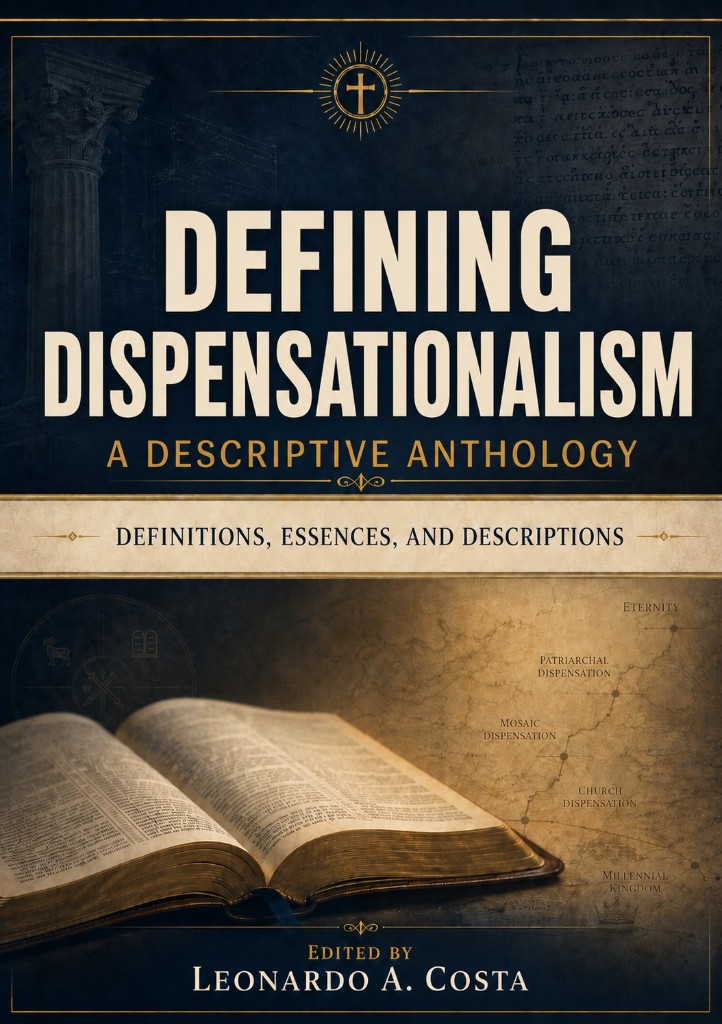
This article is only a sample: it contains 38 quotations from 27 authors, focused specifically on lists of characteristics and essential elements. The full book expands the project much further.
Defining Dispensationalism: A Descriptive Anthology — Definitions, Essences, and Descriptions is the book I wish I had when I first started studying what dispensationalism actually is. In it, I have gathered more than 250 of the best quotations answering three big questions: What is dispensationalism? What are its essential characteristics or elements? And what is a “dispensation”?
It is a curated anthology — the best definitions, side by side, in the authors' own words — designed to help you understand the system from the inside out.
The book is made for dispensationalists of every stripe — classical, revised, traditional, and progressive — and it brings together clear definitions from authors such as Lewis Sperry Chafer, John F. Walvoord, Charles C. Ryrie, John MacArthur, Arnold Fruchtenbaum, Michael J. Vlach, Craig A. Blaising, Darrell L. Bock, Renald E. Showers, Robert P. Lightner, Paul Benware, Thomas Ice, Stanley Toussaint, Cory M. Marsh, James I. Fazio, Glenn R. Kreider, Michael J. Svigel, Ron Rhodes, Elliott E. Johnson, Roy L. Aldrich, Rolland D. McCune, and many more — alongside descriptions from non-dispensationalist scholars and standard reference works, including dictionaries, encyclopedias, and lexicons.
If you have ever wanted a single resource where you can hear the leading voices on dispensationalism speak for themselves, this book was made for you. It is available now on Amazon.
FreeRequest: Matthew 24:4–31 — Chronology in Dispensationalism
The chronological view of more than 60 dispensational authors on Matthew 24 — request it by email below.
Enter your email and we will send the PDF as an attachment. See our privacy policy.
Frequently Asked Questions
What is the sine qua non of dispensationalism?
Do all dispensationalists agree on the same list of essentials?
What features are most commonly listed beyond the Ryrie core?
Author
Leonardo A. Costa
A researcher and writer exploring dispensationalism from a progressive perspective, with a deep appreciation for the tradition's heritage.
Related Articles
Can the Church Be Unrelated to the New Covenant? A Response to Christopher Cone
A point-by-point response to Christopher Cone's SCIO New Covenant view: 2 Corinthians 3, the Lord's Supper, Abrahamic.
God's Holistic Kingdom and Israel's Mediatorial Role in Dispensationalism
A dispensational argument that the Church's present participation in Kingdom blessings is explained by God's holistic plan and Israel's mediatorial vocation.
The Mystery and Progressive Revelation: Gentiles in the New Covenant and the Kingdom
From a Progressive Dispensationalist perspective: Gentile participation in the New Covenant and in the present phase of the Kingdom is precisely what the New.
The New Covenant Beneficiaries Analogy in Dispensationalism
A simple analogy showing how the Church can receive blessings of the New Covenant without becoming a formal covenant party alongside Israel.