Chart
Progressive Dispensationalism: A Theology of Harmony
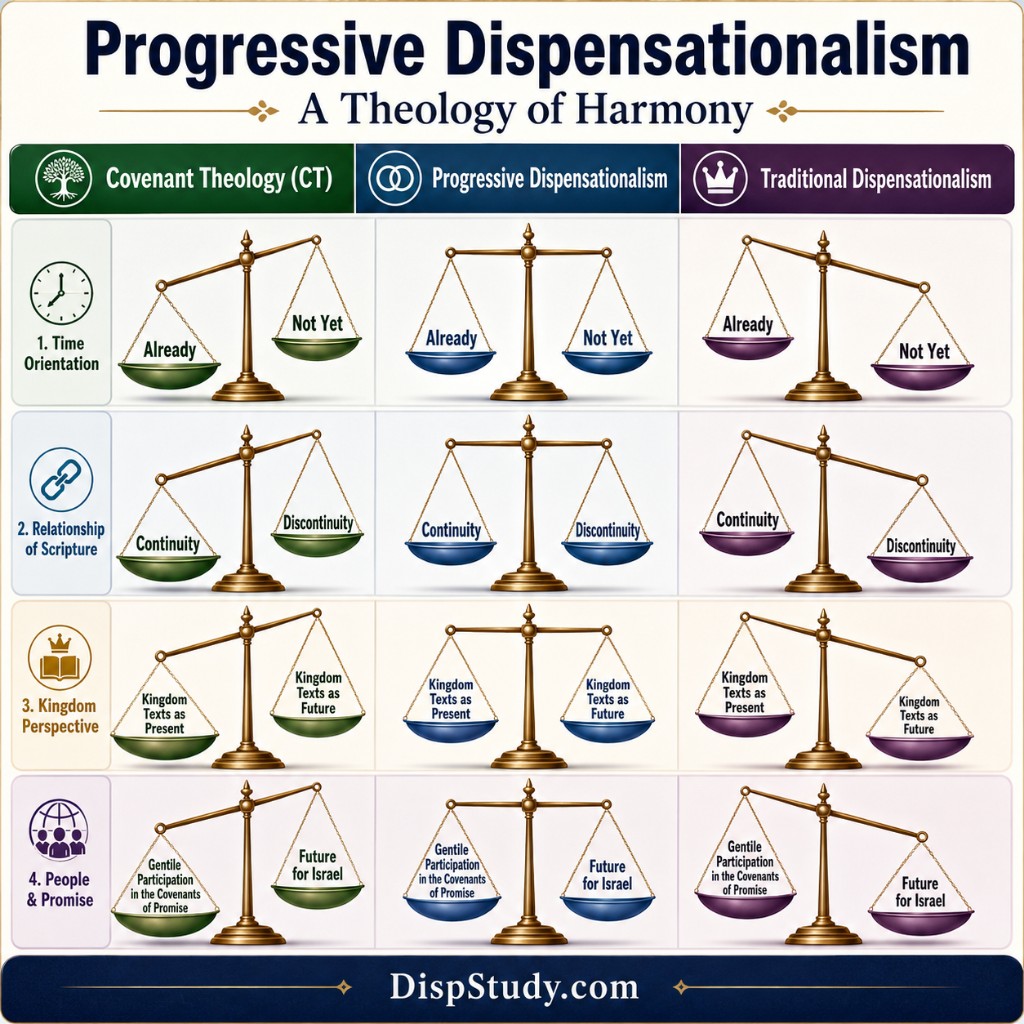
This chart presents Progressive Dispensationalism as a theology of harmony, set alongside Covenant Theology (CT) and Traditional Dispensationalism (TD). Four classic tensions in biblical theology are pictured as balance scales:
- Time Orientation — Already / Not Yet. CT tends to emphasize the "already" of the kingdom; TD tends to push the kingdom almost entirely into the "not yet"; Progressive Dispensationalism holds both in genuine balance.
- Relationship of Scripture — Continuity / Discontinuity. CT stresses continuity between the testaments and the people of God; TD stresses discontinuity, especially between Israel and the Church; Progressive Dispensationalism honors both poles without collapsing one into the other.
- Kingdom Perspective — Present / Future. CT generally reads kingdom texts as already realized in the Church; TD typically reserves kingdom texts for a future earthly reign; Progressive Dispensationalism affirms a present, inaugurated form of the kingdom and a future, consummated form.
- People and Promise — Gentile Participation / Future for Israel. CT emphasizes Gentile participation in the covenants of promise, often at the expense of a distinct future for ethnic Israel; TD safeguards a future for Israel, often at the expense of robust Gentile participation in the very covenants of promise; Progressive Dispensationalism affirms both — Gentiles are co-participants in the covenants of promise and there remains a real future for national Israel.
In each row, the scales of CT and TD tilt toward opposite extremes, while the scales of Progressive Dispensationalism remain level — visualizing its core conviction that the biblical witness should not be silenced on either side.
Text equivalent of the chart (for accessibility)
| Aspect | Covenant Theology (CT) | Progressive Dispensationalism | Traditional Dispensationalism (TD) |
|---|---|---|---|
| 1. Time Orientation (Already / Not Yet) | Tilts toward Already | Balanced (Already and Not Yet) | Tilts toward Not Yet |
| 2. Relationship of Scripture (Continuity / Discontinuity) | Tilts toward Continuity | Balanced (Continuity and Discontinuity) | Tilts toward Discontinuity |
| 3. Kingdom Perspective (Present / Future) | Tilts toward Kingdom Texts as Present | Balanced (Present and Future) | Tilts toward Kingdom Texts as Future |
| 4. People and Promise (Gentile Participation / Future for Israel) | Tilts toward Gentile Participation in the Covenants of Promise | Balanced (Gentile Participation and Future for Israel) | Tilts toward Future for Israel |