Daniel's Seventy Weeks — Historical-Messianic (Classical Historicist) View
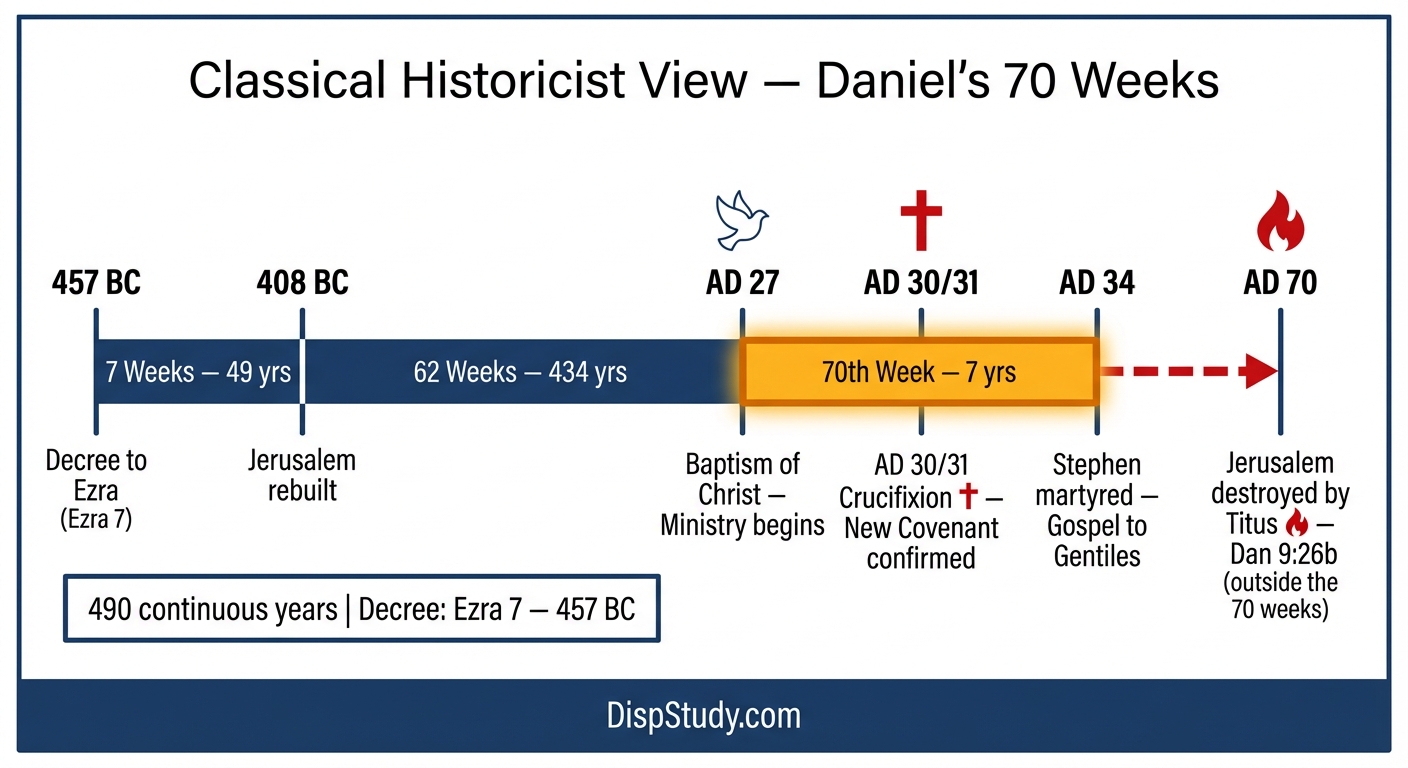
This chart illustrates the Historical-Messianic (Classical Historicist) interpretation of Daniel's Seventy Weeks (Daniel 9:24–27). This is the oldest Christian interpretation, held by Jerome, Luther, Calvin, Tyndale, Matthew Henry, E.J. Young, E.B. Pusey, Philip Mauro, and many Puritan commentators.
The starting decree is dated to 458/457 BC — the decree of Artaxerxes I to Ezra (Ezra 7:11–26). The approach uses a literal interpretation of years without requiring day-for-day precision, and adopts a Christocentric, covenantal reading with no rigid distinction between Israel and the Church.
The 69th week ends at ~AD 27 with the baptism of Jesus. The crucifixion occurs at the midpoint of the 70th week (~AD 30/31), and the 70th week concludes at ~AD 34 when the gospel spreads to the Gentiles. The destruction of Jerusalem by Titus in AD 70 is understood as a fulfillment of Daniel 9:26b, but lies outside the seventy weeks proper.
For a full comparison of all eight views, see The Eight Views of Daniel's Prophecy of the Seventy Weeks.
Text equivalent of the chart (for accessibility)
| Segment | Approximate span | Notes |
|---|---|---|
| Start | 457 BC — Artaxerxes' decree to Ezra (Ezra 7) | Beginning of the 490 years. |
| 7 weeks (49 years) | 457–408 BC | Rebuilding of Jerusalem in troubled times (Ezra and Nehemiah). |
| 62 weeks (434 years) | 408 BC–AD 27 | The intertestamental period, leading up to the Messiah. |
| End of 69 weeks | ~AD 27 — Baptism of Jesus | Beginning of his public ministry. |
| Midpoint of 70th week | ~AD 30/31 — Crucifixion | Messiah "cut off"; New Covenant confirmed; sacrifices cease theologically. |
| End of 70th week | ~AD 34 — Gospel to the Gentiles | Martyrdom of Stephen; Paul's conversion. |
| Subsequent event | AD 70 — Destruction of Jerusalem | Fulfillment of Dan 9:26b, outside the seventy weeks. |