Daniel's Seventy Weeks — Historical-Critical (Maccabean) View
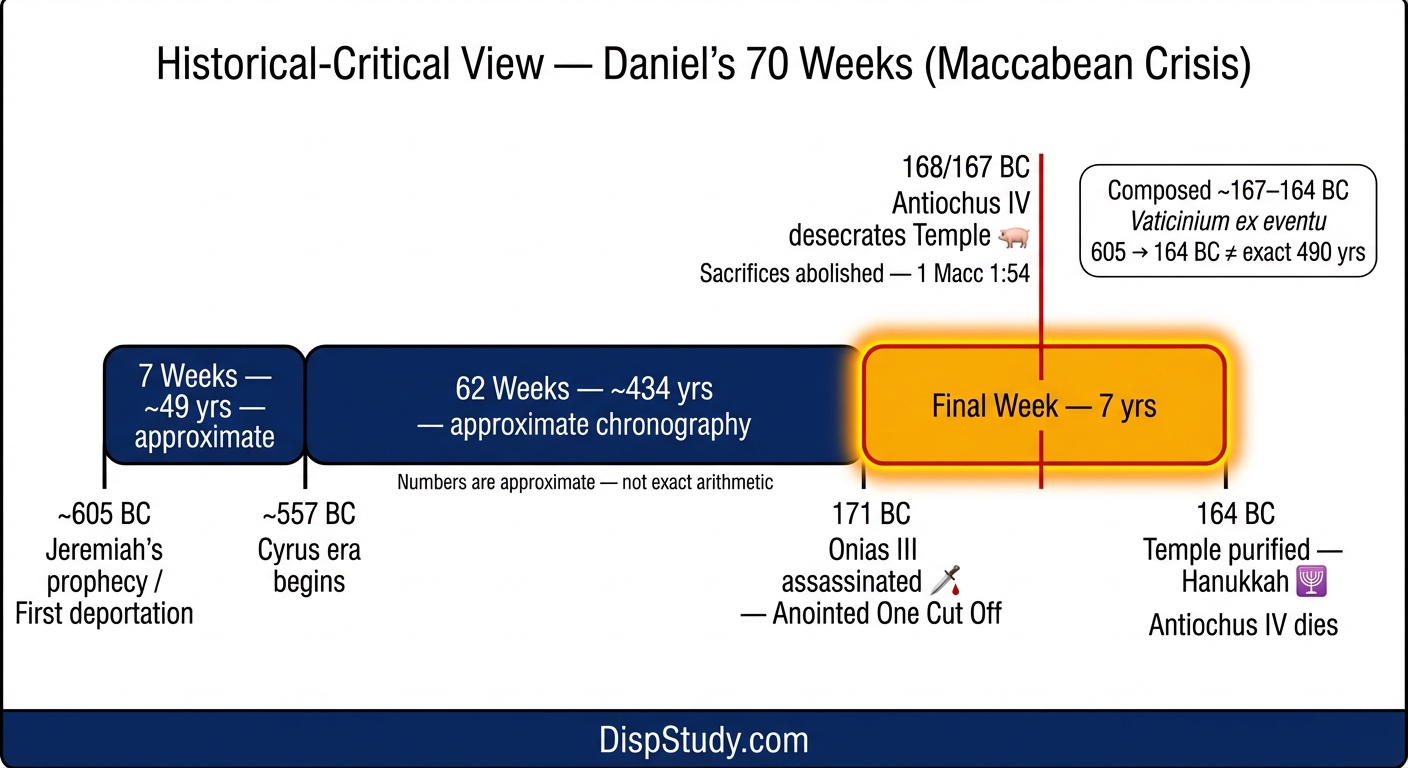
This chart illustrates the Historical-Critical (Maccabean) interpretation of Daniel's Seventy Weeks (Daniel 9:24–27), as held by J.A. Montgomery, John J. Collins, John Goldingay, and the majority of modern historical-critical scholars.
In this view, the book of Daniel was composed in the second century BC (c. 167–164 BC) as a theological response to the Maccabean crisis. The prophecy is understood as vaticinium ex eventu (prophecy-after-the-fact), and the numbers function as approximate "chronography" rather than precise chronology.
The most common variant (Variant A) begins at ~605/606 BC — Jeremiah's prophecy or the first Babylonian deportation. The "anointed prince" of v.25 is identified as Cyrus the Persian or Jeshua the post-exilic High Priest. The "anointed one cut off" (v.26) is Onias III, the legitimate High Priest assassinated c. 171/170 BC. The final week (~171–164 BC) centers on Antiochus IV Epiphanes, who desecrated the Temple in 168/167 BC. The prophecy culminates in the purification of the Temple by Judas Maccabeus in 164 BC (Hanukkah).
For a full comparison of all eight views, see The Eight Views of Daniel's Prophecy of the Seventy Weeks.
Text equivalent of the chart (for accessibility)
| Segment | Approximate span | Notes |
|---|---|---|
| Start | ~605 BC — Jeremiah's prophecy / first deportation | Variant A starting point. |
| 7 weeks (49 years) | ~605–557 BC | From the Exile to Cyrus. |
| 62 weeks (434 years) | ~557–171 BC | Persian and Hellenistic periods (chronography — numbers do not add up precisely). |
| "Anointed one cut off" | ~171 BC — Assassination of Onias III | Legitimate High Priest deposed and killed (2 Macc 4:30–38). |
| Final week (7 years) | ~171–164 BC | The Maccabean crisis. |
| Midpoint | 168/167 BC — Antiochus IV desecrates the Temple | Daily sacrifice abolished; altar to Zeus erected (1 Macc 1:45–54). |
| End | 164 BC — Rededication of the Temple (Hanukkah) | Purification by Judas Maccabeus; death of Antiochus. |